Lochhead Pamela A, Clark Jonathan, Wang Lan-Zhen, Gilmour Lesley, Squires Matthew, Gilley Rebecca, Foxton Caroline, Newell David R, Wedge Stephen R, Cook Simon J
a Signalling Laboratory; The Babraham Institute ; Cambridge , UK.
b Biological Chemistry Facility; The Babraham Institute ; Cambridge , UK.
Cell Cycle. 2016;15(4):506-18. doi: 10.1080/15384101.2015.1120915.
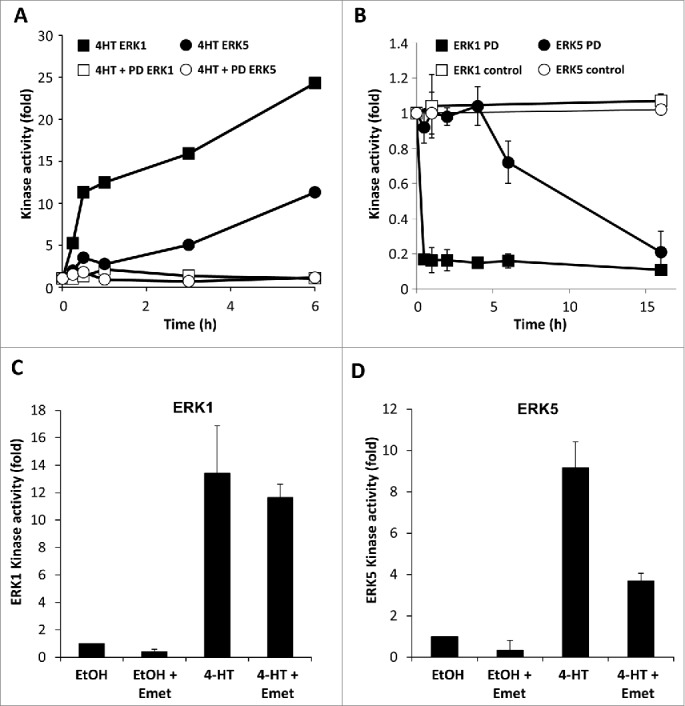
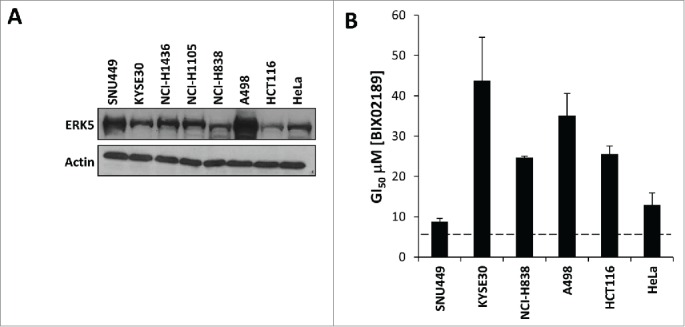
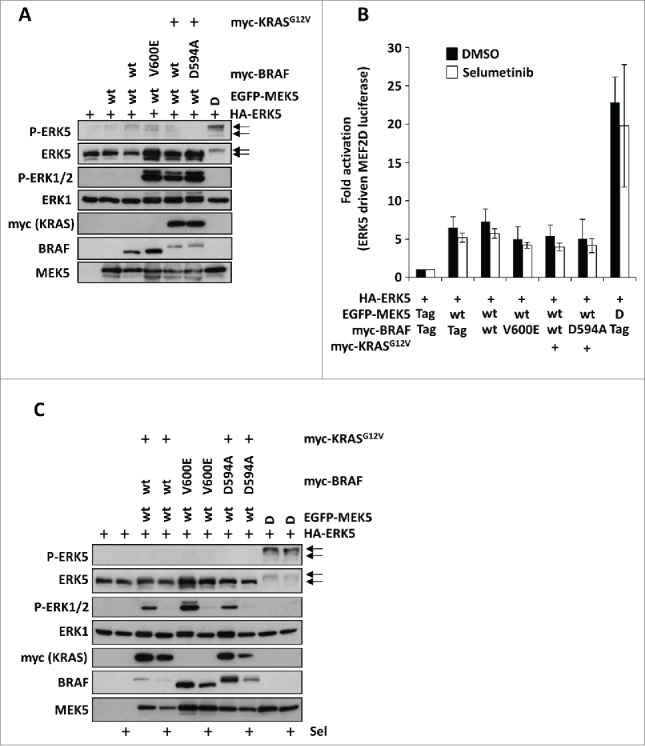
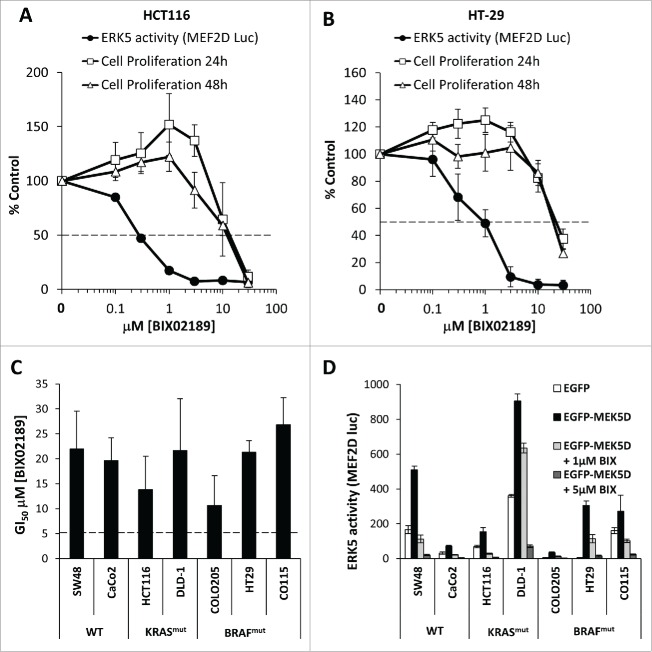
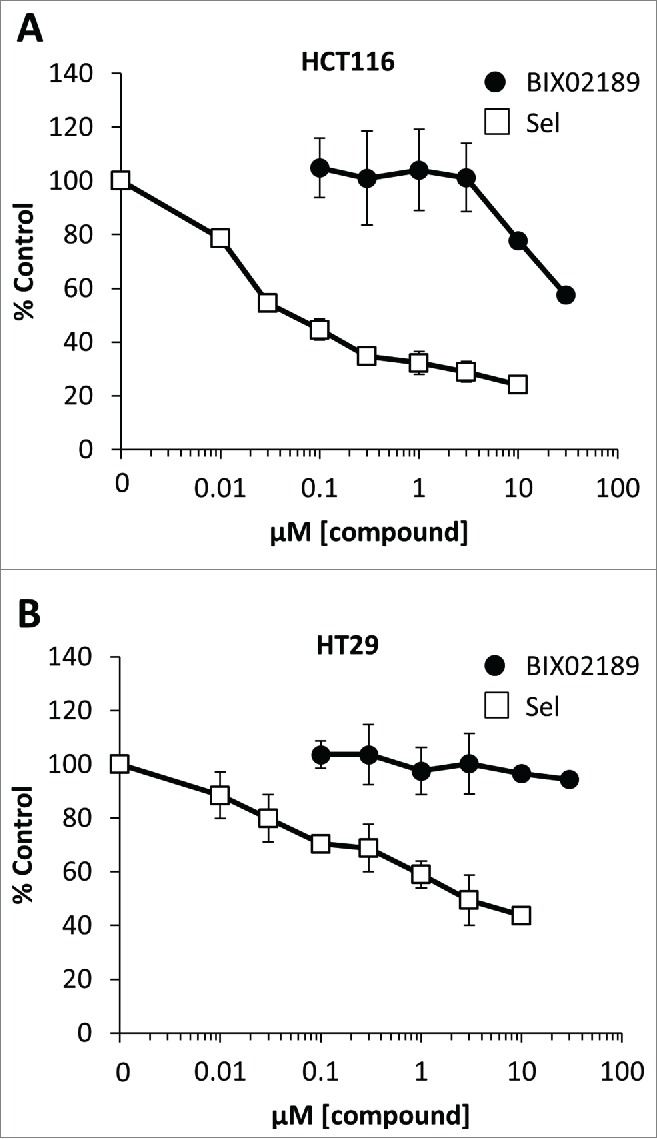
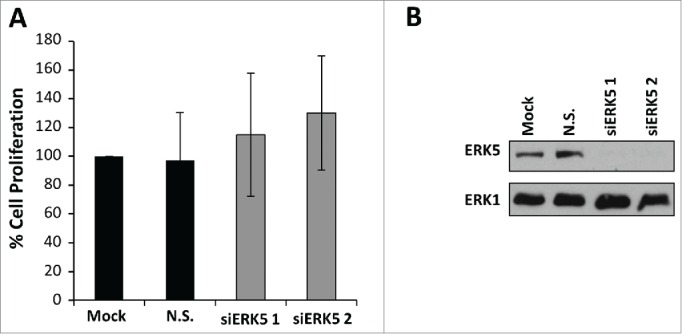
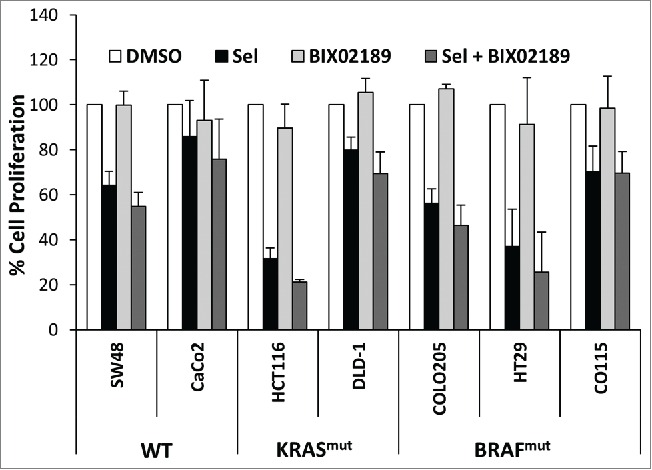
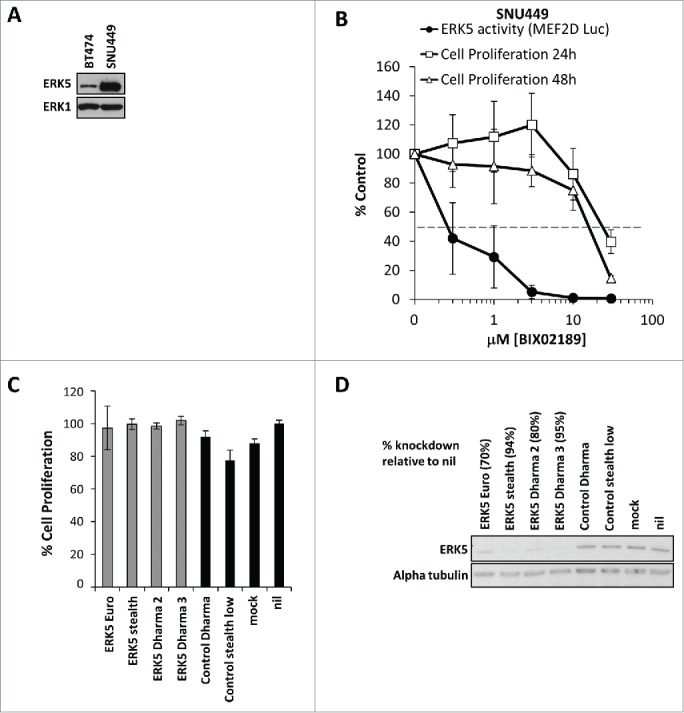
ERK5, encoded by MAPK7, has been proposed to play a role in cell proliferation, thus attracting interest as a cancer therapeutic target. While oncogenic RAS or BRAF cause sustained activation of the MEK1/2-ERK1/2 pathway, ERK5 is directly activated by MEK5. It has been proposed that RAS and RAF proteins can also promote ERK5 activation. Here we investigated the interplay between RAS-RAF-MEK-ERK and ERK5 signaling and studied the role of ERK5 in tumor cell proliferation in 2 disease-relevant cell models. We demonstrate that although an inducible form of CRAF (CRAF:ER*) can activate ERK5 in fibroblasts, the response is delayed and reflects feed-forward signaling. Additionally, oncogenic KRAS and BRAF do not activate ERK5 in epithelial cells. Although KRAS and BRAF do not couple directly to MEK5-ERK5, ERK5 signaling might still be permissive for proliferation. However, neither the selective MEK5 inhibitor BIX02189 or ERK5 siRNA inhibited proliferation of colorectal cancer cells harbouring KRAS(G12C/G13D) or BRAF(V600E). Furthermore, there was no additive or synergistic effect observed when BIX02189 was combined with the MEK1/2 inhibitor Selumetinib (AZD6244), suggesting that ERK5 was neither required for proliferation nor a driver of innate resistance to MEK1/2 inhibitors. Finally, even cancer cells with MAPK7 amplification were resistant to BIX02189 and ERK5 siRNA, showing that ERK5 amplification does not confer addiction to ERK5 for cell proliferation. Thus ERK5 signaling is unlikely to play a role in tumor cell proliferation downstream of KRAS or BRAF or in tumor cells with ERK5 amplification. These results have important implications for the role of ERK5 as an anti-cancer drug target.
由MAPK7编码的ERK5被认为在细胞增殖中发挥作用,因此作为癌症治疗靶点引起了人们的关注。致癌性RAS或BRAF会导致MEK1/2-ERK1/2通路的持续激活,而ERK5则由MEK5直接激活。有人提出RAS和RAF蛋白也可以促进ERK5的激活。在此,我们研究了RAS-RAF-MEK-ERK和ERK5信号之间的相互作用,并在两种与疾病相关的细胞模型中研究了ERK5在肿瘤细胞增殖中的作用。我们证明,虽然可诱导形式的CRAF(CRAF:ER*)可以在成纤维细胞中激活ERK5,但反应延迟且反映了前馈信号。此外,致癌性KRAS和BRAF在上皮细胞中不激活ERK5。虽然KRAS和BRAF不直接与MEK5-ERK5偶联,但ERK5信号可能仍然允许细胞增殖。然而,选择性MEK5抑制剂BIX02189或ERK5 siRNA均未抑制携带KRAS(G12C/G13D)或BRAF(V600E)的结肠癌细胞的增殖。此外,当BIX02189与MEK1/2抑制剂司美替尼(AZD6244)联合使用时,未观察到相加或协同作用,这表明ERK5既不是细胞增殖所必需的,也不是对MEK1/2抑制剂固有耐药性的驱动因素。最后,即使是具有MAPK7扩增的癌细胞也对BIX02189和ERK5 siRNA耐药,这表明ERK5扩增并不会使细胞增殖对ERK5产生依赖性。因此,ERK5信号不太可能在KRAS或BRAF下游的肿瘤细胞增殖中发挥作用,也不太可能在具有ERK5扩增的肿瘤细胞中发挥作用。这些结果对ERK5作为抗癌药物靶点的作用具有重要意义。