Wu Dawei, Wang Jianting, Zhang Min
From the Department of Otorhinolaryngology, Head and Neck Surgery, Beijing Chaoyang Hospital, Capital Medical University, Beijing, China.
Medicine (Baltimore). 2016 Mar;95(10):e2998. doi: 10.1097/MD.0000000000002998.
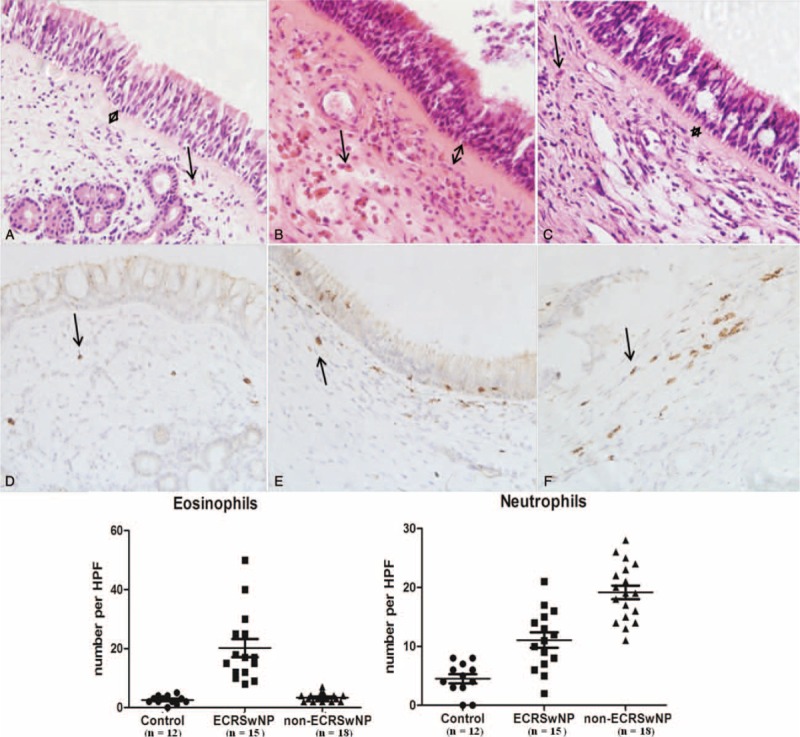
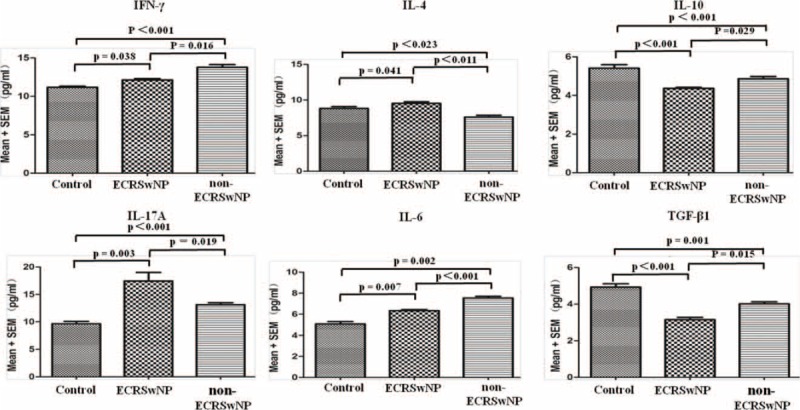
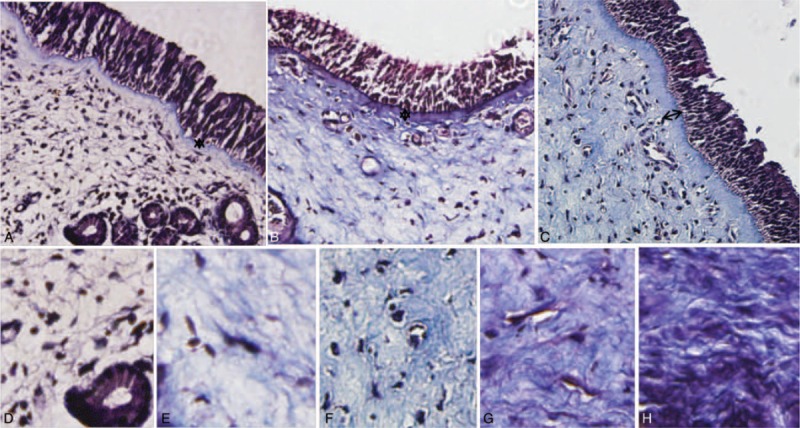
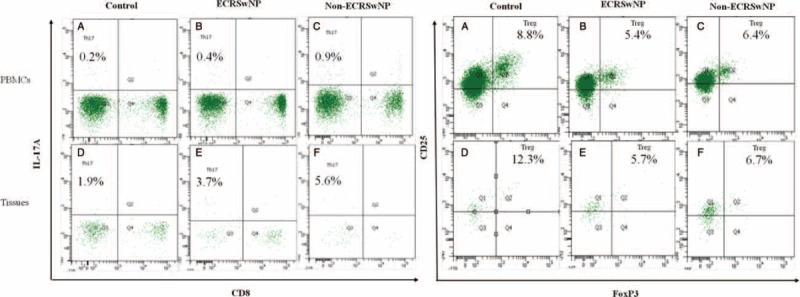
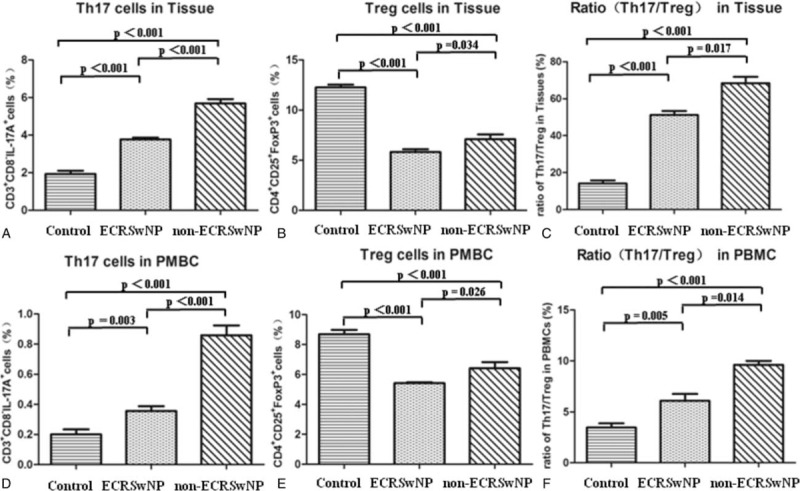
Chronic rhinosinusitis with nasal polyps (CRSwNP) is a heterogeneous disease that can be classified as eosinophilic or noneosinophilic. Nasal polyps can exhibit different types of mucosal inflammation and responses to treatment. Imbalanced ratios of T-helper 17(Th17) and regulatory T (Treg) cells may contribute to the pathogenesis of nasal polyps.This study assessed the frequency of Th17 and Treg cells and related cytokines in patients with nasal polyps and tested for associations with mucosal remodeling.Surgical samples from 12 controls and 33 CRSwNP patients were analyzed histopathologically. The frequency of Th17 and Treg cells in peripheral blood mononuclear cells (PBMCs) and tissues were determined using flow cytometry. Th17 and Treg cells-related cytokines in plasma were measured by Cytometric Bead Array (CBA) multiplex assays and enzyme-linked immunosorbent assays (ELISAs).Eosinophilic CRSwNP (ECRSwNP) patients exhibited robust eosinophilia, whereas non-ECRSwNP patients were characterized by neutrophilia. Compared with non-ECRSwNP, an increased Th17/Treg ratio in ECRSwNP was associated with a less increased frequency of Th17 cells and a more striking reduction of Treg cells. An altered Th17/Treg cell ratio was positively correlated with eosinophilic and neutrophilic infiltration, submucosal basement membrane thickness, and the degree of subepithelial collagen deposition. Compared with non-ECRSwNP, ECRSwNP had higher levels of IL-17A and IL-4, and lower levels of IL-10 and TGF-β1, whereas non-ECRSwNP showed higher levels of IFN-γ and IL-6.Th17/Treg cell imbalance in nasal polyps (both in tissues and PBMCs) with distinct cytokine profile may contribute to different inflammatory patterns (eosinophilic versus neutrophilic inflammation) and corresponding features of mucosal remodeling. Effective strategies can be designed to target a Th17/Treg imbalance to restore immune homeostasis in nasal polyps.
伴鼻息肉的慢性鼻-鼻窦炎(CRSwNP)是一种异质性疾病,可分为嗜酸性粒细胞性或非嗜酸性粒细胞性。鼻息肉可表现出不同类型的黏膜炎症及对治疗的反应。辅助性T细胞17(Th17)和调节性T(Treg)细胞比例失衡可能在鼻息肉发病机制中起作用。本研究评估了鼻息肉患者中Th17和Treg细胞及相关细胞因子的频率,并检测其与黏膜重塑的相关性。对12名对照者和33例CRSwNP患者的手术样本进行组织病理学分析。采用流式细胞术测定外周血单个核细胞(PBMC)和组织中Th17和Treg细胞的频率。通过细胞计数微珠阵列(CBA)多重检测和酶联免疫吸附测定(ELISA)检测血浆中Th17和Treg细胞相关细胞因子。嗜酸性粒细胞性CRSwNP(ECRSwNP)患者表现出强烈的嗜酸性粒细胞增多,而非ECRSwNP患者以中性粒细胞增多为特征。与非ECRSwNP相比,ECRSwNP中Th17/Treg比例增加与Th17细胞频率增加较少及Treg细胞更显著减少有关。Th17/Treg细胞比例改变与嗜酸性粒细胞和中性粒细胞浸润、黏膜下基底膜厚度及上皮下胶原沉积程度呈正相关。与非ECRSwNP相比,ECRSwNP的IL-17A和IL-4水平较高,IL-10和转化生长因子-β1(TGF-β1)水平较低,而非ECRSwNP的干扰素-γ(IFN-γ)和白细胞介素-6(IL-6)水平较高。鼻息肉(组织和PBMC中)中Th17/Treg细胞失衡及独特的细胞因子谱可能导致不同的炎症模式(嗜酸性粒细胞性与中性粒细胞性炎症)及相应的黏膜重塑特征。可设计有效的策略针对Th17/Treg失衡来恢复鼻息肉中的免疫稳态。