Department of Experimental Clinical and Health Psychology, Ghent University, Ghent, Belgium.
PLoS One. 2016 Mar 10;11(3):e0151188. doi: 10.1371/journal.pone.0151188. eCollection 2016.
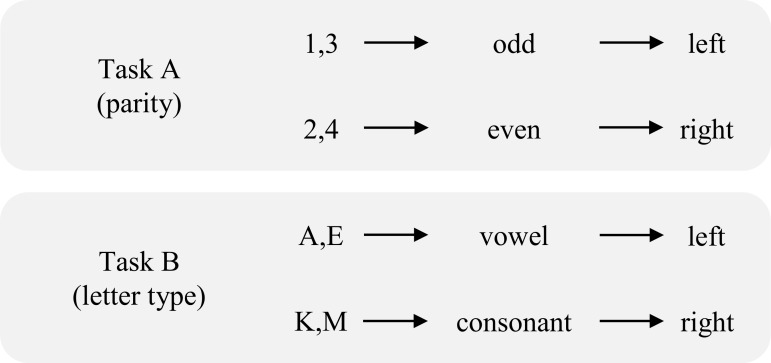
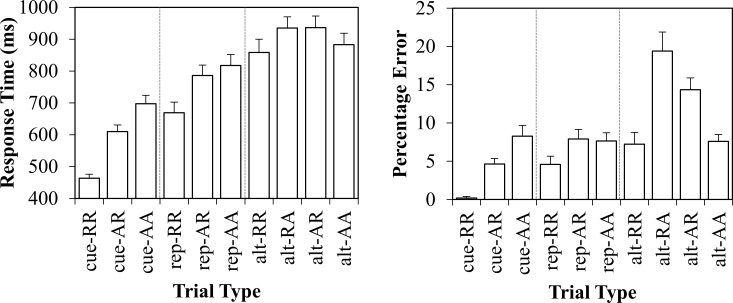
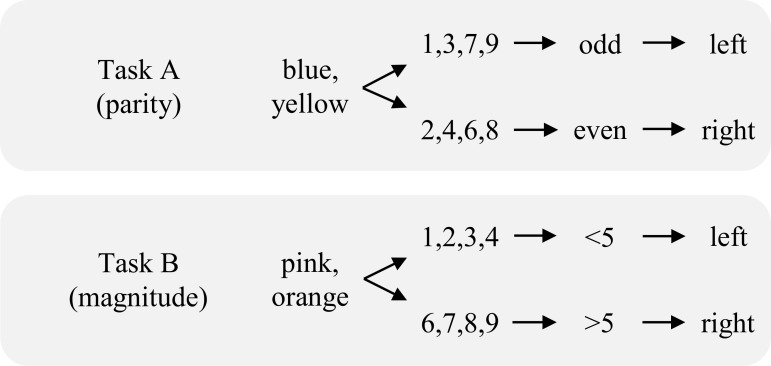
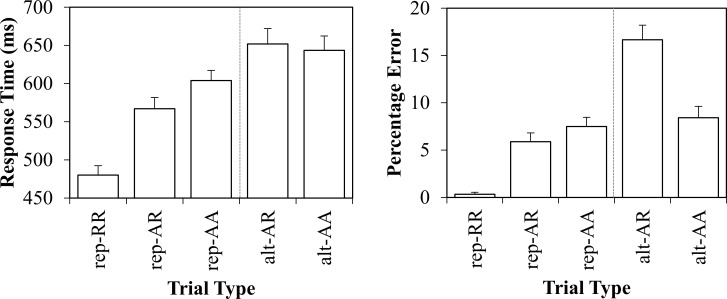
This report presents data from two versions of the task switching procedure in which the separate influence of stimulus repetitions, response key repetitions, conceptual response repetitions, cue repetitions, task repetitions, and congruency are considered. Experiment 1 used a simple alternating runs procedure with parity judgments of digits and consonant/vowel decisions of letters as the two tasks. Results revealed sizable effects of stimulus and response repetitions, and controlling for these effects reduced the switch cost. Experiment 2 was a cued version of the task switch paradigm with parity and magnitude judgments of digits as the two tasks. Results again revealed large effects of stimulus and response repetitions, in addition to cue repetition effects. Controlling for these effects again reduced the switch cost. Congruency did not interact with our novel "unbiased" measure of switch costs. We discuss how the task switch paradigm might be thought of as a more complex version of the feature integration paradigm and propose an episodic learning account of the effect. We further consider to what extent appeals to higher-order control processes might be unnecessary and propose that controls for feature integration biases should be standard practice in task switching experiments.
本报告介绍了两种任务转换程序版本的数据,其中考虑了刺激重复、反应键重复、概念反应重复、线索重复、任务重复和一致性的单独影响。实验 1 使用简单的交替运行程序,用数字的奇偶判断和字母的辅音/元音判断作为两种任务。结果显示刺激和反应重复有相当大的影响,控制这些影响会降低转换成本。实验 2 是任务转换范式的提示版本,用数字的奇偶和大小判断作为两种任务。结果再次显示刺激和反应重复的影响很大,此外还有线索重复的影响。控制这些影响也会再次降低转换成本。一致性与我们新颖的“无偏”转换成本测量没有相互作用。我们讨论了任务转换范式如何被视为特征整合范式的更复杂版本,并提出了一种关于该效应的情节学习解释。我们进一步考虑到,诉诸于更高阶的控制过程是否必要,以及在任务转换实验中控制特征整合偏差是否应成为标准做法。