Sorge F, Velayudhan-Deschamps N, Faye A, Blondé R, Naudin J
Service de pédiatrie générale, hôpital Necker, Assistance publique-Hôpitaux de Paris, 149, rue de Sèvres, 75015 Paris, France; Service de pédiatrie générale, hôpital Robert-Debré, Assistance publique-Hôpitaux de Paris, 48, boulevard Sérurier, 75019 Paris, France; Groupe de pédiatrie tropicale de la Société française de pédiatrie, 75019 Paris, France.
Groupe de pédiatrie tropicale de la Société française de pédiatrie, 75019 Paris, France; Service de pédiatrie, centre hospitalier, 1, rue Marne, 35400 Saint-Malot, France.
Arch Pediatr. 2016 Apr;23(4):424-31. doi: 10.1016/j.arcped.2015.12.021. Epub 2016 Mar 8.
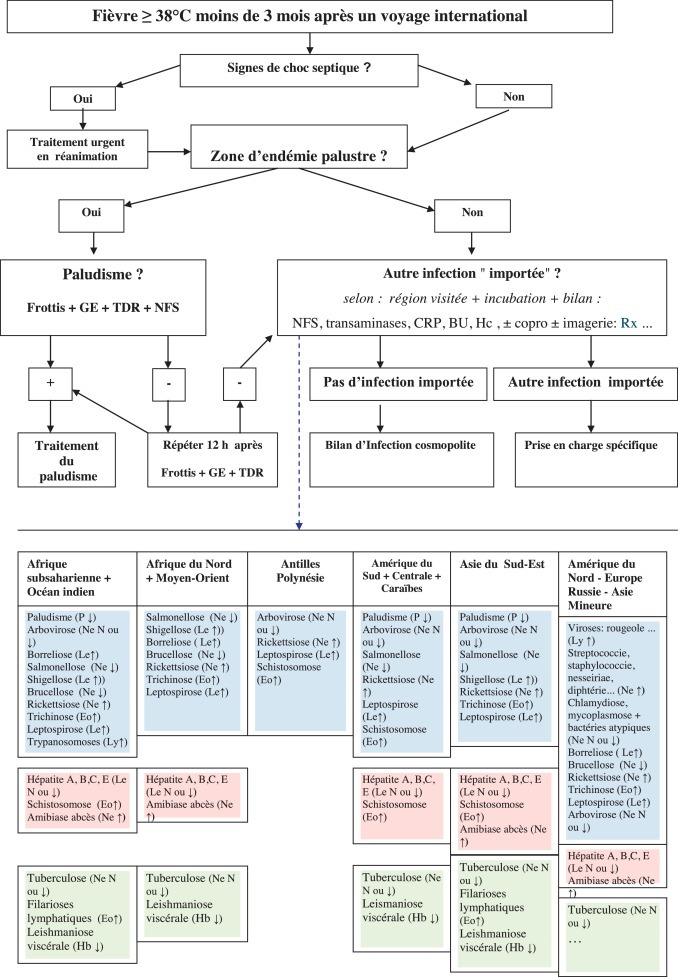
Child travelers are numerous, exposed to the risk of diseases, both infectious and noninfectious, for which practitioners often lack experience. The assessment of febrile returning child travelers is becoming more frequent and challenging. The question of previous travel should be foremost in the checklist of the interview of any febrile child traveler, because this implies a possible tropical disease such as malaria that may be life-threatening. These need to be investigated and treated effectively and rapidly. There are highly contagious infections that could pose public health risks requiring implementation of hygienic and public health measures. A detailed immunization, medical, and travel history for exposure to infectious risks using geographic, seasonal, environmental, sociocultural, and epidemiological data are needed. Along with clinical examination and elementary first-line investigations, the history should guide second-line exams, which will provide the etiology and optimal treatment in approximately 75 % of cases. The majority of children will have a cosmopolitan infection that resolves spontaneously or is simple to treat. Malaria will need urgent and specific treatment. This article describes guidance on first-line evaluation and management of febrile child travelers as recommended in France.
儿童旅行者数量众多,面临着感染性和非感染性疾病的风险,而从业者往往缺乏应对这些疾病的经验。对发热的归国儿童旅行者进行评估的情况越来越常见,且颇具挑战性。对于任何发热的儿童旅行者,在问诊清单中,旅行史问题应排在首位,因为这可能意味着患有诸如疟疾等可能危及生命的热带疾病。这些疾病需要得到有效且迅速的调查和治疗。存在一些具有高度传染性的感染,可能会构成公共卫生风险,这就需要实施卫生和公共卫生措施。需要利用地理、季节、环境、社会文化和流行病学数据,详细了解免疫接种、医疗和旅行史,以评估感染风险。除了临床检查和基本的一线检查外,病史应指导二线检查,二线检查将在大约75%的病例中提供病因和最佳治疗方案。大多数儿童会感染常见疾病,这些疾病会自行痊愈或易于治疗。疟疾则需要紧急且特定的治疗。本文介绍了法国推荐的发热儿童旅行者一线评估和管理指南。