Tietsche de Moraes Hungria Vania, Allen Syreeta, Kampanis Petros, Soares Elyara Maria
Faculdade de Ciências Médicas da Santa Casa de São Paulo (FCMSCSP), São Paulo, SP, Brazil.
The Binding Site, Birmingham, United Kingdom.
Rev Bras Hematol Hemoter. 2016 Jan-Feb;38(1):37-43. doi: 10.1016/j.bjhh.2015.11.003. Epub 2016 Feb 1.
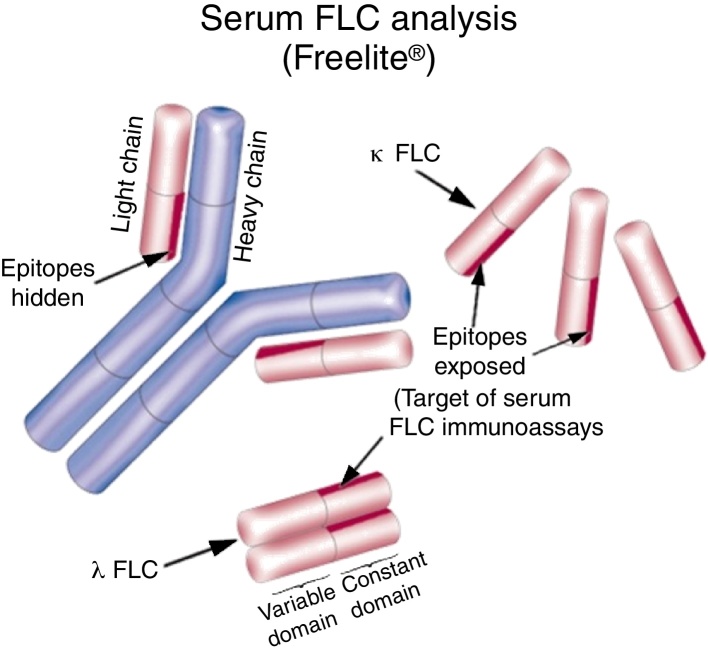
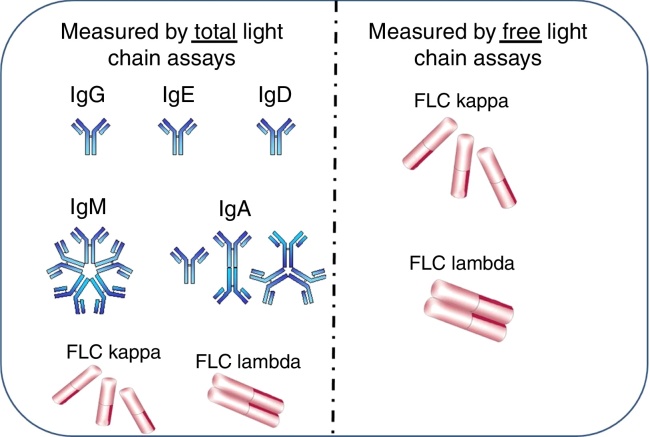
The diagnosis of Multiple Myeloma is a challenge to the physician due to the non-specific symptoms (anemia, bone pain and recurrent infections) that are commonplace in the elderly population. However, early diagnosis is associated with less severe disease, including fewer patients presenting with acute renal injury, pathological fractures and severe anemia. Since 2006, the serum free light chain test Freelite(®) has been included alongside standard laboratory tests (serum and urine protein electrophoresis, and serum and urine immunofixation) as an aid in the identification of monoclonal proteins, which are a cornerstone for the diagnosis of Multiple Myeloma. The serum free light chain assay recognizes the light chain component of the immunoglobulin in its free form with high sensitivity. Other assays that measure light chains in the free and intact immunoglobulin forms are sensitive, but unfortunately, due to the nomenclature used, these assays (total light chains) are sometimes used in place of the free light chain assay. This paper reviews the available literature comparing the two assays and tries to clarify hypothetical limitations of the total assay to detect Multiple Myeloma. Furthermore, we elaborate on our study comparing the two assays used in 11 Light Chain Multiple Myeloma patients at presentation and 103 patients taken through the course of their disease. The aim of this article is to provide a clear discrimination between the two assays and to provide information to physicians and laboratory technicians so that they can utilize the International Myeloma Working Group guidelines.
由于多发性骨髓瘤的非特异性症状(贫血、骨痛和反复感染)在老年人群中很常见,因此对医生来说,多发性骨髓瘤的诊断是一项挑战。然而,早期诊断与病情较轻相关,包括出现急性肾损伤、病理性骨折和严重贫血的患者较少。自2006年以来,血清游离轻链检测Freelite(®)已被纳入标准实验室检测(血清和尿蛋白电泳以及血清和尿免疫固定电泳),以帮助识别单克隆蛋白,而单克隆蛋白是诊断多发性骨髓瘤的基石。血清游离轻链检测能够高灵敏度地识别游离形式的免疫球蛋白轻链成分。其他检测游离和完整免疫球蛋白形式轻链的检测方法也很灵敏,但不幸的是,由于所使用的命名法,这些检测方法(总轻链)有时被用来替代游离轻链检测。本文回顾了比较这两种检测方法的现有文献,并试图阐明总检测法在检测多发性骨髓瘤方面可能存在的局限性。此外,我们详细阐述了我们对11例初诊轻链型多发性骨髓瘤患者和103例病程中患者使用这两种检测方法的研究。本文的目的是明确区分这两种检测方法,并向医生和实验室技术人员提供信息,以便他们能够采用国际骨髓瘤工作组的指南。