Myers K C, Howell J C, Wallace G, Dandoy C, El-Bietar J, Lane A, Davies S M, Jodele S, Rose S R
Division of Bone Marrow Transplantation and Immune Deficiency, Department of Pediatrics, Cincinnati Children's Hospital, Children's Hospital Medical Center and University of Cincinnati College of Medicine, Cincinnati, OH, USA.
Division of Endocrinology, Department of Pediatrics, Children's Hospital Medical Center and University of Cincinnati College of Medicine, Cincinnati, OH, USA.
Bone Marrow Transplant. 2016 Jul;51(7):980-4. doi: 10.1038/bmt.2016.39. Epub 2016 Mar 14.
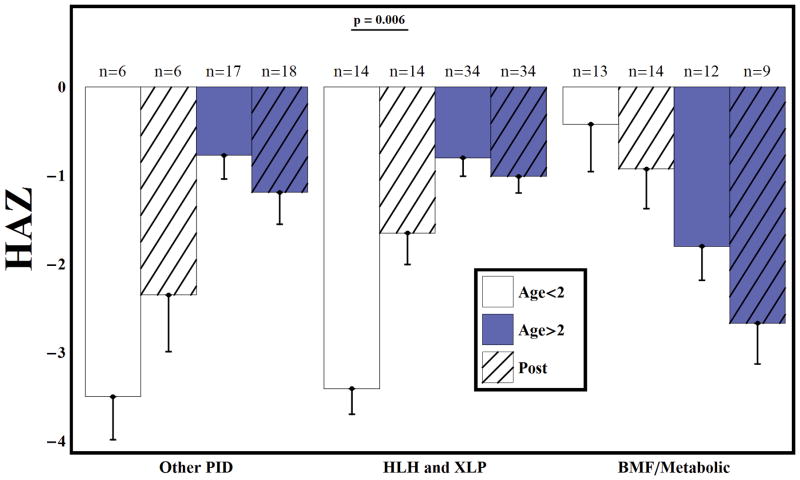
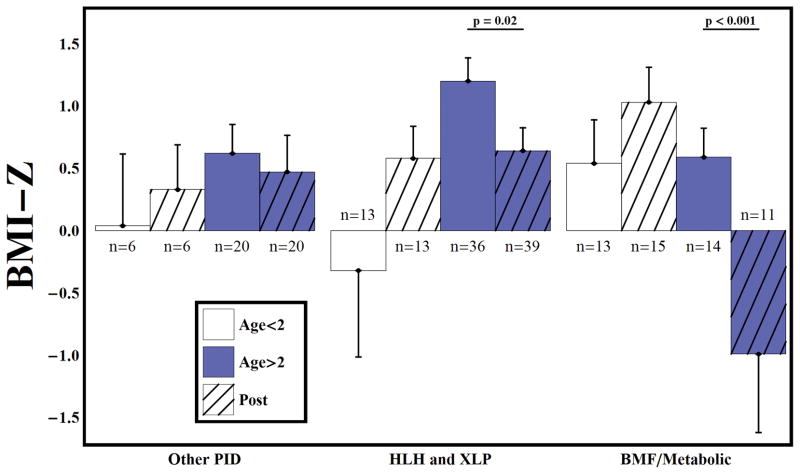
Myeloablative conditioning regimens for hematopoietic stem cell transplant (HSCT) are known to affect endocrine function, but little is known regarding reduced intensity conditioning (RIC) regimens. We retrospectively reviewed 114 children and young adults after single RIC HSCT. The analysis was grouped by age (<2 and ⩾2 years) and diagnosis (hemophagocytic lymphohistiocystosis/X-linked lymphoproliferative syndrome (HLH/XLP), other immune disorders, metabolic/genetic disorders). All groups displayed short stature by mean height-adjusted Z-score (HAZ) before (-1.29) and after HSCT (HAZ -1.38, P=0.47). After HSCT, younger children with HLH/XLP grew better (HAZ -3.41 vs -1.65, P=0.006), whereas older subjects had decline in growth (HAZ -0.8 vs -1.01, P=0.06). Those with steroid therapy beyond standard GVHD prophylaxis were shorter than those without (P 0.04). After HSCT, older subjects with HLH/XLP became thinner with a mean body mass index (BMI) Z-score of 1.20 vs 0.64, P=0.02, and similar to metabolic/genetic disorders (BMI-Z= 0.59 vs -0.99, P<0.001). BMI increased among younger children in these same groups. Thyroid function was abnormal in 24% (18/76). 25-OH vitamin D levels were insufficient in 73% (49/65), with low bone mineral density in 8 of 19 evaluable subjects. Despite RIC, children and young adults still have significant late endocrine effects. Further research is required to compare post-transplant endocrine effects after RIC to those after standard chemotherapy protocols.
已知造血干细胞移植(HSCT)的清髓性预处理方案会影响内分泌功能,但对于减低强度预处理(RIC)方案的了解却很少。我们回顾性分析了114例接受单次RIC HSCT的儿童和青年。分析按年龄(<2岁和≥2岁)和诊断(噬血细胞性淋巴组织细胞增生症/ X连锁淋巴增殖综合征(HLH / XLP)、其他免疫疾病、代谢/遗传疾病)进行分组。所有组在HSCT前(平均身高校正Z评分(HAZ)为-1.29)和HSCT后(HAZ为-1.38,P = 0.47)均显示身材矮小。HSCT后,患有HLH / XLP的年幼儿童生长较好(HAZ为-3.41对-1.65,P = 0.006),而年长受试者的生长出现下降(HAZ为-0.8对-1.01,P = 0.06)。接受超过标准移植物抗宿主病(GVHD)预防剂量类固醇治疗的患者比未接受者更矮(P = 0.04)。HSCT后,患有HLH / XLP的年长受试者变瘦,平均体重指数(BMI)Z评分为1.20对0.64,P = 0.02,与代谢/遗传疾病患者相似(BMI-Z = 0.59对-0.99,P<0.001)。这些组中的年幼儿童BMI增加。24%(18/76)的患者甲状腺功能异常。73%(。49/65)的患者25-羟维生素D水平不足,19例可评估受试者中有8例骨密度低。尽管采用了RIC方案,但儿童和青年仍有显著的晚期内分泌影响。需要进一步研究以比较RIC后与标准化疗方案后的移植后内分泌影响。