Anthony Nolan Research Institute, Royal Free Hospital and University College London, London, United Kingdom.
Department of Haemato-Oncology, The Royal Marsden Hospital, Sutton, United Kingdom.
Front Immunol. 2020 Jun 8;11:966. doi: 10.3389/fimmu.2020.00966. eCollection 2020.
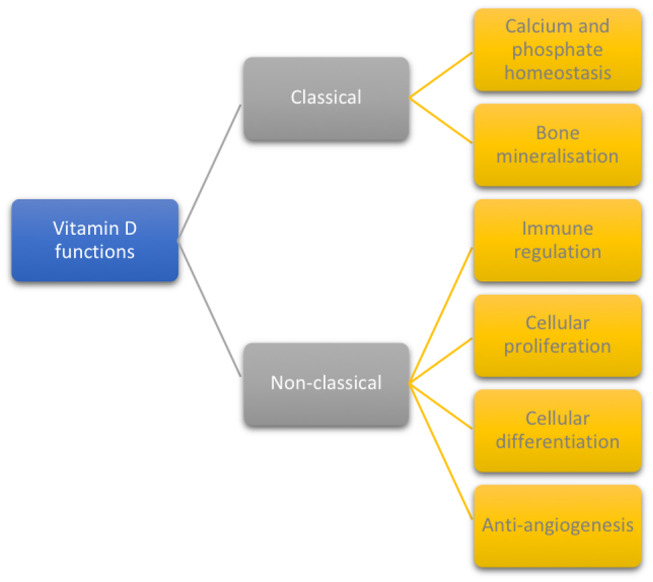
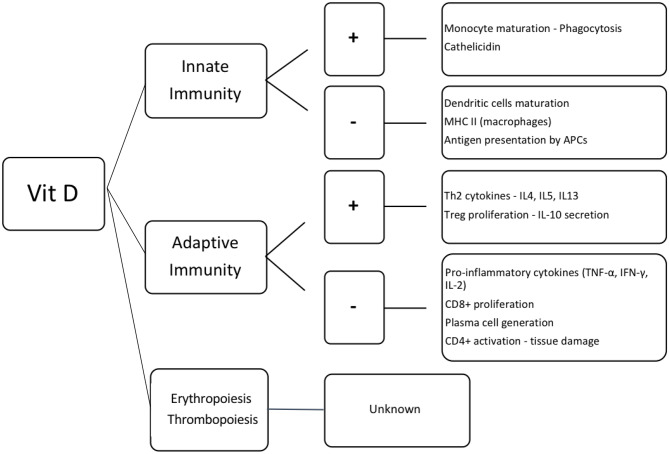
Vitamin D was discovered 100 years ago and since then multiple studies have consistently proved its effect on bone health and mineral metabolism. Further research has also explored its so-called "non-classical" biological effects, encompassing immune regulation and control of cell proliferation and differentiation. Vitamin D downregulates pro-inflammatory immune cells and subsequently their cytokine production, while enhancing the anti-inflammatory subsets, thus mediating inflammation and fostering a more tolerogenic environment. Its biological action is exerted through the vitamin D receptor, a nuclear receptor that mediates gene transcription and is expressed in most cells from the innate and adaptive immunity. Owing to its immune-modulatory properties, its role in cancer pathophysiology, hematology disorders and stem cell transplantation has also been investigated. Vitamin D deficiency causes immune imbalance and cytokine dysregulation, contributing to some autoimmune diseases. In the hematopoietic stem cell transplant setting this could lead to complications such as acute and chronic graft-versus-host disease, ultimately impacting transplant outcomes. Other factors have also been linked to this, including specific polymorphisms of the vitamin D receptor in both stem cell donors and recipients. Nevertheless, studies thus far have shown conflicting results and the use of vitamin D or its receptor as biomarkers has not been validated yet, therefore there are no evidence-based consensus guidelines to guide clinicians in their day-to-day practice. To gain more insight in this topic, we have reviewed the existent literature and gathered the current evidence. This is an overview of the role of serum vitamin D and its receptor as biomarkers for clinical outcomes in patients undergoing hematopoietic stem cell transplantation. Further prospective studies with larger cohorts are warranted to validate the viability of using serum vitamin D, and its receptor, as biomarkers in potential stem cell donors and patients, to identify those at risk of post-transplant complications and enable early therapeutic interventions.
维生素 D 发现于 100 年前,此后多项研究一致证实了其对骨骼健康和矿物质代谢的作用。进一步的研究还探索了其所谓的“非经典”生物学效应,包括免疫调节和控制细胞增殖和分化。维生素 D 下调促炎免疫细胞,随后抑制其细胞因子的产生,同时增强抗炎亚群,从而介导炎症并促进更耐受的环境。其生物学作用是通过维生素 D 受体发挥的,维生素 D 受体是一种核受体,介导基因转录,存在于固有和适应性免疫的大多数细胞中。由于其免疫调节特性,其在癌症发病机制、血液疾病和干细胞移植中的作用也得到了研究。维生素 D 缺乏会导致免疫失衡和细胞因子失调,导致一些自身免疫性疾病。在造血干细胞移植环境中,这可能导致急性和慢性移植物抗宿主病等并发症,最终影响移植结果。其他因素也与此有关,包括干细胞供体和受体内维生素 D 受体的特定多态性。然而,迄今为止的研究结果相互矛盾,维生素 D 或其受体作为生物标志物的使用尚未得到验证,因此,目前没有基于证据的共识指南来指导临床医生的日常实践。为了更深入地了解这一主题,我们回顾了现有的文献,并收集了当前的证据。这是一篇关于血清维生素 D 及其受体作为造血干细胞移植患者临床结局生物标志物的综述。需要进一步进行前瞻性研究,以扩大队列,验证使用血清维生素 D 及其受体作为潜在干细胞供体和患者的生物标志物的可行性,以识别移植后并发症风险较高的患者,并进行早期治疗干预。