Keane Christopher Robert
Behavioral and Community Health Sciences, Graduate School of Public Health, University of Pittsburgh, 130 DeSoto Street, Pittsburgh, PA, 15261, USA.
BMC Public Health. 2016 Mar 15;16:265. doi: 10.1186/s12889-016-2938-8.
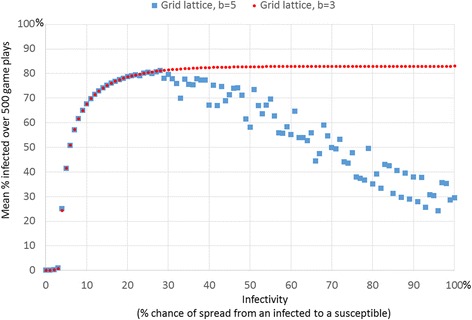
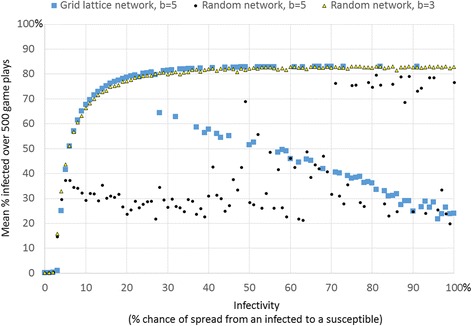
Collective health behavior often demonstrates counter-intuitive dynamics, sometimes resisting interventions designed to produce change, or even producing effects that are in the opposite direction than intended by the intervention, e.g. lowering infectivity resulting in increased infections. At other times collective health behavior exhibits sudden large-scale change in response to small interventions or change in the environment, a phenomenon often called "tipping." I hypothesize that these seemingly very different phenomena can all be explained by the same dynamic, a type of collective resilience.
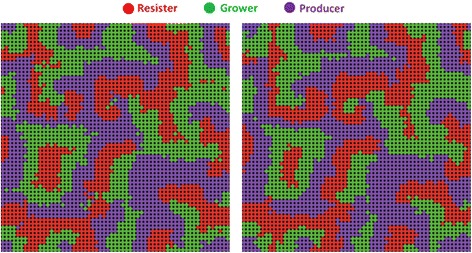
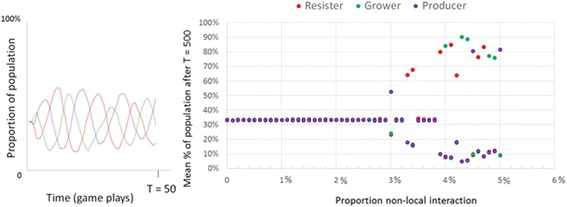
I compared two simple agent-based models of interactions in networks: a public health behavior game, in which individuals decide whether or not to adopt protective behavior, and a microbial-level game, in which three different strains of bacteria attack each other. I examined the type of networks and other conditions that support a dynamic balance, and determined what changes of conditions will tip the balance.
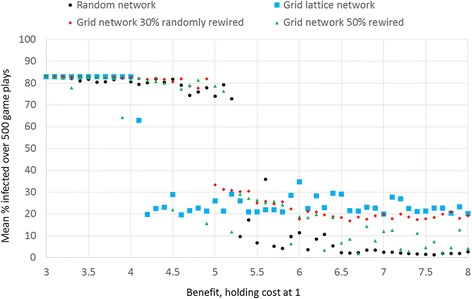
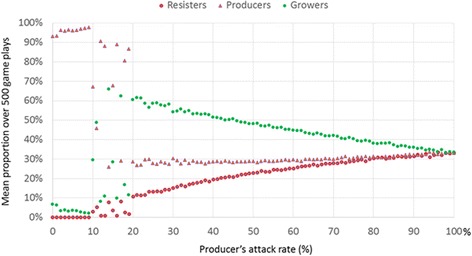
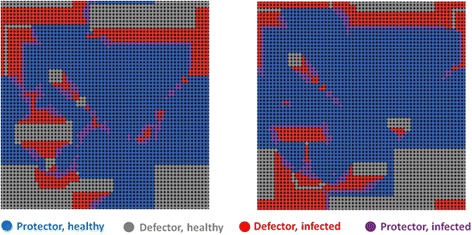
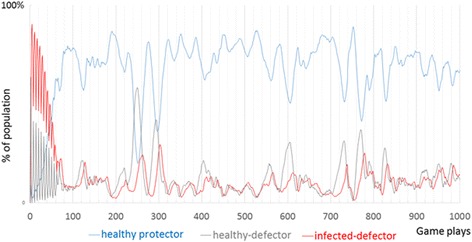
Both models show lasting dynamic equilibrium and resilience, resulting from negative feedback that supports oscillating coexistence of diversity under a range of conditions. In the public health game, health protection is followed by free-riding defectors, followed by a rise in infection, in long-lasting cycles. In the microbial game, each of three strains takes turns dominating. In both games, the dynamic balance is tipped by lowering the level of local clustering, changing the level of benefit, or lowering infectivity or attack rate. Lowering infectivity has the surprising effect of increasing the numbers of infected individuals. We see parallel results in the microbial game of three bacterial strains, where lowering one strain's attack rate (analogous to lowering infectivity) increases the numbers of the restrained attacker, a phenomenon captured by the phrase, "the enemy of my enemy is my friend."
Collective behavior often shows a dynamic balance, resulting from negative feedback, supporting diversity and resisting change. Above certain threshold conditions, the dynamic balance is tipped towards uniformity of behavior. Under a certain range of conditions we see "hydra effects" in which interventions to lower attack rate or infectivity are self-defeating. Simple models of collective behavior can explain these seemingly disparate dynamics.
群体健康行为常常呈现出违反直觉的动态变化,有时会抵制旨在促成改变的干预措施,甚至产生与干预预期方向相反的效果,例如降低传染性却导致感染增加。在其他时候,群体健康行为会因微小的干预或环境变化而呈现出突然的大规模变化,这种现象通常被称为“临界点变化”。我假设这些看似截然不同的现象都可以用同一种动态变化来解释,即一种群体恢复力。
我比较了网络中两种基于主体的简单互动模型:一种是公共卫生行为博弈,其中个体决定是否采取保护行为;另一种是微生物层面的博弈,其中三种不同菌株的细菌相互攻击。我研究了支持动态平衡的网络类型和其他条件,并确定哪些条件变化会打破平衡。
两个模型都显示出持久的动态平衡和恢复力,这是由负反馈导致的,负反馈支持在一系列条件下多样性的振荡共存。在公共卫生博弈中,健康保护之后是搭便车的背叛者,接着感染率上升,形成持久的循环。在微生物博弈中,三种菌株轮流占据主导地位。在这两种博弈中,通过降低局部聚类水平、改变收益水平或降低传染性或攻击率,动态平衡会被打破。降低传染性会产生增加感染个体数量的惊人效果。我们在三种细菌菌株的微生物博弈中看到了类似的结果,降低一种菌株的攻击率(类似于降低传染性)会增加受抑制攻击者的数量,这种现象可以用“敌人的敌人就是我的朋友”来描述。
群体行为通常表现出一种由负反馈导致的动态平衡,支持多样性并抵制变化。在特定的阈值条件之上,动态平衡会朝着行为的一致性倾斜。在一定的条件范围内,我们会看到“九头蛇效应”,即降低攻击率或传染性的干预措施会适得其反。简单的群体行为模型可以解释这些看似不同的动态变化。