Ayyadevara Srinivas, Mercanti Federico, Wang Xianwei, Mackintosh Samuel G, Tackett Alan J, Prayaga Sastry V S, Romeo Francesco, Shmookler Reis Robert J, Mehta Jawahar L
From the Central Arkansas Veterans Healthcare System, Little Rock (S.A., F.M., X.W., R.J.S.R., J.L.M.); Department of Geriatrics (S.A., R.J.S.R.), Division of Cardiology (F.M., X.W., S.V.S.P., J.L.M.), and Department of Biochemistry and Molecular Biology (S.G.M., A.J.T., R.J.S.R.), University of Arkansas for Medical Sciences (UAMS), Little Rock; and Department of Cardiology, University of Rome "Tor Vergata", Rome, Italy (F.M., F.R.).
Hypertension. 2016 May;67(5):1006-13. doi: 10.1161/HYPERTENSIONAHA.115.06849. Epub 2016 Mar 14.
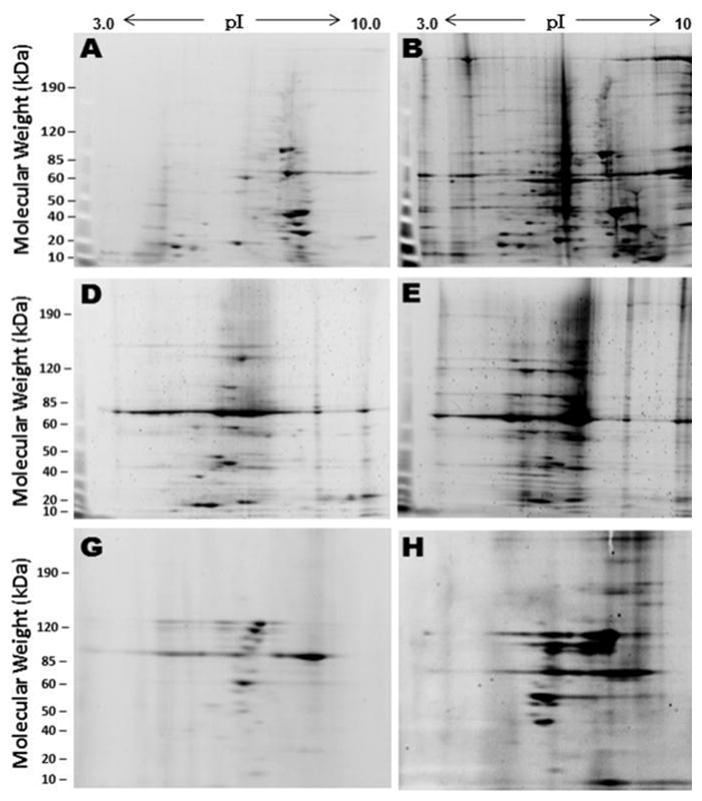
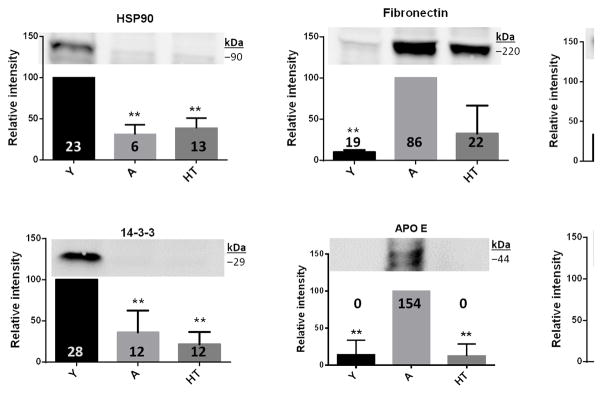
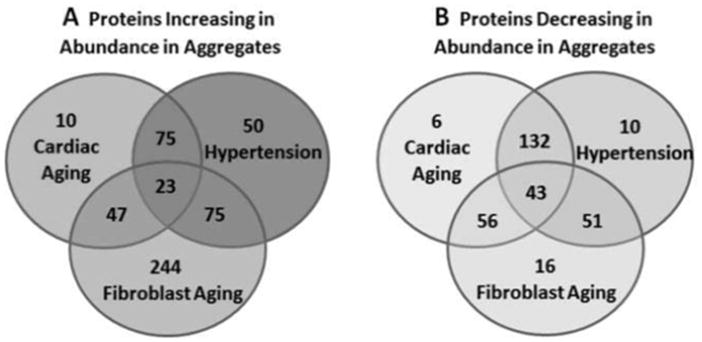
Neurodegenerative diseases are largely defined by protein aggregates in affected tissues. Aggregates contain some shared components as well as proteins thought to be specific for each disease. Aggregation has not previously been reported in the normal, aging heart or the hypertensive heart. Detergent-insoluble protein aggregates were isolated from mouse heart and characterized on 2-dimensional gels. Their levels increased markedly and significantly with aging and after sustained angiotensin II-induced hypertension. Of the aggregate components identified by high-resolution proteomics, half changed in abundance with age (392/787) or with sustained hypertension (459/824), whereas 30% (273/901) changed concordantly in both, each P<0.05. One fifth of these proteins were previously associated with age-progressive neurodegenerative or cardiovascular diseases, or both (eg, ApoE, ApoJ, ApoAIV, clusterin, complement C3, and others involved in stress-response and protein-homeostasis pathways). Because fibrosis is a characteristic of both aged and hypertensive hearts, we posited that aging of fibroblasts may contribute to the aggregates observed in cardiac tissue. Indeed, as cardiac myofibroblasts "senesced" (approached their replicative limit) in vitro, they accrued aggregates with many of the same constituent proteins observed in vivo during natural aging or sustained hypertension. In summary, we have shown for the first time that compact (detergent-insoluble) protein aggregates accumulate during natural aging, chronic hypertension, and in vitro myofibroblast senescence, sharing many common proteins. Thus, aggregates that arise from disparate causes (aging, hypertension, and replicative senescence) may have common underlying mechanisms of accrual.
神经退行性疾病在很大程度上由受影响组织中的蛋白质聚集体所定义。聚集体包含一些共同成分以及被认为是每种疾病特有的蛋白质。此前尚未报道在正常、衰老心脏或高血压心脏中存在聚集现象。从不溶性去污剂蛋白聚集体中分离出小鼠心脏组织,并通过二维凝胶电泳对其进行表征。随着衰老以及在持续的血管紧张素 II 诱导的高血压后,它们的水平显著且明显升高。通过高分辨率蛋白质组学鉴定出的聚集体成分中,一半在丰度上随年龄(392/787)或持续高血压(459/824)而变化,而 30%(273/901)在两者中均一致变化,每个 P<0.05。这些蛋白质中有五分之一先前与年龄相关性神经退行性疾病或心血管疾病,或两者都有关联(例如,载脂蛋白 E、载脂蛋白 J、载脂蛋白 AIV、簇集蛋白、补体 C3 以及其他参与应激反应和蛋白质稳态途径的蛋白)。由于纤维化是衰老心脏和高血压心脏的共同特征,我们推测成纤维细胞的衰老可能导致心脏组织中观察到的聚集体形成。事实上,随着心肌成纤维细胞在体外“衰老”(接近其复制极限),它们积累了与自然衰老或持续高血压期间体内观察到的许多相同组成蛋白的聚集体。总之,我们首次表明紧密(不溶性去污剂)蛋白聚集体在自然衰老、慢性高血压以及体外成纤维细胞衰老过程中积累,共享许多共同蛋白质。因此,由不同原因(衰老、高血压和复制性衰老)产生的聚集体可能具有共同的潜在积累机制。