Mudadu Maurício A, Porto-Neto Laercio R, Mokry Fabiana B, Tizioto Polyana C, Oliveira Priscila S N, Tullio Rymer R, Nassu Renata T, Niciura Simone C M, Tholon Patrícia, Alencar Maurício M, Higa Roberto H, Rosa Antônio N, Feijó Gélson L D, Ferraz André L J, Silva Luiz O C, Medeiros Sérgio R, Lanna Dante P, Nascimento Michele L, Chaves Amália S, Souza Andrea R D L, Packer Irineu U, Torres Roberto A A, Siqueira Fabiane, Mourão Gerson B, Coutinho Luiz L, Reverter Antonio, Regitano Luciana C A
Embrapa Agricultural Informatics, Av. André Tosello, 209, Campinas, SP, Brazil.
Embrapa Southeast Livestock, Rodovia Washington Luiz, Km 234, São Carlos, SP, Brazil.
BMC Genomics. 2016 Mar 15;17:235. doi: 10.1186/s12864-016-2535-3.
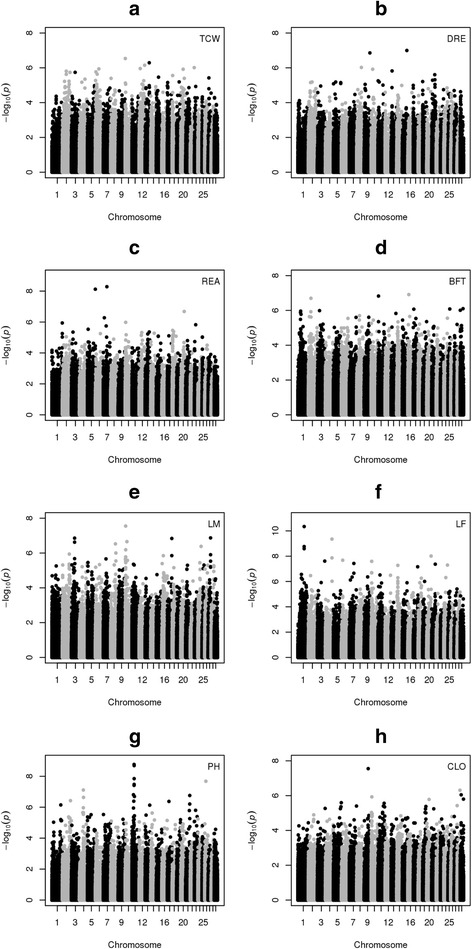
Nelore is the major beef cattle breed in Brazil with more than 130 million heads. Genome-wide association studies (GWAS) are often used to associate markers and genomic regions to growth and meat quality traits that can be used to assist selection programs. An alternative methodology to traditional GWAS that involves the construction of gene network interactions, derived from results of several GWAS is the AWM (Association Weight Matrices)/PCIT (Partial Correlation and Information Theory). With the aim of evaluating the genetic architecture of Brazilian Nelore cattle, we used high-density SNP genotyping data (~770,000 SNP) from 780 Nelore animals comprising 34 half-sibling families derived from highly disseminated and unrelated sires from across Brazil. The AWM/PCIT methodology was employed to evaluate the genes that participate in a series of eight phenotypes related to growth and meat quality obtained from this Nelore sample.
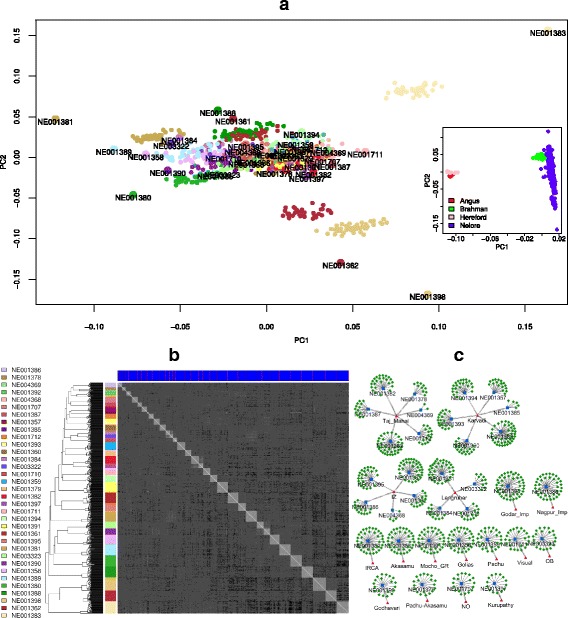
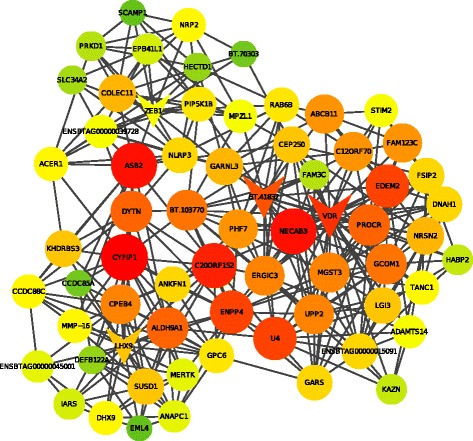
Our results indicate a lack of structuring between the individuals studied since principal component analyses were not able to differentiate families by its sires or by its ancestral lineages. The application of the AWM/PCIT methodology revealed a trio of transcription factors (comprising VDR, LHX9 and ZEB1) which in combination connected 66 genes through 359 edges and whose biological functions were inspected, some revealing to participate in biological growth processes in literature searches.
The diversity of the Nelore sample studied is not high enough to differentiate among families neither by sires nor by using the available ancestral lineage information. The gene networks constructed from the AWM/PCIT methodology were a useful alternative in characterizing genes and gene networks that were allegedly influential in growth and meat quality traits in Nelore cattle.
内洛尔牛是巴西主要的肉牛品种,存栏量超过1.3亿头。全基因组关联研究(GWAS)常被用于将标记和基因组区域与生长及肉质性状相关联,以辅助选择计划。一种不同于传统GWAS的替代方法是AWM(关联权重矩阵)/PCIT(偏相关和信息理论),它涉及根据多个GWAS的结果构建基因网络相互作用。为了评估巴西内洛尔牛的遗传结构,我们使用了来自780头内洛尔牛的高密度SNP基因分型数据(约770,000个SNP),这些牛包含34个半同胞家系,其来源是巴西各地广泛分布且无亲缘关系的种公牛。采用AWM/PCIT方法来评估参与从该内洛尔牛样本中获得的一系列与生长和肉质相关的八种表型的基因。
我们的结果表明,所研究的个体之间缺乏结构差异,因为主成分分析无法按种公牛或祖先谱系区分家系。AWM/PCIT方法的应用揭示了一组转录因子(包括VDR、LHX9和ZEB1),它们通过359条边连接了66个基因,并对其生物学功能进行了检查,在文献检索中发现其中一些参与了生物生长过程。
所研究的内洛尔牛样本的多样性不足以按种公牛或利用现有的祖先谱系信息来区分家系。由AWM/PCIT方法构建的基因网络是表征据称对内洛尔牛生长和肉质性状有影响的基因和基因网络的一种有用的替代方法。