Silberg J L, Copeland W, Linker J, Moore A A, Roberson-Nay R, York T P
Department of Human and Molecular Genetics,Virginia Commonwealth University School of Medicine,Richmond,Virginia,USA.
Department of Psychiatry and Behavioral Sciences,Duke University Medical Center,Durham,North Carolina,USA.
Psychol Med. 2016 Jul;46(9):1875-83. doi: 10.1017/S0033291716000362. Epub 2016 Mar 16.
Bullying victimization in childhood is associated with a broad array of serious mental health disturbances, including anxiety, depression, and suicidal ideation and behavior. The key goal of this study was to evaluate whether bullying victimization is a true environmental risk factor for psychiatric disturbance using data from 145 bully-discordant monozygotic (MZ) juvenile twin pairs from the Virginia Twin Study of Adolescent Behavioral Development (VTSABD) and their follow-up into young adulthood.
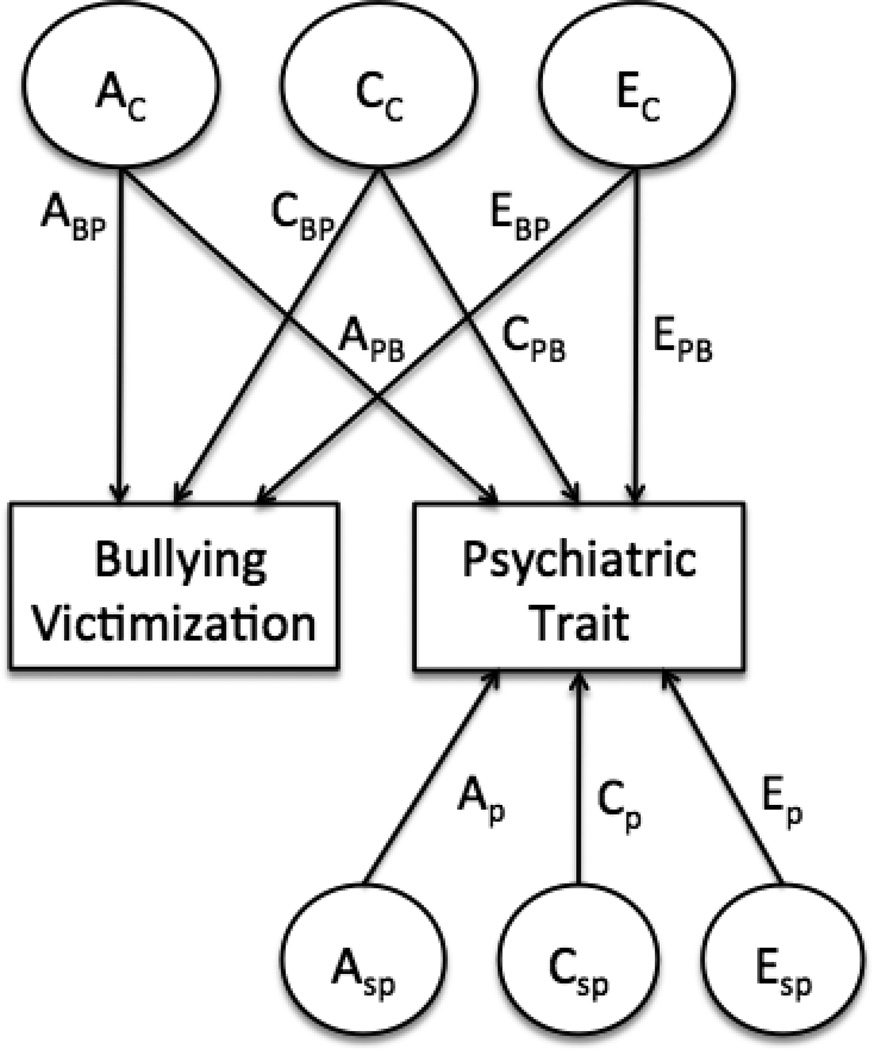
Since MZ twins share an identical genotype and familial environment, a higher rate of psychiatric disturbance in a bullied MZ twin compared to their non-bullied MZ co-twin would be evidence of an environmental impact of bullying victimization. Environmental correlations between being bullied and the different psychiatric traits were estimated by fitting structural equation models to the full sample of MZ and DZ twins (N = 2824). Environmental associations were further explored using the longitudinal data on the bullying-discordant MZ twins.
Being bullied was associated with a wide range of psychiatric disorders in both children and young adults. The analysis of data on the MZ-discordant twins supports a genuine environmental impact of bullying victimization on childhood social anxiety [odds ratio (OR) 1.7], separation anxiety (OR 1.9), and young adult suicidal ideation (OR 1.3). There was a shared genetic influence on social anxiety and bullying victimization, consistent with social anxiety being both an antecedent and consequence of being bullied.
Bullying victimization in childhood is a significant environmental trauma and should be included in any mental health assessment of children and young adults.
童年时期遭受欺凌与一系列严重的心理健康问题相关,包括焦虑、抑郁以及自杀意念和行为。本研究的主要目标是利用弗吉尼亚青少年行为发展双胞胎研究(VTSABD)中145对欺凌情况不一致的同卵(MZ)青少年双胞胎及其成年后的随访数据,评估欺凌受害是否是精神障碍的一个真正环境风险因素。
由于同卵双胞胎共享相同的基因型和家庭环境,与未受欺凌的同卵双胞胎相比,受欺凌的同卵双胞胎中精神障碍发生率更高将证明欺凌受害的环境影响。通过对同卵和异卵双胞胎的全样本(N = 2824)拟合结构方程模型,估计受欺凌与不同精神特质之间的环境相关性。利用欺凌情况不一致的同卵双胞胎的纵向数据进一步探讨环境关联。
在儿童和年轻人中,受欺凌都与多种精神障碍相关。对同卵不一致双胞胎数据的分析支持了欺凌受害对儿童社交焦虑[优势比(OR)1.7]、分离焦虑(OR 1.9)和年轻人自杀意念(OR 1.3)的真正环境影响。社交焦虑和欺凌受害存在共同的遗传影响,这与社交焦虑既是受欺凌的前因又是后果相一致。
童年时期的欺凌受害是一种重大的环境创伤,应纳入对儿童和年轻人的任何心理健康评估中。