Labib Sarah, Williams Andrew, Yauk Carole L, Nikota Jake K, Wallin Håkan, Vogel Ulla, Halappanavar Sabina
Environmental Health Science and Research Bureau, Health Canada, Ottawa, ON, K1A 0K9, Canada.
National Research Centre for the Working Environment, Lerso Parkallé 105, DK-2100, Copenhagen, Denmark.
Part Fibre Toxicol. 2016 Mar 15;13:15. doi: 10.1186/s12989-016-0125-9.
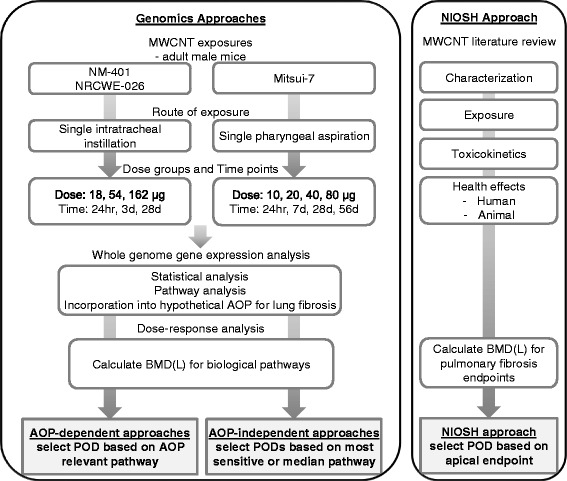
A diverse class of engineered nanomaterials (ENMs) exhibiting a wide array of physical-chemical properties that are associated with toxicological effects in experimental animals is in commercial use. However, an integrated framework for human health risk assessment (HHRA) of ENMs has yet to be established. Rodent 2-year cancer bioassays, clinical chemistry, and histopathological endpoints are still considered the 'gold standard' for detecting substance-induced toxicity in animal models. However, the use of data derived from alternative toxicological tools, such as genome-wide expression profiling and in vitro high-throughput assays, are gaining acceptance by the regulatory community for hazard identification and for understanding the underlying mode-of-action. Here, we conducted a case study to evaluate the application of global gene expression data in deriving pathway-based points of departure (PODs) for multi-walled carbon nanotube (MWCNT)-induced lung fibrosis, a non-cancer endpoint of regulatory importance.
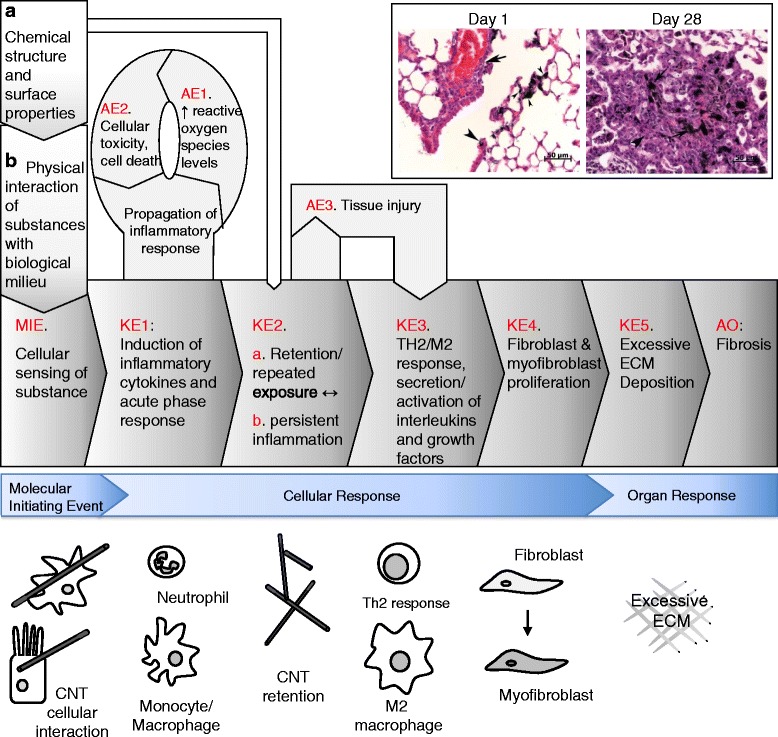
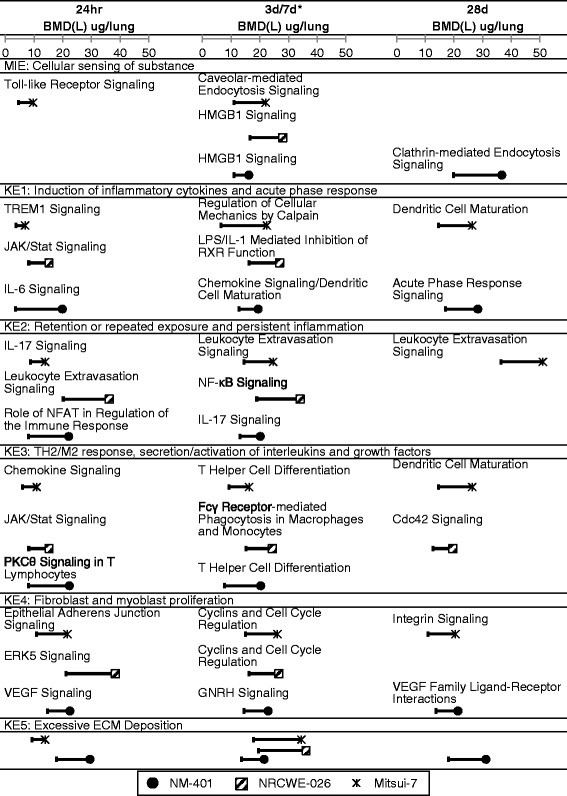
Gene expression profiles from the lungs of mice exposed to three individual MWCNTs with different physical-chemical properties were used within the framework of an adverse outcome pathway (AOP) for lung fibrosis to identify key biological events linking MWCNT exposure to lung fibrosis. Significantly perturbed pathways were categorized along the key events described in the AOP. Benchmark doses (BMDs) were calculated for each perturbed pathway and were used to derive transcriptional BMDs for each MWCNT.
Similar biological pathways were perturbed by the different MWCNT types across the doses and post-exposure time points studied. The pathway BMD values showed a time-dependent trend, with lower BMDs for pathways perturbed at the earlier post-exposure time points (24 h, 3d). The transcriptional BMDs were compared to the apical BMDs derived by the National Institute for Occupational Safety and Health (NIOSH) using alveolar septal thickness and fibrotic lesions endpoints. We found that regardless of the type of MWCNT, the BMD values for pathways associated with fibrosis were 14.0-30.4 μg/mouse, which are comparable to the BMDs derived by NIOSH for MWCNT-induced lung fibrotic lesions (21.0-27.1 μg/mouse).
The results demonstrate that transcriptomic data can be used to as an effective mechanism-based method to derive acceptable levels of exposure to nanomaterials in product development when epidemiological data are unavailable.
一类具有多种物理化学性质且在实验动物中显示出与毒理学效应相关的多种特性的工程纳米材料(ENM)正在商业使用。然而,尚未建立用于ENM的人类健康风险评估(HHRA)的综合框架。啮齿动物2年癌症生物测定、临床化学和组织病理学终点仍被视为检测动物模型中物质诱导毒性的“金标准”。然而,来自替代毒理学工具(如全基因组表达谱分析和体外高通量测定)的数据在危害识别和理解潜在作用模式方面正逐渐被监管机构所接受。在此,我们进行了一项案例研究,以评估全球基因表达数据在推导基于途径的多壁碳纳米管(MWCNT)诱导的肺纤维化(一种具有监管重要性的非癌症终点)的出发点(POD)方面的应用。
在肺纤维化的不良结局途径(AOP)框架内,使用来自暴露于三种具有不同物理化学性质的单个MWCNT的小鼠肺部的基因表达谱,以识别将MWCNT暴露与肺纤维化联系起来的关键生物学事件。沿着AOP中描述的关键事件对显著受干扰的途径进行分类。计算每个受干扰途径的基准剂量(BMD),并用于推导每种MWCNT的转录BMD。
在所研究的剂量和暴露后时间点,不同类型的MWCNT干扰了相似的生物学途径。途径BMD值显示出时间依赖性趋势,在暴露后较早时间点(24小时、3天)受干扰的途径的BMD较低。将转录BMD与美国国家职业安全与健康研究所(NIOSH)使用肺泡间隔厚度和纤维化病变终点得出的顶端BMD进行比较。我们发现,无论MWCNT的类型如何,与纤维化相关途径的BMD值为14.0 - 30.4μg/小鼠,这与NIOSH得出的MWCNT诱导的肺纤维化病变的BMD(21.0 - 27.1μg/小鼠)相当。
结果表明,当缺乏流行病学数据时,转录组数据可作为一种基于有效机制的方法,用于在产品开发中推导纳米材料的可接受暴露水平。