Si Xinxin, Liu Yue, Lv Jinghuan, Ding Haijian, Zhang Xin A, Shao Lipei, Yang Nan, Cheng He, Sun Luan, Zhu Dongliang, Yang Yin, Li Andi, Han Xiao, Sun Yujie
Key Laboratory of Human Functional Genomics of Jiangsu Province, Nanjing Medical University, Nanjing, Jiangsu, China.
Department of Cell Biology, Nanjing Medical University, Nanjing, Jiangsu, China.
Oncotarget. 2016 Apr 12;7(15):20966-80. doi: 10.18632/oncotarget.8038.
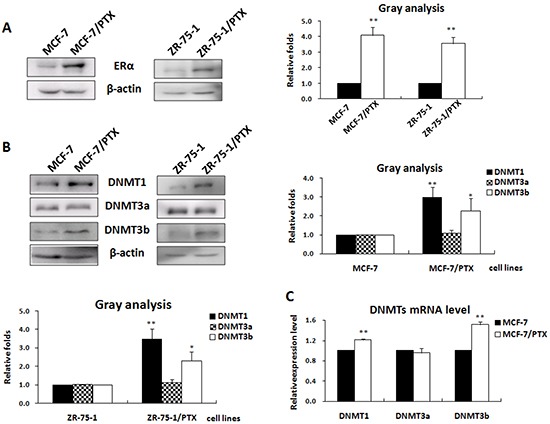
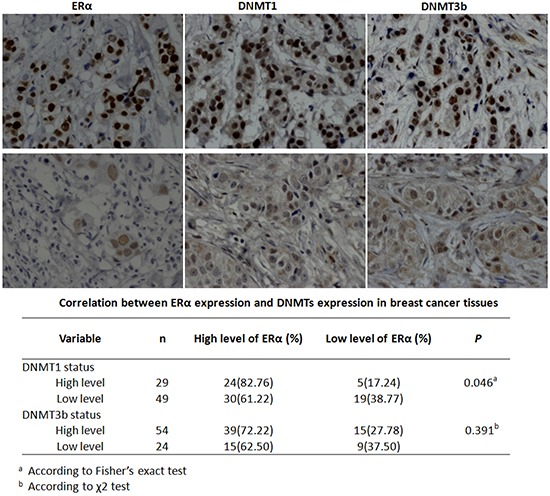
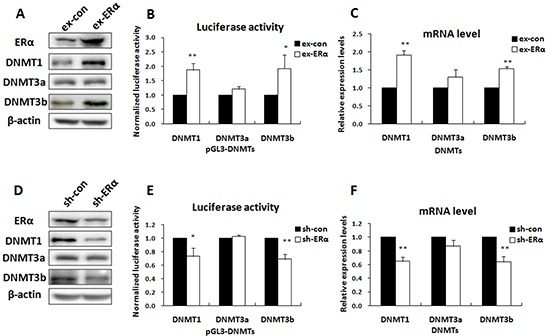
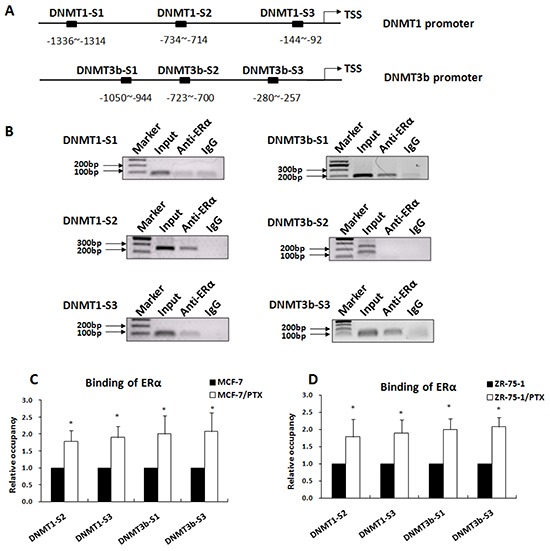
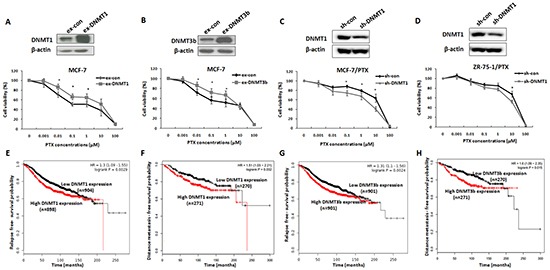
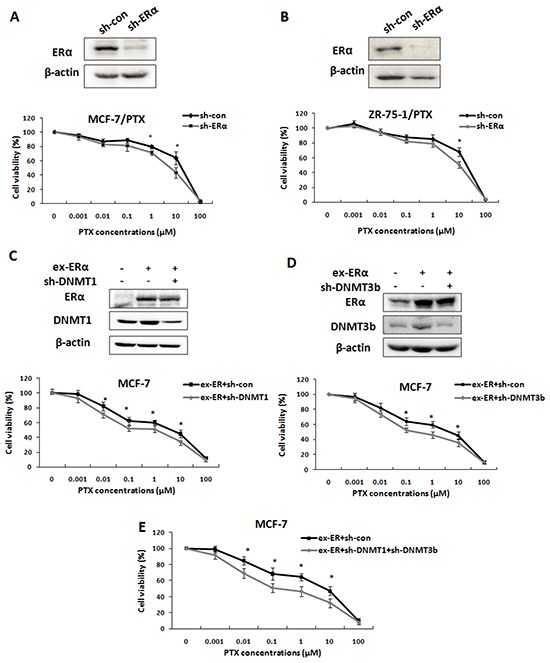
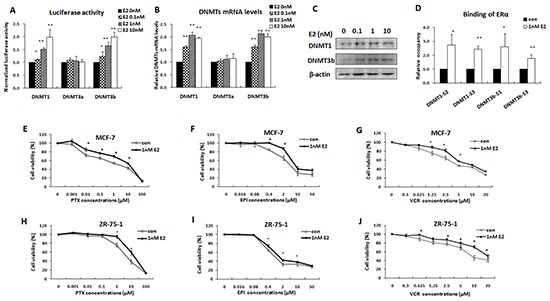
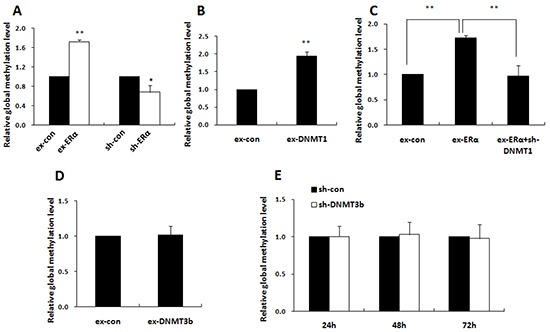
Drug-induced aberrant DNA methylation is the first identified epigenetic marker involved in chemotherapy resistance. Understanding how the aberrant DNA methylation is acquired would impact cancer treatment in theory and practice. In this study we systematically investigated whether and how ERα propelled aberrant global DNA hypermethylation in the context of breast cancer drug resistance. Our data demonstrated that anticancer drug paclitaxel (PTX) augmented ERα binding to the DNMT1 and DNMT3b promoters to activate DNMT1 and DNMT3b genes, enhancing the PTX resistance of breast cancer cells. In support of these observations, estrogen enhanced multi-drug resistance of breast cancer cells by up-regulation of DNMT1 and DNMT3b genes. Nevertheless, the aberrant global DNA hypermethylation was dominantly induced by ERα-activated-DNMT1, since DNMT1 over-expression significantly increased global DNA methylation and DNMT1 knockdown reversed the ERα-induced global DNA methylation. Altering DNMT3b expression had no detectable effect on global DNA methylation. Consistently, the expression level of DNMT1 was positively correlated with ERα in 78 breast cancer tissue samples shown by our immunohistochemistry (IHC) analysis and negatively correlated with relapse-free survival (RFS) and distance metastasis-free survival (DMFS) of ERα-positive breast cancer patients. This study provides a new perspective for understanding the mechanism underlying drug-resistance-facilitating aberrant DNA methylation in breast cancer and other estrogen dependent tumors.
药物诱导的异常DNA甲基化是首个被鉴定出与化疗耐药相关的表观遗传标志物。了解异常DNA甲基化是如何产生的,在理论和实践上都会对癌症治疗产生影响。在本研究中,我们系统地研究了在乳腺癌耐药背景下,雌激素受体α(ERα)是否以及如何推动整体异常DNA高甲基化。我们的数据表明,抗癌药物紫杉醇(PTX)增强了ERα与DNA甲基转移酶1(DNMT1)和DNA甲基转移酶3b(DNMT3b)启动子的结合,从而激活DNMT1和DNMT3b基因,增强了乳腺癌细胞对PTX的耐药性。支持这些观察结果的是,雌激素通过上调DNMT1和DNMT3b基因增强了乳腺癌细胞的多药耐药性。然而,整体异常DNA高甲基化主要是由ERα激活的DNMT1诱导的,因为DNMT1的过表达显著增加了整体DNA甲基化,而DNMT1的敲低逆转了ERα诱导的整体DNA甲基化。改变DNMT3b的表达对整体DNA甲基化没有可检测到的影响。同样,通过我们的免疫组织化学(IHC)分析显示,在78个乳腺癌组织样本中,DNMT1的表达水平与ERα呈正相关,与ERα阳性乳腺癌患者的无复发生存期(RFS)和无远处转移生存期(DMFS)呈负相关。本研究为理解乳腺癌和其他雌激素依赖性肿瘤中促进耐药的异常DNA甲基化的潜在机制提供了新的视角。