
适应性致死率:我们能从豚鼠适应性埃博拉病毒感染模型中学到什么。
Adapted Lethality: What We Can Learn from Guinea Pig-Adapted Ebola Virus Infection Model.
作者信息
Cheresiz S V, Semenova E A, Chepurnov A A
机构信息
Department of Medicine, Novosibirsk State University, Pirogova Street 2, 630090 Novosibirsk-90, Russia; Institute of Internal and Preventive Medicine, Bogatkova Street 175/1, 630089 Novosibirsk-89, Russia.
Institute of Clinical Immunology, Yadrincevskaya Street 14, 630047 Novosibirsk-47, Russia.
出版信息
Adv Virol. 2016;2016:8059607. doi: 10.1155/2016/8059607. Epub 2016 Feb 18.
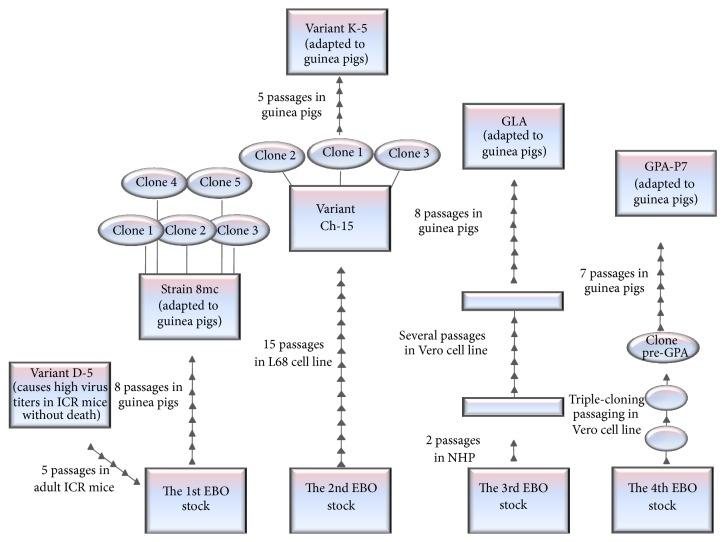
Establishment of small animal models of Ebola virus (EBOV) infection is important both for the study of genetic determinants involved in the complex pathology of EBOV disease and for the preliminary screening of antivirals, production of therapeutic heterologic immunoglobulins, and experimental vaccine development. Since the wild-type EBOV is avirulent in rodents, the adaptation series of passages in these animals are required for the virulence/lethality to emerge in these models. Here, we provide an overview of our several adaptation series in guinea pigs, which resulted in the establishment of guinea pig-adapted EBOV (GPA-EBOV) variants different in their characteristics, while uniformly lethal for the infected animals, and compare the virologic, genetic, pathomorphologic, and immunologic findings with those obtained in the adaptation experiments of the other research groups.
建立埃博拉病毒(EBOV)感染的小动物模型,对于研究EBOV疾病复杂病理过程中涉及的遗传决定因素,以及抗病毒药物的初步筛选、治疗性异种免疫球蛋白的生产和实验性疫苗的开发都很重要。由于野生型EBOV在啮齿动物中无致病性,因此需要在这些动物中进行适应性传代系列,以使这些模型中出现毒力/致死性。在此,我们概述了我们在豚鼠中的几个适应性传代系列,这些传代系列导致建立了特性不同的豚鼠适应性EBOV(GPA-EBOV)变体,虽然对感染动物均具有致死性,但我们将其病毒学、遗传学、病理形态学和免疫学结果与其他研究小组在适应性实验中获得的结果进行了比较。



 Zotero 插件