Cao Ya-Nan, Comes Hans Peter, Sakaguchi Shota, Chen Lu-Yao, Qiu Ying-Xiong
Key Laboratory of Conservation Biology for Endangered Wildlife of the Ministry of Education, and College of Life Sciences, Zhejiang University, Hangzhou, 310058, China.
Department of Ecology & Evolution, Salzburg University, A-5020, Salzburg, Austria.
BMC Evol Biol. 2016 Mar 22;16:66. doi: 10.1186/s12862-016-0636-x.
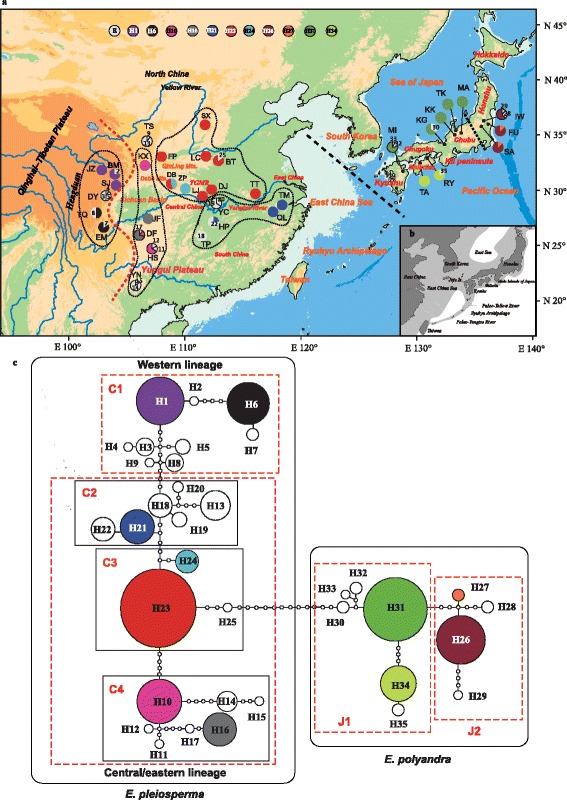
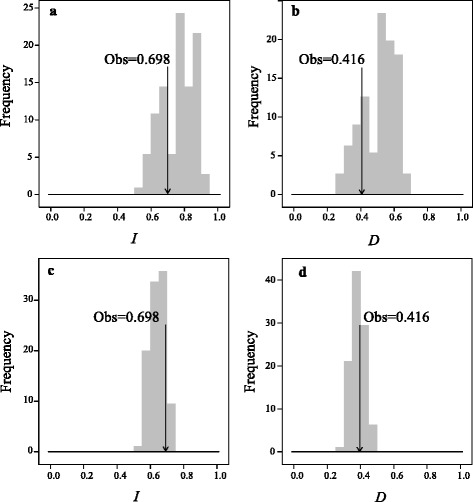
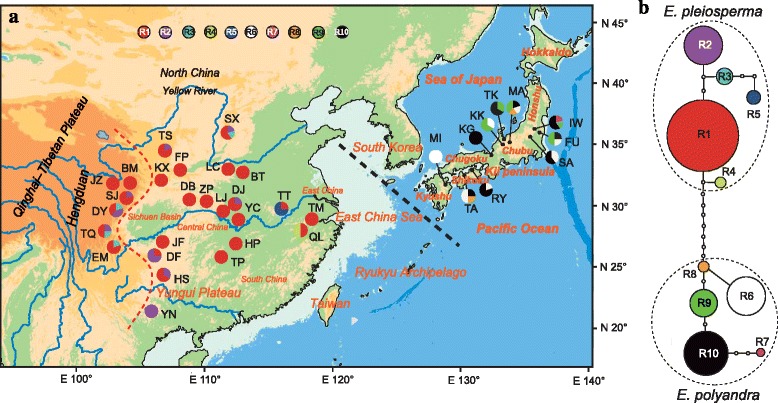
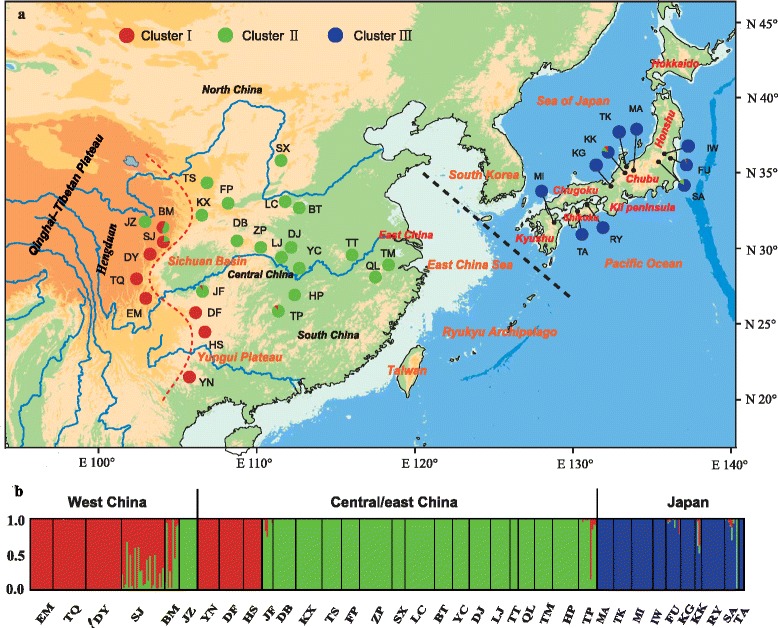
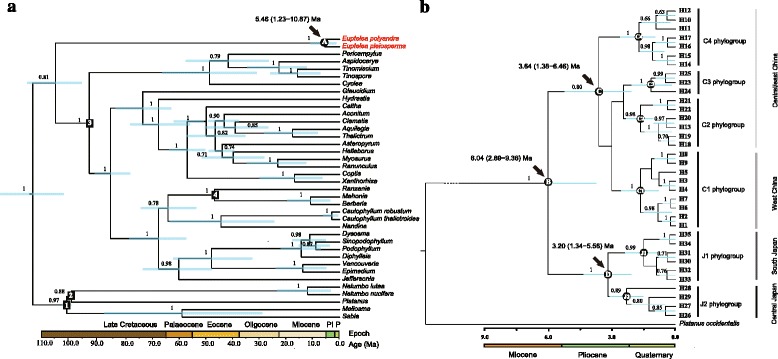
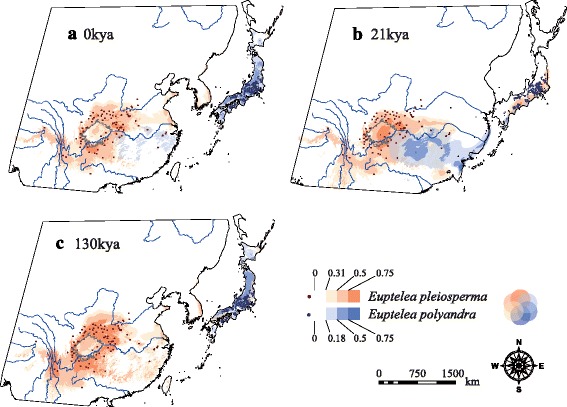
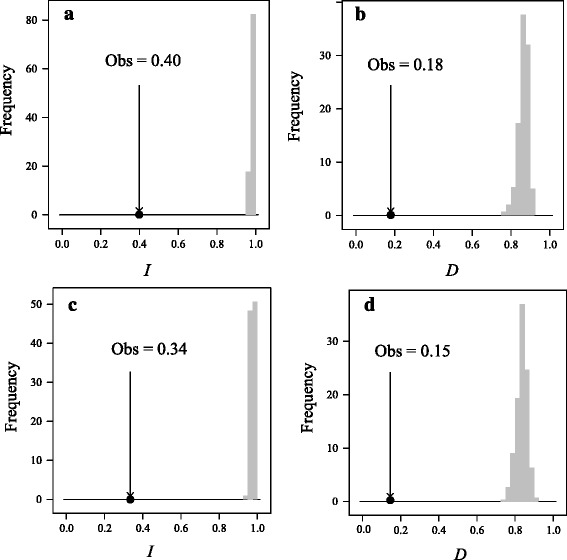
The evolutionary origin and historical demography of extant Arcto-Tertiary forest species in East Asia is still poorly understood. Here, we reconstructed the evolutionary and population demographic history of the two extant Euptelea species in China (E. pleiosperma) and Japan (E. polyandra). Chloroplast/nuclear DNA sequences and microsatellite loci were obtained from 36 Euptelea populations to explore molecular structure and diversity in relation to past and present distributions based on ecological niche modelling (ENM). Time-calibrated phylogenetic/phylogeographic inferences and niche-identity tests were used to infer the historical process of lineage formation.
Euptelea pleiosperma diverged from E. polyandra around the Late Miocene and experienced significant ecological differentiation. A near-simultaneous diversification of six phylogroups occurred during the mid-to-late Pliocene, in response to the abrupt uplift of the eastern Tibetan Plateau and an increasingly cooler and drier climate. Populations of E. pleiosperma seem to have been mostly stationary through the last glacial cycles, while those of E. polyandra reflect more recent climate-induced cycles of range contraction and expansion.
Our results illustrate how Late Neogene climatic/tectonic changes promoted speciation and lineage diversification in East Asia's Tertiary relict flora. They also demonstrate for the first time a greater variation in such species' responses to glacial cycles in Japan when compared to congeners in China.
东亚现存北极第三纪森林物种的进化起源和历史种群统计学仍知之甚少。在此,我们重建了中国现存的两种领春木属物种(多籽领春木)和日本现存的领春木属物种(领春木)的进化和种群统计历史。从36个领春木种群中获取叶绿体/核DNA序列和微卫星位点,基于生态位建模(ENM)探索与过去和现在分布相关的分子结构和多样性。使用时间校准的系统发育/系统地理学推断和生态位同一性测试来推断谱系形成的历史过程。
多籽领春木在晚中新世左右与领春木分化,并经历了显著的生态分化。在上新世中期至晚期,由于青藏高原东部的突然隆升以及气候日益变冷变干,六个系统发育类群几乎同时发生了多样化。多籽领春木的种群在末次冰期循环中似乎大多保持稳定,而领春木的种群则反映了最近由气候引起的范围收缩和扩张循环。
我们的结果说明了晚第三纪气候/构造变化如何促进了东亚第三纪残遗植物区系的物种形成和谱系多样化。它们还首次证明,与中国的同属物种相比,此类物种在日本对冰期循环的反应存在更大差异。