Yamashita Shimpei, Kohjimoto Yasuo, Iguchi Takashi, Koike Hiroyuki, Kusumoto Hiroki, Iba Akinori, Kikkawa Kazuro, Kodama Yoshiki, Matsumura Nagahide, Hara Isao
Department of Urology, Wakayama Medical University, 811-1 Kimiidera, Wakayama, 641-0012, Japan.
BMC Urol. 2016 Mar 22;16:13. doi: 10.1186/s12894-016-0133-y.
While novel drugs have been developed, docetaxel remains one of the standard initial systemic therapies for castration-resistant prostate cancer (CRPC) patients. Despite the excellent anti-tumor effect of docetaxel, its severe adverse effects sometimes distress patients. Therefore, it would be very helpful to predict the efficacy of docetaxel before treatment. The aims of this study were to evaluate the potential value of patient characteristics in predicting overall survival (OS) and to develop a risk classification for CRPC patients treated with docetaxel-based chemotherapy.
This study included 79 patients with CRPC treated with docetaxel. The variables, including patient characteristics at diagnosis and at the start of chemotherapy, were retrospectively collected. Prognostic factors predicting OS were analyzed using the Cox proportional hazard model. Risk stratification for overall survival was determined based on the results of multivariate analysis.
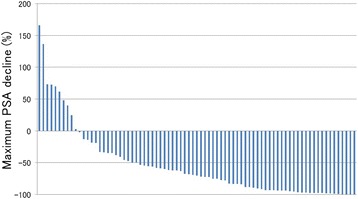
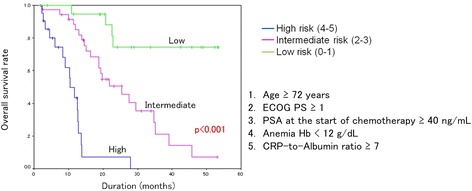
PSA response ≥50 % was observed in 55 (69.6 %) of all patients, and the median OS was 22.5 months. The multivariate analysis showed that age, serum PSA level at the start of chemotherapy, and Hb were independent prognostic factors for OS. In addition, ECOG performance status (PS) and the CRP-to-albumin ratio were not significant but were considered possible predictors for OS. Risk stratification according to the number of these risk factors could effectively stratify CRPC patients treated with docetaxel in terms of OS.
Age, serum PSA level at the start of chemotherapy, and Hb were identified as independent prognostic factors of OS. ECOG PS and the CRP-to-albumin ratio were not significant, but were considered possible predictors for OS in Japanese CRPC patients treated with docetaxel. Risk stratification based on these factors could be helpful for estimating overall survival.
尽管已研发出新型药物,但多西他赛仍是去势抵抗性前列腺癌(CRPC)患者标准的初始全身治疗方法之一。尽管多西他赛具有出色的抗肿瘤效果,但其严重的不良反应有时会困扰患者。因此,在治疗前预测多西他赛的疗效将非常有帮助。本研究的目的是评估患者特征在预测总生存期(OS)方面的潜在价值,并为接受基于多西他赛化疗的CRPC患者制定风险分类。
本研究纳入了79例接受多西他赛治疗的CRPC患者。回顾性收集包括诊断时和化疗开始时患者特征在内的变量。使用Cox比例风险模型分析预测OS的预后因素。根据多变量分析结果确定总生存期的风险分层。
所有患者中有55例(69.6%)观察到PSA反应≥50%,中位OS为22.5个月。多变量分析显示,年龄、化疗开始时的血清PSA水平和血红蛋白(Hb)是OS的独立预后因素。此外,东部肿瘤协作组(ECOG)体能状态(PS)和CRP与白蛋白比值虽不显著,但被认为可能是OS的预测指标。根据这些风险因素的数量进行风险分层,可以有效地对接受多西他赛治疗的CRPC患者的OS进行分层。
年龄、化疗开始时的血清PSA水平和Hb被确定为OS的独立预后因素。ECOG PS和CRP与白蛋白比值虽不显著,但被认为可能是接受多西他赛治疗的日本CRPC患者OS的预测指标。基于这些因素的风险分层有助于估计总生存期。