Peeters Mieke J, van den Brand Jan Ajg, van Zuilen Arjan D, Koster Yelka, Bots Michiel L, Vervloet Marc G, Blankestijn Peter J, Wetzels Jack Fm
464 Department of Nephrology, Radboud University Medical Center, PO box 9101, 6500 HB, Nijmegen, The Netherlands.
Department of Nephrology, University Medical Center Utrecht, Utrecht, The Netherlands.
J Nephrol. 2017 Feb;30(1):109-118. doi: 10.1007/s40620-015-0260-7. Epub 2016 Mar 22.
Abdominal aortic calcification (AAC) is independently associated with cardiovascular events in dialysis patients and in the general population. However, data in non-dialysis chronic kidney disease (CKD) patients are limited. We analyzed determinants and prognostic value of AAC in non-dialysis CKD patients.
We included patients with CKD not receiving renal replacement therapy from the MASTERPLAN study, a randomized controlled trial that started in 2004. In the period 2008-2009, an X-ray to evaluate AAC was performed in a subgroup of patients. We studied AAC using a semi-quantitative scoring system by lateral lumbar X-ray. We used baseline and 2-year data to find determinants of AAC. We used a composite cardiovascular endpoint and propensity score matching to evaluate the prognostic value of AAC.
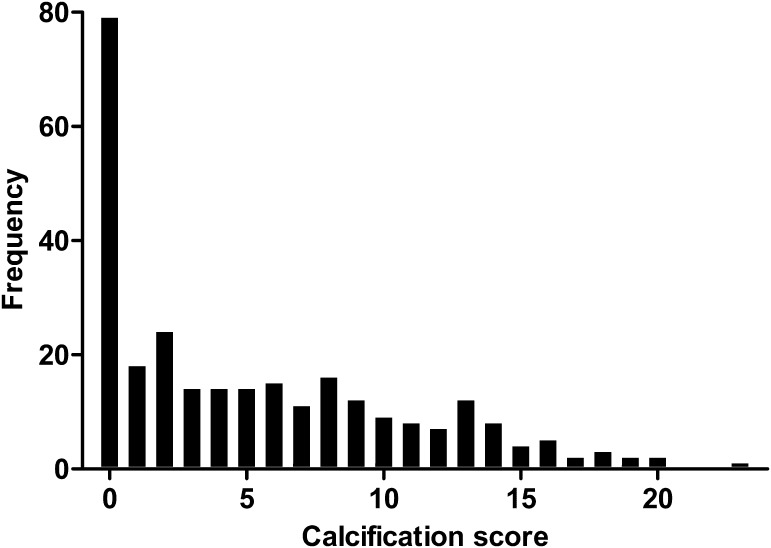
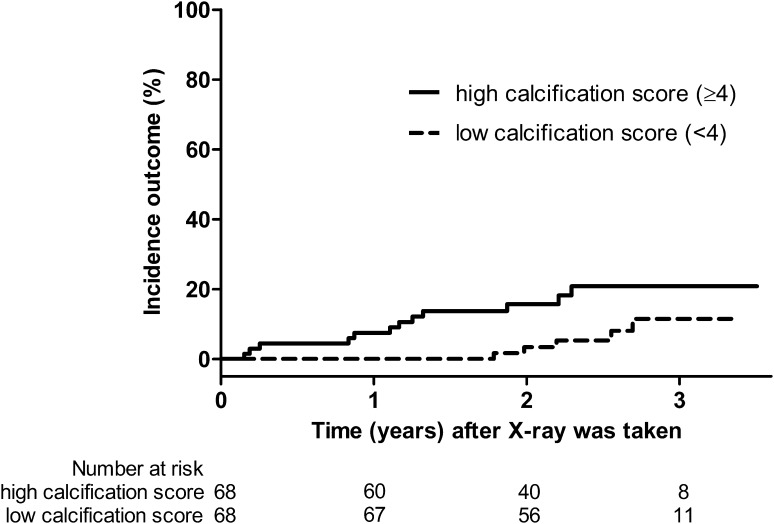
In 280 patients an X-ray was performed. In 79 patients (28 %) the X-ray showed no calcification, in 62 patients (22 %) calcification was minor (<4), while 139 patients (50 %) had moderate or heavy calcification (≥4). Older age, prior cardiovascular disease, higher triglyceride levels, and higher phosphate levels were independent determinants of a calcification score ≥4. AAC score ≥4 was independently associated with cardiovascular events, with a hazard ratio of 5.5 (95 % confidence interval 1.2-24.8).
Assessment of AAC can identify CKD patients at higher cardiovascular risk, and may provide important information for personalized treatment. Whether this approach will ultimately translate into better outcomes remains to be answered.
腹主动脉钙化(AAC)与透析患者及普通人群的心血管事件独立相关。然而,非透析慢性肾脏病(CKD)患者的数据有限。我们分析了非透析CKD患者中AAC的决定因素及预后价值。
我们纳入了来自MASTERPLAN研究的未接受肾脏替代治疗的CKD患者,该研究是一项始于2004年的随机对照试验。在2008 - 2009年期间,对部分患者进行了评估AAC的X线检查。我们通过腰椎侧位X线采用半定量评分系统研究AAC。我们使用基线数据和2年数据来寻找AAC的决定因素。我们使用复合心血管终点和倾向评分匹配来评估AAC的预后价值。
对280例患者进行了X线检查。79例患者(28%)的X线显示无钙化,62例患者(22%)钙化轻微(<4),而139例患者(50%)有中度或重度钙化(≥4)。年龄较大、既往有心血管疾病、甘油三酯水平较高和磷酸盐水平较高是钙化评分≥4的独立决定因素。AAC评分≥4与心血管事件独立相关,风险比为5.5(95%置信区间1.2 - 24.8)。
对AAC的评估可识别心血管风险较高的CKD患者,并可能为个性化治疗提供重要信息。这种方法最终是否会带来更好的结果仍有待解答。