Taylor Janet L, Amann Markus, Duchateau Jacques, Meeusen Romain, Rice Charles L
1Neuroscience Research Australia, Sydney, AUSTRALIA; 2School of Medical Sciences, the University of New South Wales, Sydney, AUSTRALIA; 3Department of Medicine, University of Utah, Salt Lake City, UT; 4Laboratory of Applied Biology and Neurophysiology, ULB Neuroscience Institute, Université Libre de Bruxelles, Brussels, BELGIUM; 5Human Physiology Research Group Vrije Universiteit Brussel, Brussels, BELGIUM; 6School of Public Health, Tropical Medicine and Rehabilitation Sciences, James Cook University, Queensland, AUSTRALIA; and 7School of Kinesiology, and Department of Anatomy and Cell Biology, The University of Western Ontario, London, CANADA.
Med Sci Sports Exerc. 2016 Nov;48(11):2294-2306. doi: 10.1249/MSS.0000000000000923.
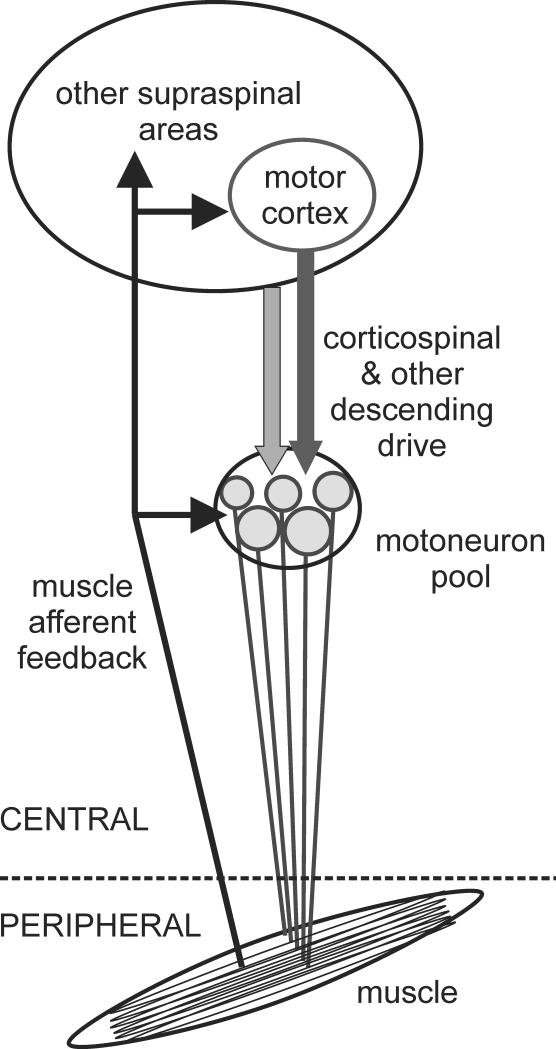
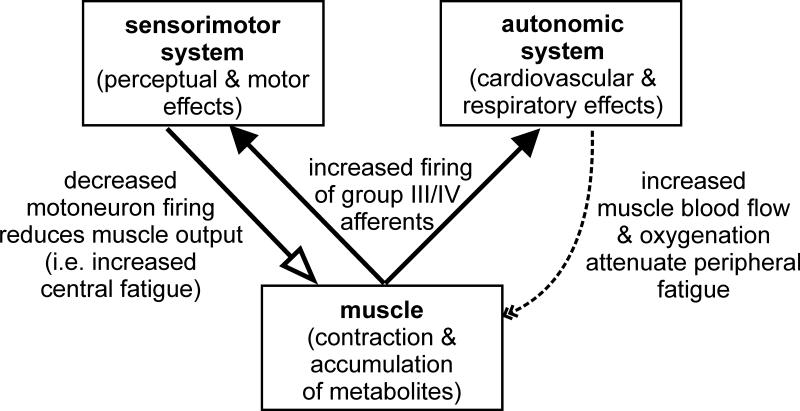
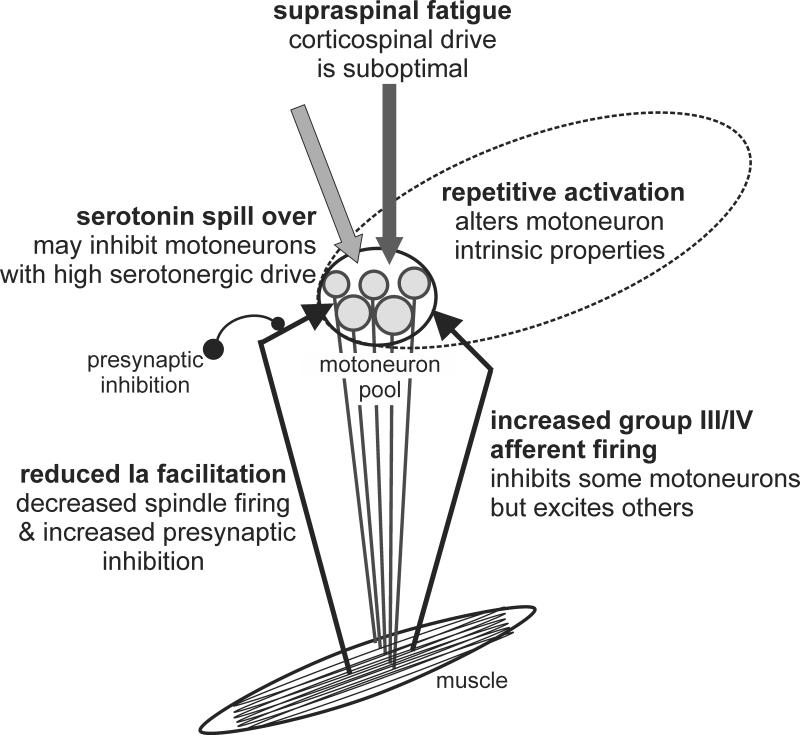
: During exercise, there is a progressive reduction in the ability to produce muscle force. Processes within the nervous system as well as within the muscles contribute to this fatigue. In addition to impaired function of the motor system, sensations associated with fatigue and impairment of homeostasis can contribute to the impairment of performance during exercise. This review discusses some of the neural changes that accompany exercise and the development of fatigue. The role of brain monoaminergic neurotransmitter systems in whole-body endurance performance is discussed, particularly with regard to exercise in hot environments. Next, fatigue-related alterations in the neuromuscular pathway are discussed in terms of changes in motor unit firing, motoneuron excitability, and motor cortical excitability. These changes have mostly been investigated during single-limb isometric contractions. Finally, the small-diameter muscle afferents that increase firing with exercise and fatigue are discussed. These afferents have roles in cardiovascular and respiratory responses to exercise, and in the impairment of exercise performance through interaction with the motor pathway, as well as in providing sensations of muscle discomfort. Thus, changes at all levels of the nervous system, including the brain, spinal cord, motor output, sensory input, and autonomic function, occur during exercise and fatigue. The mix of influences and the importance of their contribution vary with the type of exercise being performed.
在运动过程中,产生肌肉力量的能力会逐渐下降。神经系统以及肌肉内部的过程都会导致这种疲劳。除了运动系统功能受损外,与疲劳和内环境稳态受损相关的感觉也会导致运动过程中表现的下降。本综述讨论了运动及疲劳发展过程中伴随的一些神经变化。讨论了脑单胺能神经递质系统在全身耐力表现中的作用,特别是在炎热环境中的运动。接下来,从运动单位放电、运动神经元兴奋性和运动皮层兴奋性的变化方面讨论了神经肌肉通路中与疲劳相关的改变。这些变化大多是在单肢等长收缩过程中进行研究的。最后,讨论了随着运动和疲劳而增加放电的小直径肌肉传入神经。这些传入神经在运动的心血管和呼吸反应中发挥作用,通过与运动通路相互作用影响运动表现,还会产生肌肉不适感。因此,在运动和疲劳过程中,神经系统的各个层面,包括大脑、脊髓、运动输出、感觉输入和自主功能,都会发生变化。各种影响因素的组合及其贡献的重要性会因所进行的运动类型而异。