Kamat Rujvi, Doyle Katie L, Iudicello Jennifer E, Morgan Erin E, Morris Sheldon, Smith Davey M, Little Susan J, Grant Igor, Woods Steven Paul
Departments of *Psychiatry ‡Medicine, University of California, San Diego, La Jolla, California †San Diego University/University of California, San Diego Joint Doctoral Program in Clinical Psychology, San Diego, California §Veterans Affairs Healthcare System, San Diego, California ∥Department of Psychology, University of Houston, Houston, Texas.
Cogn Behav Neurol. 2016 Mar;29(1):1-10. doi: 10.1097/WNN.0000000000000084.
Acute and early human immunodeficiency virus infection (AEH) is accompanied by neuroinflammatory processes as well as impairment in neurocognitive and everyday functions, but little is known about the frequency and clinical correlates of the neurobehavioral disturbances during this period. We compared pre-seroconversion with current levels of apathy, disinhibition, and executive dysfunction; we also examined everyday function and HIV disease correlates of neuropsychiatric impairment in individuals with AEH.
In this study, 34 individuals with AEH and 39 HIV-seronegative participants completed neuromedical and neuropsychological assessments, a structured psychiatric interview, and the apathy, disinhibition, and executive dysfunction subscales of the Frontal Systems Behavioral Scale.
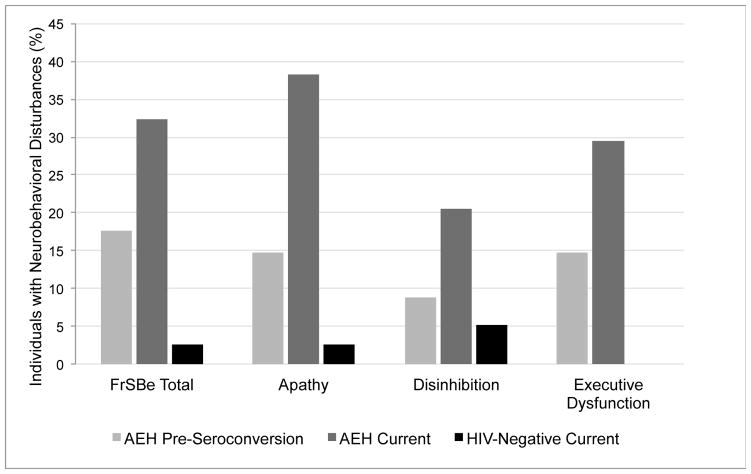
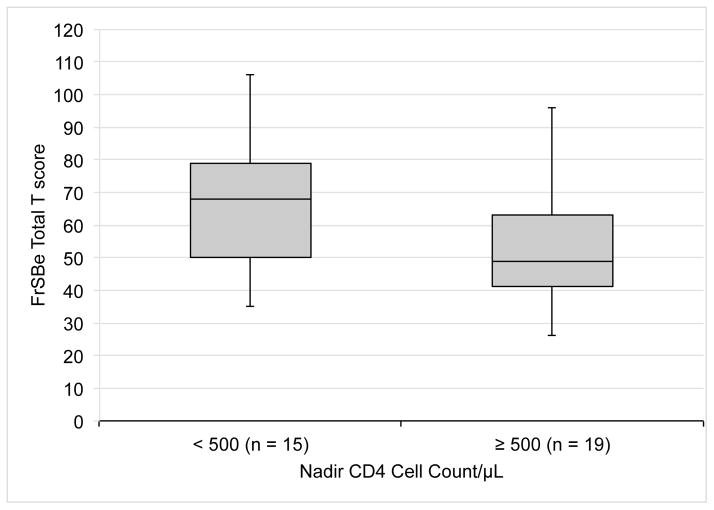
Independent of any substance use and mood disorders, the AEH group had significantly higher levels of current apathy and executive dysfunction than the controls, but not greater disinhibition. Retrospective ratings of pre-seroconversion levels of apathy, disinhibition, and executive dysfunction were all higher in the AEH group than the controls. After seroconversion, the AEH cohort had increases in current apathy and executive dysfunction, but not disinhibition. In the AEH cohort, higher current global neurobehavioral dysfunction was significantly associated with lower nadir CD4 counts, slowed information processing speed, and more everyday function problems.
These data suggest that individuals who have recently acquired HIV experienced higher-than-normal premorbid levels of neurobehavioral disturbance. Apathy and executive dysfunction are exacerbated during AEH, particularly in association with lower CD4 counts.
急性和早期人类免疫缺陷病毒感染(AEH)伴有神经炎症过程以及神经认知和日常功能损害,但在此期间神经行为障碍的发生率及其临床相关因素却鲜为人知。我们比较了血清转化前与当前的冷漠、去抑制和执行功能障碍水平;我们还研究了AEH患者神经精神损害的日常功能及与HIV疾病的相关性。
在本研究中,34例AEH患者和39例HIV血清阴性参与者完成了神经医学和神经心理学评估、结构化精神科访谈以及额叶系统行为量表的冷漠、去抑制和执行功能障碍分量表测试。
在不考虑任何物质使用和情绪障碍的情况下,AEH组当前的冷漠和执行功能障碍水平显著高于对照组,但去抑制水平无差异。AEH组血清转化前的冷漠、去抑制和执行功能障碍回顾性评分均高于对照组。血清转化后,AEH队列中当前的冷漠和执行功能障碍有所增加,但去抑制无变化。在AEH队列中,当前较高的整体神经行为功能障碍与更低的CD4细胞计数最低点、信息处理速度减慢以及更多的日常功能问题显著相关。
这些数据表明,近期感染HIV的个体病前神经行为障碍水平高于正常。在AEH期间,冷漠和执行功能障碍会加剧,尤其是与较低的CD4细胞计数相关时。