Department of Psychiatry, University of California, San Diego, CA, United States.
Department of Psychiatry, University of California, San Diego, CA, United States; Veterans Administration San Diego Healthcare System, San Diego, CA, United States.
Psychiatry Res. 2014 Jan 30;215(1):208-16. doi: 10.1016/j.psychres.2013.11.004. Epub 2013 Nov 13.
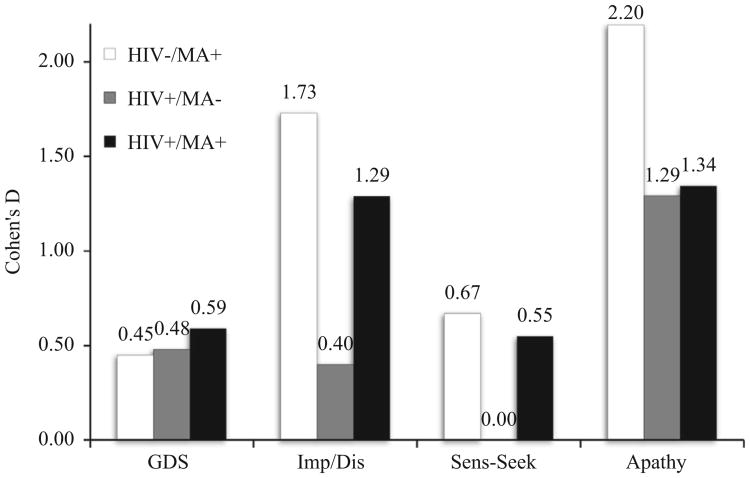
Human immunodeficiency virus (HIV) infection and methamphetamine (MA) dependence are associated with neural injury preferentially involving frontostriatal circuits. Little is known, however, about how these commonly comorbid conditions impact behavioral presentations typically associated with frontal systems dysfunction. Our sample comprised 47 HIV-uninfected/MA-nondependent; 25 HIV-uninfected/MA-dependent; 36 HIV-infected/MA-nondependent; and 28 HIV-infected/MA-dependent subjects. Participants completed self-report measures of "frontal systems" behaviors, including impulsivity/disinhibition, sensation-seeking, and apathy. They also underwent comprehensive neurocognitive and neuropsychiatric assessments that allowed for detailed characterization of neurocognitive deficits and comorbid/premorbid conditions, including lifetime Mood and Substance Use Disorders, Attention-Deficit/Hyperactivity Disorder, and Antisocial Personality Disorder. Multivariable regression models adjusting for potential confounds (i.e., demographics and comorbid/premorbid conditions) showed that MA dependence was independently associated with increased impulsivity/disinhibition, sensation-seeking and apathy, and HIV infection with greater apathy. However, we did not see synergistic/additive effects of HIV and MA on frontal systems behaviors. Global neurocognitive impairment was relatively independent of the frontal systems behaviors, which is consistent with the view that these constructs may have relatively separable biopsychosocial underpinnings. Future research should explore whether both neurocognitive impairment and frontal systems behaviors may independently contribute to everyday functioning outcomes relevant to HIV and MA.
人类免疫缺陷病毒(HIV)感染和甲基苯丙胺(MA)依赖与神经损伤有关,这些损伤主要涉及额皮质-纹状体回路。然而,人们对这些常见的共病条件如何影响与额皮质系统功能障碍相关的行为表现知之甚少。我们的样本包括 47 名未感染 HIV/未依赖 MA 的个体、25 名未感染 HIV/依赖 MA 的个体、36 名感染 HIV/未依赖 MA 的个体和 28 名感染 HIV/依赖 MA 的个体。参与者完成了“额皮质系统”行为的自我报告测量,包括冲动/抑制失调、寻求刺激和冷漠。他们还接受了全面的神经认知和神经精神评估,以便详细描述神经认知缺陷和共病/前驱疾病,包括终生情绪和物质使用障碍、注意力缺陷/多动障碍和反社会人格障碍。调整潜在混杂因素(即人口统计学和共病/前驱疾病)的多变量回归模型显示,MA 依赖与冲动/抑制失调、寻求刺激和冷漠的增加独立相关,而 HIV 感染与更大的冷漠相关。然而,我们没有看到 HIV 和 MA 对额皮质系统行为的协同/附加效应。总体神经认知障碍与额皮质系统行为相对独立,这与这些结构可能具有相对独立的生物心理社会基础的观点一致。未来的研究应该探讨神经认知障碍和额皮质系统行为是否都可能独立影响与 HIV 和 MA 相关的日常功能结果。