Cruz Hernández Sergio Isaac de la, Puerta-Guardo Henry Nelson, Flores Aguilar Hilario, González Mateos Silvia, López Martinez Irma, Ortiz-Navarrete Vianney, Ludert Juan E, Angel Rosa María del
Departamento de Virología, Instituto de Diagnóstico y Referencia Epidemiológicos, México, DF, México.
Departamento de Infectómica y Patogénesis Molecular, Instituto Politécnico Nacional, Centro de Investigación y Estudios Avanzados, México, DF, México.
Mem Inst Oswaldo Cruz. 2016 Mar;111(3):161-7. doi: 10.1590/0074-02760150359.
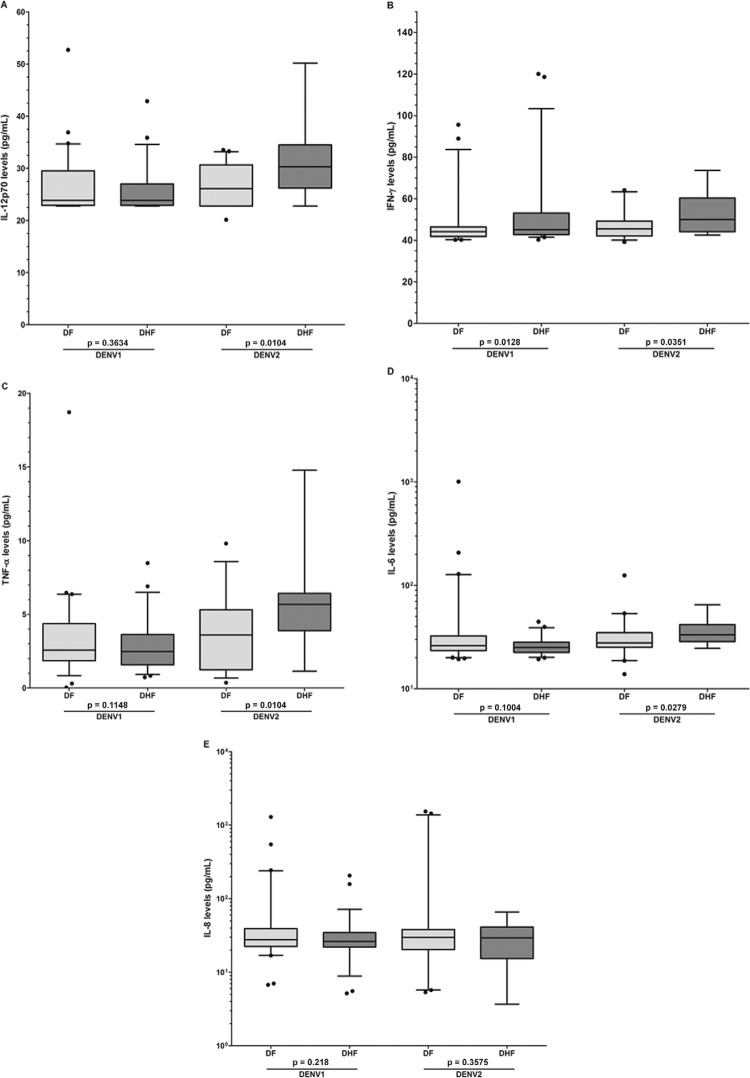
Severe dengue pathogenesis is not fully understood, but high levels of proinflammatory cytokines have been associated with dengue disease severity. In this study, the cytokine levels in 171 sera from Mexican patients with primary dengue fever (DF) and dengue haemorrhagic fever (DHF) from dengue virus (DENV) 1 (n = 116) or 2 (n = 55) were compared. DF and DHF were defined according to the patient's clinical condition, the primary infections as indicated by IgG enzymatic immunoassay negative results, and the infecting serotype as assessed by real-time reverse transcription-polymerase chain reaction. Samples were analysed for circulating levels of interleukin (IL)-12p70, interferon (IFN)-γ, tumour necrosis factor (TNF)-α, IL-6, and IL-8 using a commercial cytometric bead array. Significantly higher IFN-γ levels were found in patients with DHF than those with DF. However, significantly higher IL-12p70, TNF-α, and IL-6 levels were associated with DHF only in patients who were infected with DENV2 but not with DENV1. Moreover, patients with DF who were infected with DENV1 showed higher levels of IL-12p70, TNF-α, and IL-6 than patients with DHF early after-fever onset. The IL-8 levels were similar in all cases regardless of the clinical condition or infection serotype. These results suggest that the association between high proinflammatory cytokine levels and dengue disease severity does not always stand, and it once again highlights the complex nature of DHF pathogenesis.
严重登革热的发病机制尚未完全明确,但促炎细胞因子水平升高与登革热疾病严重程度相关。在本研究中,比较了171例来自墨西哥的原发性登革热(DF)和登革出血热(DHF)患者血清中的细胞因子水平,这些患者感染的登革病毒(DENV)为1型(n = 116)或2型(n = 55)。DF和DHF根据患者的临床状况、IgG酶免疫测定阴性结果所表明的原发性感染以及实时逆转录-聚合酶链反应评估的感染血清型来定义。使用商业细胞计数珠阵列分析样本中白细胞介素(IL)-12p70、干扰素(IFN)-γ、肿瘤坏死因子(TNF)-α、IL-6和IL-8的循环水平。发现DHF患者的IFN-γ水平显著高于DF患者。然而,仅在感染DENV2而非DENV1的患者中,IL-12p70、TNF-α和IL-6水平显著升高与DHF相关。此外,感染DENV1的DF患者在发热发作后早期的IL-12p70、TNF-α和IL-6水平高于DHF患者。无论临床状况或感染血清型如何,所有病例中的IL-8水平均相似。这些结果表明,促炎细胞因子水平升高与登革热疾病严重程度之间的关联并非总是成立,这再次凸显了DHF发病机制的复杂性。