Ball Sarah L, Greenhalgh Joanne, Roland Martin
RAND Europe, Westbrook Centre, Milton Road, Cambridge, CB4 1YG, UK.
School of Sociology and Social Policy, University of Leeds, LEEDS, LS2 9JT, UK.
BMC Fam Pract. 2016 Mar 24;17:37. doi: 10.1186/s12875-016-0434-y.
The rising volume of referrals to secondary care is a continuing concern in the NHS in England, with considerable resource implications. Referral management centres (RMCs) are one of a range of initiatives brought in to curtail this rise, but there is currently limited evidence for their effectiveness, and little is known about their mechanisms of action. This study aimed to gain a better understanding of how RMCs operate and the factors contributing to the achievement of their goals. Drawing on the principles of realist evaluation, we sought to elicit programme theories (the ideas and assumptions about how a programme works) and to identify the key issues to be considered when establishing or evaluating such schemes.
Qualitative study with a purposive sample of health professionals and managers involved in the commissioning, set-up and running of four referral management centres in England and with GPs referring through these centres. Semi-structured interviews were conducted with 18 participants. Interviews were audio-recorded and transcribed. Data were analysed thematically.
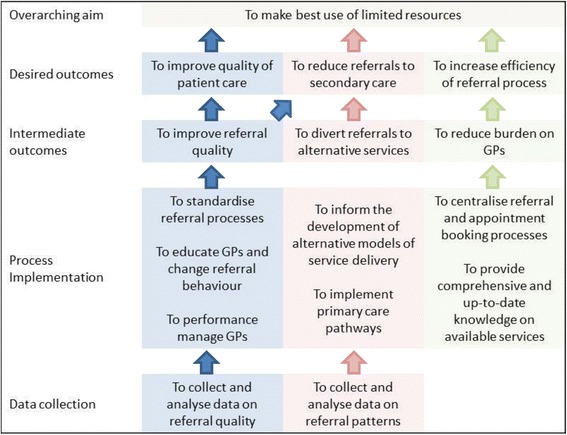
Interview data highlighted the diverse aims and functions of RMCs, reflecting a range of underlying programme theories. These included the overarching theory that RMCs work by ensuring the best use of limited resources and three sub-theories, relating to how this could be achieved, namely, improving the quality of referrals and patient care, reducing referrals, and increasing efficiency in the referral process. The aims of the schemes, however, varied between sites and between stakeholders, and evolved significantly over time. Three themes were identified relating to the context in which RMCs were implemented and managed: the impact of practical and administrative difficulties; the importance and challenge of stakeholder buy-in; and the dependence of perceived effectiveness on the aims and priorities of the scheme. Many RMCs were described as successful by those involved, despite limited evidence of reduced referrals or cost-savings.
The findings of this study have a number of implications for the development of similar schemes, with respect to the need to ensure clarity of aims and to identify indicators of success from the outset, to anticipate scheme evolution and plan for potential changes with respect to IT systems and referral processes. Also identified, is the need for further research that evaluates the effectiveness and cost effectiveness of particular models of RMC.
转介至二级医疗服务机构的数量不断增加,这一直是英格兰国民医疗服务体系(NHS)持续关注的问题,且涉及大量资源。转诊管理中心(RMC)是为遏制这一增长而采取的一系列举措之一,但目前关于其有效性的证据有限,对其作用机制也知之甚少。本研究旨在更好地了解RMC的运作方式以及促成其目标实现的因素。基于现实主义评估原则,我们试图引出项目理论(关于项目如何运作的理念和假设),并确定在建立或评估此类计划时需要考虑的关键问题。
对参与英格兰四个转诊管理中心的委托、设立和运营的卫生专业人员及管理人员,以及通过这些中心进行转诊的全科医生进行了有目的抽样的定性研究。对18名参与者进行了半结构化访谈。访谈进行了录音并转录。对数据进行了主题分析。
访谈数据突出了RMC的不同目标和功能,反映了一系列潜在的项目理论。其中包括总体理论,即RMC通过确保有限资源的最佳利用来发挥作用,以及三个子理论,涉及如何实现这一目标,即提高转诊质量和患者护理水平、减少转诊以及提高转诊过程的效率。然而,这些计划的目标在不同地点和利益相关者之间存在差异,并且随着时间的推移有显著演变。确定了与RMC实施和管理背景相关的三个主题:实际和行政困难的影响;利益相关者认可的重要性和挑战;以及感知到的有效性对计划目标和优先事项的依赖性。尽管减少转诊或节省成本的证据有限,但许多参与其中的人将许多RMC描述为成功的。
本研究的结果对类似计划的发展有诸多启示,包括需要从一开始就确保目标明确并确定成功指标,预测计划演变并针对信息技术系统和转诊流程的潜在变化制定计划。还确定需要进一步研究评估特定模式的RMC的有效性和成本效益。