
脂多糖和肿瘤坏死因子α通过增加类泛素蛋白酶18(USP18)的表达来抑制肝细胞中的干扰素信号传导。
Lipopolysaccharide and Tumor Necrosis Factor Alpha Inhibit Interferon Signaling in Hepatocytes by Increasing Ubiquitin-Like Protease 18 (USP18) Expression.
作者信息
MacParland Sonya A, Ma Xue-Zhong, Chen Limin, Khattar Ramzi, Cherepanov Vera, Selzner Markus, Feld Jordan J, Selzner Nazia, McGilvray Ian D
机构信息
Multi-Organ Transplant Program, University Health Network, University of Toronto, Toronto, Ontario, Canada.
Institute of Blood Transfusion, Chinese Academy of Medical Science, Chengdu, China.
出版信息
J Virol. 2016 May 27;90(12):5549-5560. doi: 10.1128/JVI.02557-15. Print 2016 Jun 15.
UNLABELLED
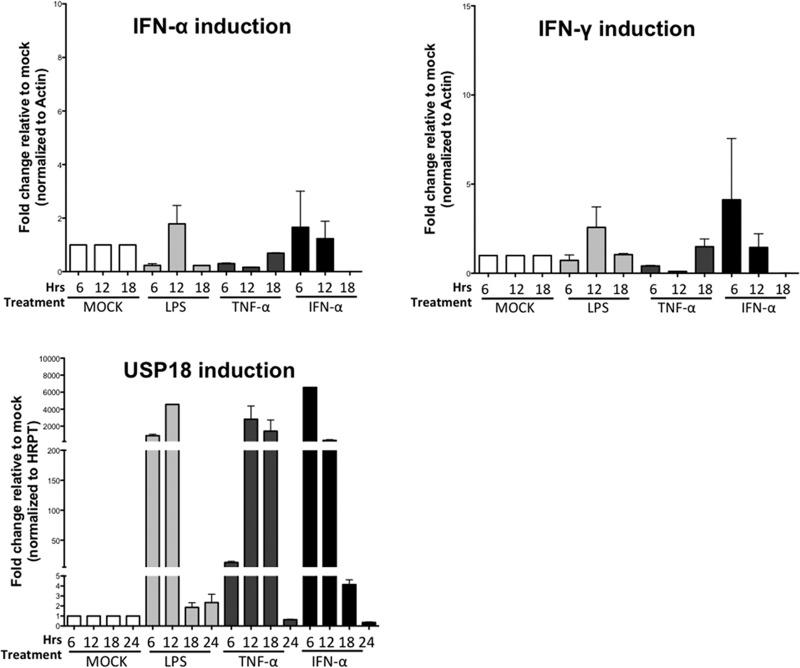
Inflammation may be maladaptive to the control of viral infection when it impairs interferon (IFN) responses, enhancing viral replication and spread. Dysregulated immunity as a result of inappropriate innate inflammatory responses is a hallmark of chronic viral infections such as, hepatitis B virus and hepatitis C virus (HCV). Previous studies from our laboratory have shown that expression of an IFN-stimulated gene (ISG), ubiquitin-like protease (USP)18 is upregulated in chronic HCV infection, leading to impaired hepatocyte responses to IFN-α. We examined the ability of inflammatory stimuli, including tumor necrosis factor alpha (TNF-α), lipopolysaccharide (LPS), interleukin-6 (IL-6) and IL-10 to upregulate hepatocyte USP18 expression and blunt the IFN-α response. Human hepatoma cells and primary murine hepatocytes were treated with TNF-α/LPS/IL-6/IL-10 and USP18, phosphorylated (p)-STAT1 and myxovirus (influenza virus) resistance 1 (Mx1) expression was determined. Treatment of Huh7.5 cells and primary murine hepatocytes with LPS and TNF-α, but not IL-6 or IL-10, led to upregulated USP18 expression and induced an IFN-α refractory state, which was reversed by USP18 knockdown. Liver inflammation was induced in vivo using a murine model of hepatic ischemia/reperfusion injury. Hepatic ischemia/reperfusion injury led to an induction of USP18 expression in liver tissue and promotion of lymphocytic choriomeningitis replication. These data demonstrate that certain inflammatory stimuli (TNF-α and LPS) but not others (IL-6 and IL-10) target USP18 expression and thus inhibit IFN signaling. These findings represent a new paradigm for how inflammation alters hepatic innate immune responses, with USP18 representing a potential target for intervention in various inflammatory states.
IMPORTANCE
Inflammation may prevent the control of viral infection when it impairs the innate immune response, enhancing viral replication and spread. Blunted immunity as a result of inappropriate innate inflammatory responses is a common characteristic of chronic viral infections. Previous studies have shown that expression of certain interferon-stimulated genes is upregulated in chronic HCV infection, leading to impaired hepatocyte responses. In this study, we show that multiple inflammatory stimuli can modulate interferon stimulated gene expression and thus inhibit hepatocyte interferon signaling via USP18 induction. These findings represent a new paradigm for how inflammation alters hepatic innate immune responses, with the induction of USP18 representing a potential target for intervention in various inflammatory states.
未标记
当炎症损害干扰素(IFN)反应、增强病毒复制和传播时,可能对病毒感染的控制产生适应不良。不适当的先天性炎症反应导致的免疫失调是慢性病毒感染(如乙型肝炎病毒和丙型肝炎病毒(HCV))的一个标志。我们实验室之前的研究表明,在慢性HCV感染中,一种IFN刺激基因(ISG),泛素样蛋白酶(USP)18的表达上调,导致肝细胞对IFN-α的反应受损。我们研究了包括肿瘤坏死因子α(TNF-α)、脂多糖(LPS)、白细胞介素-6(IL-6)和IL-10在内的炎症刺激上调肝细胞USP18表达并减弱IFN-α反应的能力。用人肝癌细胞和原代小鼠肝细胞分别用TNF-α/LPS/IL-6/IL-10处理,并测定USP18、磷酸化(p)-STAT1和抗黏液病毒(流感病毒)1(Mx1)的表达。用LPS和TNF-α处理Huh7.5细胞和原代小鼠肝细胞,但不用IL-6或IL-10处理,导致USP18表达上调并诱导IFN-α难治状态,USP18敲低可逆转这种状态。使用肝缺血/再灌注损伤小鼠模型在体内诱导肝脏炎症。肝缺血/再灌注损伤导致肝组织中USP18表达的诱导和淋巴细胞性脉络丛脑膜炎复制的促进。这些数据表明,某些炎症刺激(TNF-α和LPS)而非其他刺激(IL-6和IL-10)靶向USP18表达,从而抑制IFN信号传导。这些发现代表了炎症如何改变肝脏先天性免疫反应的新范式,USP18代表了干预各种炎症状态的潜在靶点。
重要性
当炎症损害先天性免疫反应、增强病毒复制和传播时,可能会阻止对病毒感染的控制。不适当的先天性炎症反应导致的免疫减弱是慢性病毒感染的一个共同特征。之前的研究表明,在慢性HCV感染中某些IFN刺激基因的表达上调,导致肝细胞反应受损。在本研究中,我们表明多种炎症刺激可调节IFN刺激基因的表达,从而通过USP18的诱导抑制肝细胞IFN信号传导。这些发现代表了炎症如何改变肝脏先天性免疫反应的新范式,USP18的诱导代表了干预各种炎症状态的潜在靶点。



 Zotero 插件