Department of Rheumatology and Clinical Immunology, The First Affiliated Hospital of Bengbu Medical College, Bengbu, China.
Anhui Provincial Key Laboratory of Immunology in Chronic Diseases, Bengbu Medical College, Bengbu, China.
Front Immunol. 2022 Jul 28;13:962393. doi: 10.3389/fimmu.2022.962393. eCollection 2022.
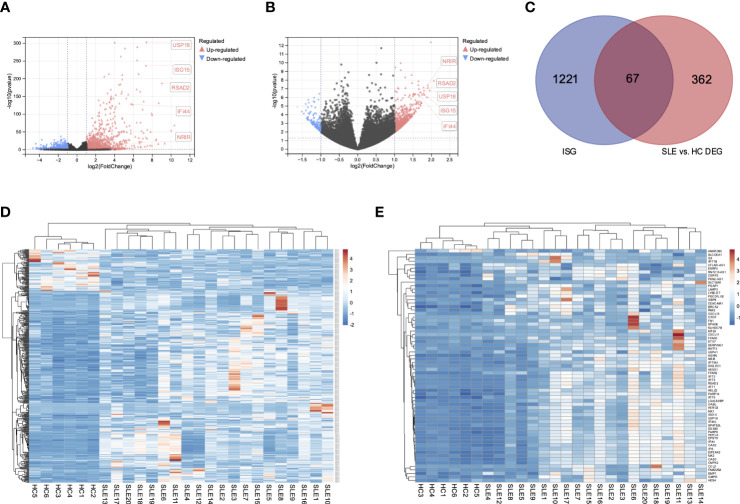
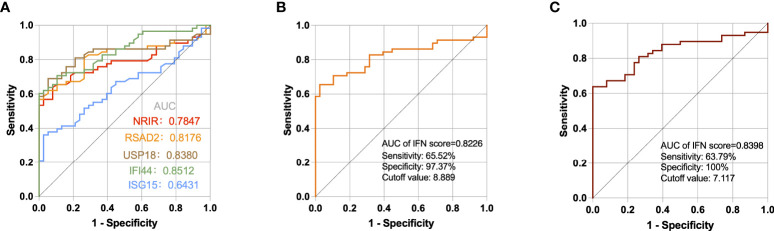
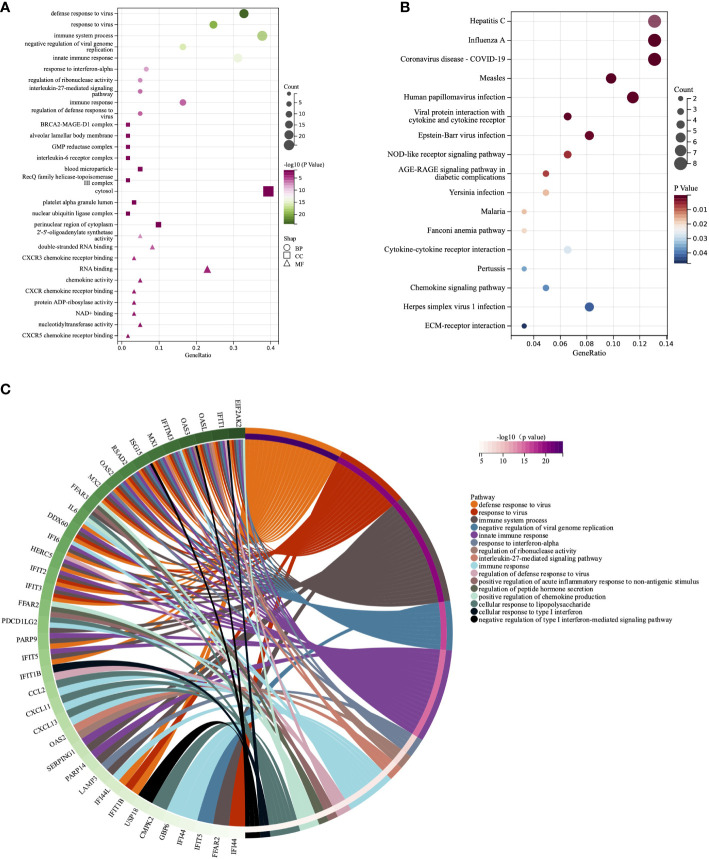
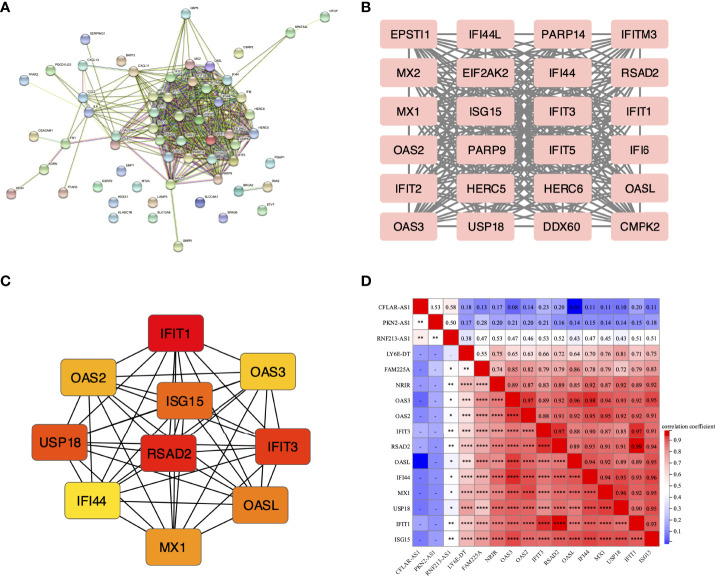
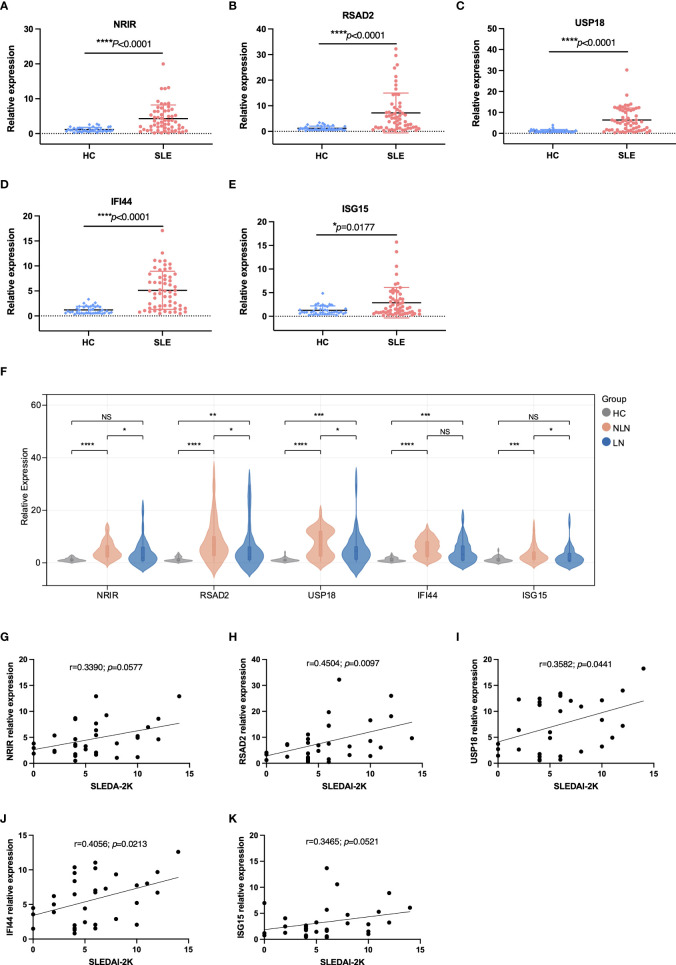
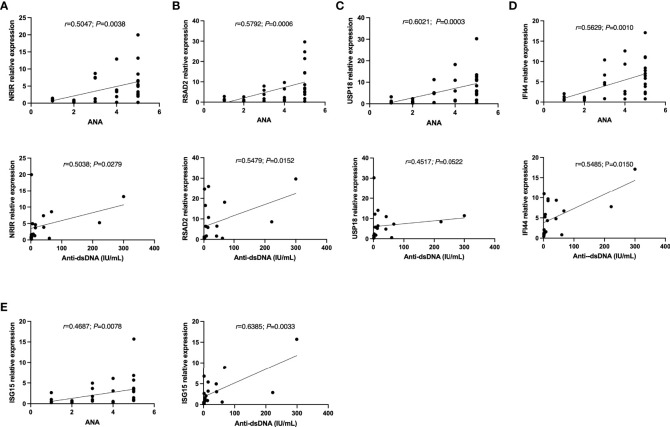
Systemic lupus erythematosus (SLE) is a chronic autoimmune disease with highly heterogeneous clinical symptoms and severity. There is complex pathogenesis of SLE, one of which is IFNs overproduction and downstream IFN-stimulated genes (ISGs) upregulation. Identifying the key ISGs differentially expressed in peripheral blood mononuclear cells (PBMCs) of patients with SLE and healthy people could help to further understand the role of the IFN pathway in SLE and discover potential diagnostic biomarkers. The differentially expressed ISGs (DEISG) in PBMCs of SLE patients and healthy persons were screened from two datasets of the Gene Expression Omnibus (GEO) database. A total of 67 DEISGs, including 6 long noncoding RNAs (lncRNAs) and 61 messenger RNAs (mRNAs) were identified by the "DESeq2" R package. According to Gene Ontology (GO) enrichment analysis and Kyoto Encyclopedia of Genes and Genomes (KEGG) pathway enrichment analysis, those DEISGs were mainly concentrated in the response to virus and immune system processes. Protein-protein interaction (PPI) network showed that most of these DEISGs could interact strongly with each other. Then, IFIT1, RSAD2, IFIT3, USP18, ISG15, OASL, MX1, OAS2, OAS3, and IFI44 were considered to be hub ISGs in SLE by "MCODE" and "Cytohubba" plugins of Cytoscape, Moreover, the results of expression correlation suggested that 3 lncRNAs (NRIR, FAM225A, and LY6E-DT) were closely related to the IFN pathway. The lncRNA NRIR and mRNAs (RSAD2, USP18, IFI44, and ISG15) were selected as candidate ISGs for verification. RT-qPCR results showed that PBMCs from SLE patients had substantially higher expression levels of 5 ISGs compared to healthy controls (HCs). Additionally, statistical analyses revealed that the expression levels of these ISGs were strongly associated to various clinical symptoms, including thrombocytopenia and facial erythema, as well as laboratory indications, including the white blood cell (WBC) count and levels of autoantibodies. The Receiver Operating Characteristic (ROC) curve demonstrated that the IFI44, USP18, RSAD2, and IFN score had good diagnostic capabilities of SLE. According to our study, SLE was associated with ISGs including NRIR, RSAD2, USP18, IFI44, and ISG15, which may contribute to the future diagnosis and new personalized targeted therapies.
系统性红斑狼疮(SLE)是一种具有高度异质性临床表现和严重程度的慢性自身免疫性疾病。SLE 的发病机制复杂,其中之一是 IFN 的过度产生和下游 IFN 刺激基因(ISGs)的上调。鉴定 SLE 患者和健康人外周血单个核细胞(PBMC)中差异表达的关键 ISGs,有助于进一步了解 IFN 通路在 SLE 中的作用,并发现潜在的诊断生物标志物。从基因表达综合数据库(GEO)数据库中的两个数据集筛选 SLE 患者和健康人 PBMC 中的差异表达 ISGs(DEISG)。通过“DESeq2”R 包鉴定到 67 个差异表达 ISGs,包括 6 个长非编码 RNA(lncRNA)和 61 个信使 RNA(mRNA)。根据基因本体论(GO)富集分析和京都基因与基因组百科全书(KEGG)通路富集分析,这些 DEISGs 主要集中在对病毒和免疫系统过程的反应中。蛋白质-蛋白质相互作用(PPI)网络表明,这些 DEISGs 中的大多数可以相互强烈地相互作用。然后,通过 Cytoscape 的“MCODE”和“Cytohubba”插件,将 IFIT1、RSAD2、IFIT3、USP18、ISG15、OASL、MX1、OAS2、OAS3 和 IFI44 视为 SLE 中的枢纽 ISGs。此外,表达相关性的结果表明,3 个 lncRNA(NRIR、FAM225A 和 LY6E-DT)与 IFN 途径密切相关。选择 lncRNA NRIR 和 mRNAs(RSAD2、USP18、IFI44 和 ISG15)作为验证的候选 ISGs。RT-qPCR 结果显示,与健康对照组(HC)相比,SLE 患者的 PBMC 中 5 个 ISGs 的表达水平明显升高。此外,统计分析表明,这些 ISGs 的表达水平与包括血小板减少和面部红斑以及白细胞(WBC)计数和自身抗体水平在内的各种临床症状以及实验室指标强烈相关。受试者工作特征(ROC)曲线表明,IFI44、USP18、RSAD2 和 IFN 评分对 SLE 具有良好的诊断能力。根据我们的研究,SLE 与包括 NRIR、RSAD2、USP18、IFI44 和 ISG15 在内的 ISGs 相关,这可能有助于未来的诊断和新的个性化靶向治疗。