Vereczki Viktória K, Veres Judit M, Müller Kinga, Nagy Gergö A, Rácz Bence, Barsy Boglárka, Hájos Norbert
Lendület' Laboratory of Network Neurophysiology, Institute of Experimental Medicine, Hungarian Academy of SciencesBudapest, Hungary; Department of Anatomy, Histology and Embryology, Faculty of Medicine, Semmelweis UniversityBudapest, Hungary.
Lendület' Laboratory of Network Neurophysiology, Institute of Experimental Medicine, Hungarian Academy of SciencesBudapest, Hungary; János Szentágothai School of Neurosciences, Semmelweis UniversityBudapest, Hungary.
Front Neuroanat. 2016 Mar 7;10:20. doi: 10.3389/fnana.2016.00020. eCollection 2016.
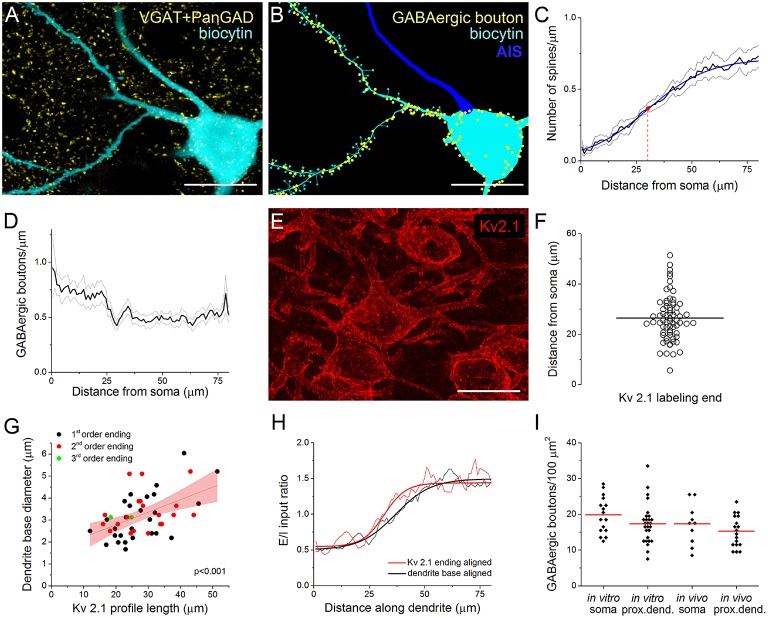
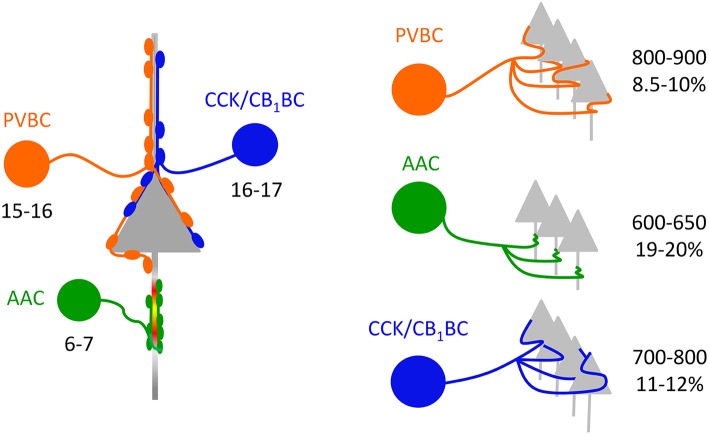
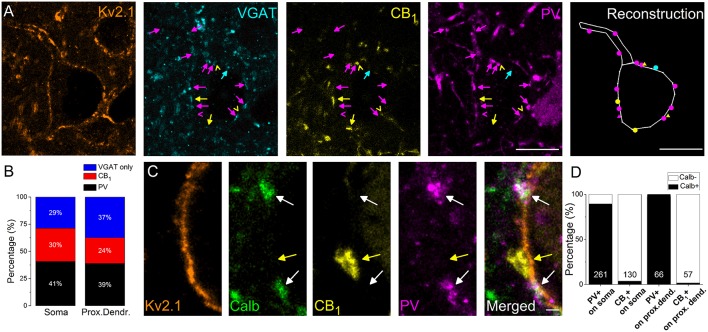
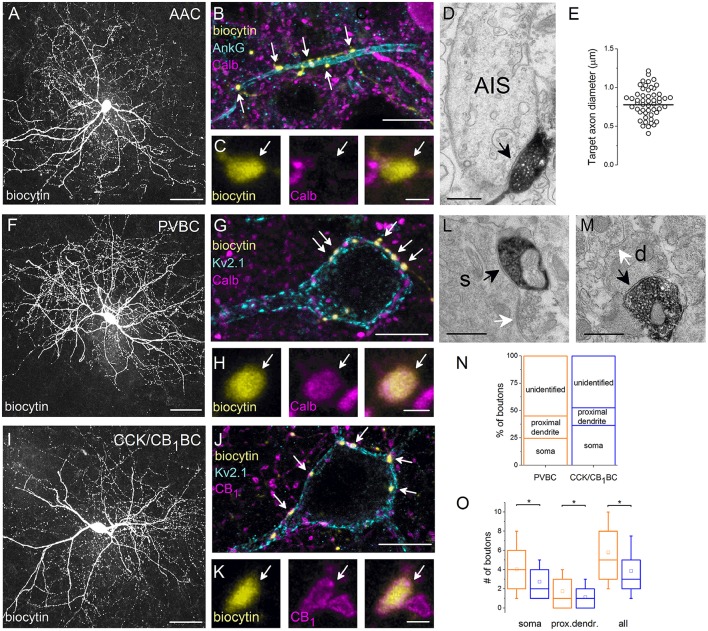
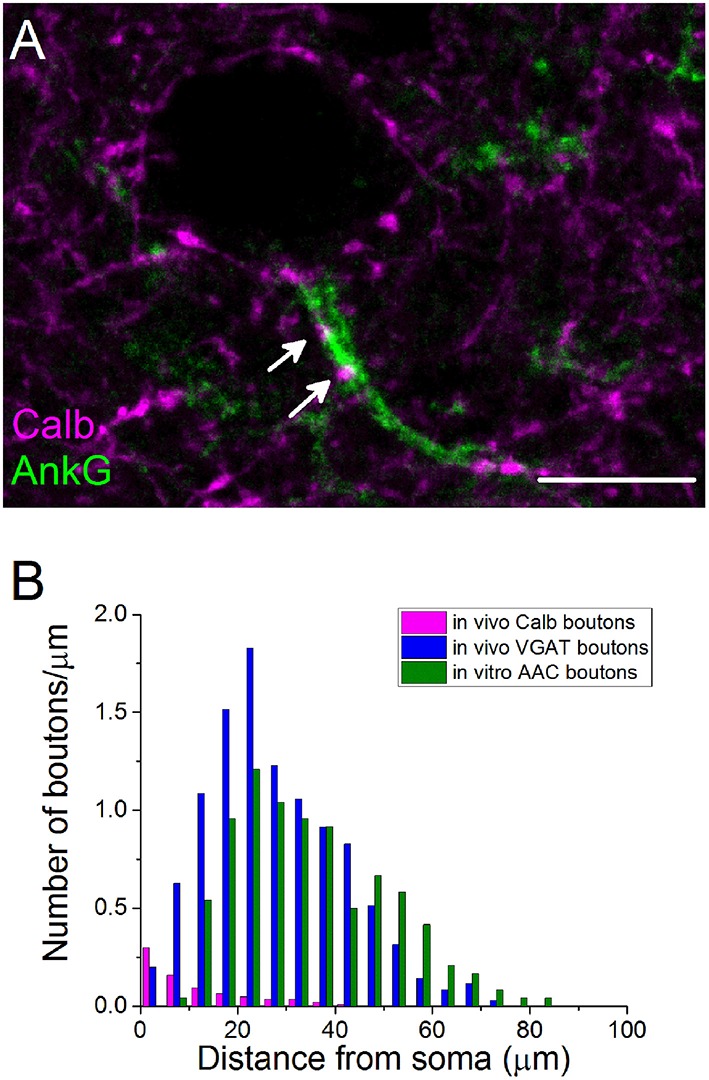
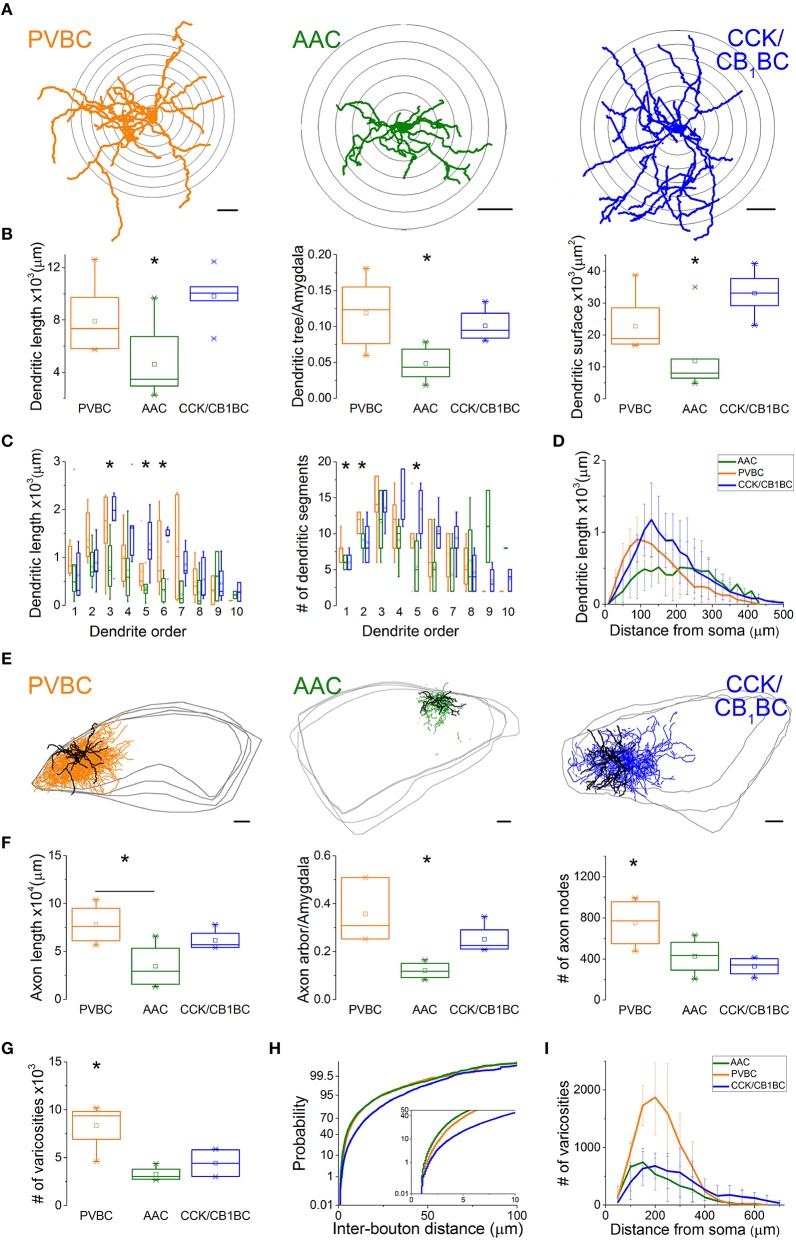
Spike generation is most effectively controlled by inhibitory inputs that target the perisomatic region of neurons. Despite the critical importance of this functional domain, very little is known about the organization of the GABAergic inputs contacting the perisomatic region of principal cells (PCs) in the basolateral amygdala. Using immunocytochemistry combined with in vitro single-cell labeling we determined the number and sources of GABAergic inputs of PCs at light and electron microscopic levels in mice. We found that the soma and proximal dendrites of PCs were innervated primarily by two neurochemically distinct basket cell types expressing parvalbumin (PVBC) or cholecystokinin and CB1 cannabinoid receptors (CCK/CB1BC). The innervation of the initial segment of PC axons was found to be parceled out by PVBCs and axo-axonic cells (AAC), as the majority of GABAergic inputs onto the region nearest to the soma (between 0 and 10 μm) originated from PVBCs, while the largest portion of the axon initial segment was innervated by AACs. Detailed morphological investigations revealed that the three perisomatic region-targeting interneuron types significantly differed in dendritic and axonal arborization properties. We found that, although individual PVBCs targeted PCs via more terminals than CCK/CB1BCs, similar numbers (15-17) of the two BC types converge onto single PCs, whereas fewer (6-7) AACs innervate the axon initial segment of single PCs. Furthermore, we estimated that a PVBC and a CCK/CB1BC may target 800-900 and 700-800 PCs, respectively, while an AAC can innervate 600-650 PCs. Thus, BCs and AACs innervate ~10 and 20% of PC population, respectively, within their axonal cloud. Our results collectively suggest, that these interneuron types may be differently affiliated within the local amygdalar microcircuits in order to fulfill specific functions in network operation during various brain states.
峰电位的产生最有效地受靶向神经元胞体周围区域的抑制性输入控制。尽管该功能域至关重要,但对于基底外侧杏仁核中与主细胞(PC)胞体周围区域接触的GABA能输入的组织情况却知之甚少。我们使用免疫细胞化学结合体外单细胞标记技术,在光镜和电镜水平上确定了小鼠PC的GABA能输入的数量和来源。我们发现,PC的胞体和近端树突主要由两种神经化学性质不同的篮状细胞类型支配,即表达小白蛋白的篮状细胞(PVBC)或胆囊收缩素和CB1大麻素受体的篮状细胞(CCK/CB1BC)。我们发现PC轴突起始段的支配由PVBC和轴-轴突细胞(AAC)分担,因为大部分到最靠近胞体区域(0至10μm之间)的GABA能输入源自PVBC,而轴突起始段的最大部分由AAC支配。详细的形态学研究表明,这三种靶向胞体周围区域的中间神经元类型在树突和轴突分支特性上有显著差异。我们发现,虽然单个PVBC通过比CCK/CB1BC更多的终末靶向PC,但两种篮状细胞类型汇聚到单个PC上的数量相似(15 - 17个),而支配单个PC轴突起始段的AAC较少(6 - 7个)。此外,我们估计一个PVBC和一个CCK/CB1BC可能分别靶向800 - 900个和700 - 800个PC,而一个AAC可以支配600 - 650个PC。因此,在其轴突范围内,篮状细胞和AAC分别支配约10%和20%的PC群体。我们的结果共同表明,这些中间神经元类型在局部杏仁核微回路中可能有不同的联系,以便在各种脑状态下的网络运作中发挥特定功能。