Sferruzzi-Perri Amanda N, Camm Emily J
Department of Physiology, Development and Neuroscience, University of Cambridge Cambridge, UK.
Front Physiol. 2016 Mar 14;7:33. doi: 10.3389/fphys.2016.00033. eCollection 2016.
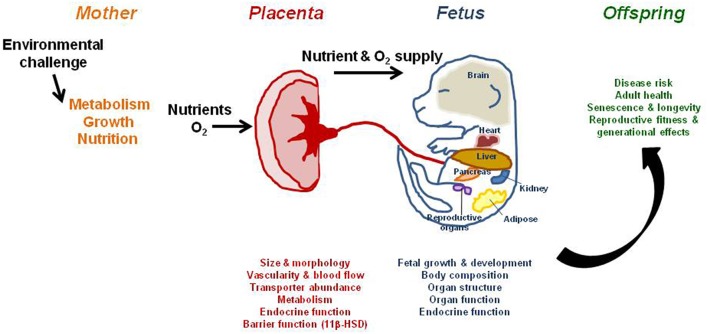
Size at birth is a critical determinant of life expectancy, and is dependent primarily on the placental supply of nutrients. However, the placenta is not just a passive organ for the materno-fetal transfer of nutrients and oxygen. Studies show that the placenta can adapt morphologically and functionally to optimize substrate supply, and thus fetal growth, under adverse intrauterine conditions. These adaptations help meet the fetal drive for growth, and their effectiveness will determine the amount and relative proportions of specific metabolic substrates supplied to the fetus at different stages of development. This flow of nutrients will ultimately program physiological systems at the gene, cell, tissue, organ, and system levels, and inadequacies can cause permanent structural and functional changes that lead to overt disease, particularly with increasing age. This review examines the environmental regulation of the placental phenotype with particular emphasis on the impact of maternal nutritional challenges and oxygen scarcity in mice, rats and guinea pigs. It also focuses on the effects of such conditions on fetal growth and the developmental programming of disease postnatally. A challenge for future research is to link placental structure and function with clinical phenotypes in the offspring.
出生时的体型是预期寿命的关键决定因素,且主要取决于胎盘的营养供应。然而,胎盘并非仅仅是一个用于母婴间营养和氧气传递的被动器官。研究表明,在不利的子宫内环境下,胎盘能够在形态和功能上进行适应性变化,以优化底物供应,从而促进胎儿生长。这些适应性变化有助于满足胎儿的生长需求,其有效性将决定在发育的不同阶段供应给胎儿的特定代谢底物的数量和相对比例。这种营养物质的流动最终会在基因、细胞、组织、器官和系统水平上对生理系统进行编程,而营养不足会导致永久性的结构和功能变化,进而引发显性疾病,尤其是随着年龄增长。本综述探讨了胎盘表型的环境调节,特别强调了母体营养挑战和氧气缺乏对小鼠、大鼠和豚鼠的影响。它还关注这些状况对胎儿生长以及出生后疾病发育编程的影响。未来研究面临的一个挑战是将胎盘结构和功能与后代的临床表型联系起来。