Liu Miao, Zhong Cheng, Zhang Yu Ming, Xu Ze Ming, Qiao Chang Sheng, Jia Shi Ru
Key Laboratory of Industrial Fermentation Microbiology, Ministry of Education, Tianjin University of Science and Technology Tianjin, China.
Key Laboratory of Industrial Fermentation Microbiology, Ministry of Education, Tianjin University of Science and TechnologyTianjin, China; Key Laboratory of Systems Bioengineering, Ministry of Education, Tianjin UniversityTianjin, China.
Front Microbiol. 2016 Mar 17;7:331. doi: 10.3389/fmicb.2016.00331. eCollection 2016.
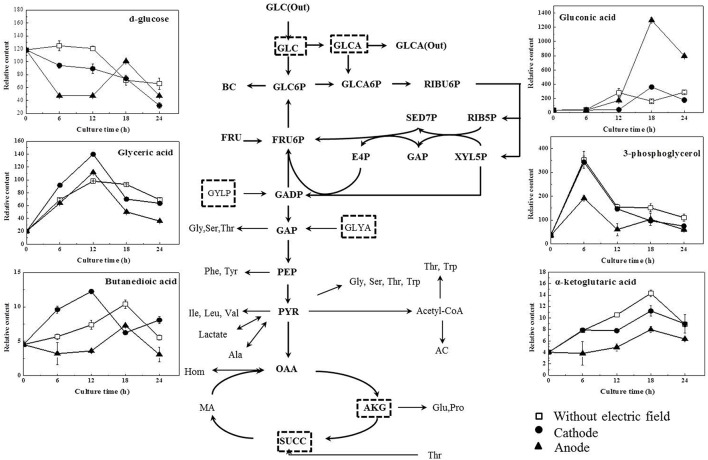
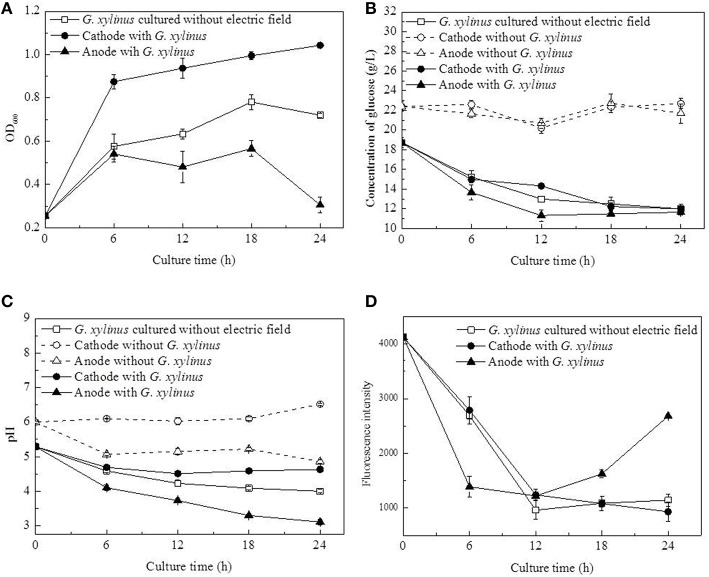
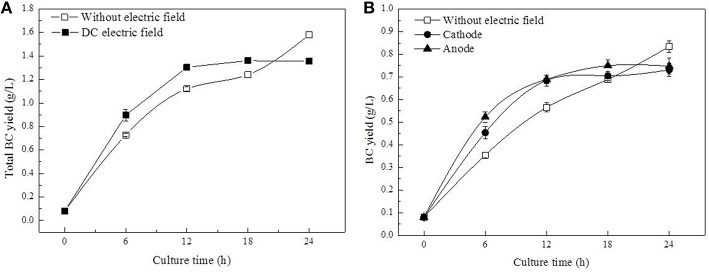
The effects of a direct current (DC) electric field on the growth and metabolism of Gluconacetobacter xylinus were investigated in static culture. When a DC electric field at 10 mA was applied using platinum electrodes to the culture broth, bacterial cellulose (BC) production was promoted in 12 h but was inhibited in the last 12 h as compared to the control (without DC electric field). At the cathode, the presence of the hydrogen generated a strong reductive environment that is beneficial to cell growth. As compared to the control, the activities of glycolysis and tricarboxylic acid cycle, as well as BC productivity were observed to be slightly higher in the first 12 h. However, due to the absence of sufficient oxygen, lactic acid was accumulated from pyruvic acid at 18 h, which was not in favor of BC production. At the anode, DC inhibited cell growth in 6 h when compared to the control. The metabolic activity in G. xylinus was inhibited through the suppression of the tricarboxylic acid cycle and glycolysis. At 18-24 h, cell density was observed to decrease, which might be due to the electrolysis of water that significantly dropped the pH of cultural broth far beyond the optimal range. Meanwhile, metabolites for self-protection were accumulated, for instance proline, glutamic acid, gluconic acid, and fatty acids. Notably, the accumulation of gluconic acid and lactic acid made it a really tough acid stress to cells at the anode and finally led to depression of cell growth.
在静态培养条件下,研究了直流(DC)电场对木醋杆菌生长和代谢的影响。当使用铂电极向培养液施加10 mA的直流电场时,与对照(无直流电场)相比,细菌纤维素(BC)产量在12 h内得到促进,但在最后12 h受到抑制。在阴极,产生的氢气营造了有利于细胞生长的强还原环境。与对照相比,在前12 h观察到糖酵解和三羧酸循环的活性以及BC生产力略高。然而,由于缺乏足够的氧气,在18 h时丙酮酸积累形成乳酸,这不利于BC的产生。在阳极,与对照相比,直流电场在6 h时抑制细胞生长。木醋杆菌的代谢活性通过三羧酸循环和糖酵解的抑制而受到抑制。在18 - 24 h,观察到细胞密度下降,这可能是由于水的电解使培养液的pH值大幅下降至远超出最佳范围所致。同时,积累了用于自我保护的代谢产物,例如脯氨酸、谷氨酸、葡萄糖酸和脂肪酸。值得注意的是,葡萄糖酸和乳酸的积累对阳极处的细胞造成了严重的酸胁迫,最终导致细胞生长受到抑制。