Abdallah Atiyeh M, Al-Mazroea Abdulhadi H, Al-Harbi Waleed N, Al-Harbi Nabeeh A, Eldardear Amr E, Almohammadi Yousef, Al-Harbi Khalid M
West Midlands Regional Genetics Laboratory, Birmingham Women's NHS Foundation Trust , Birmingham , UK.
Pediatric Department, Maternity and Children Hospital, Ministry of Health, College of Medicine, Taibah University , Al-Madinah , Saudi Arabia.
Front Immunol. 2016 Mar 14;7:98. doi: 10.3389/fimmu.2016.00098. eCollection 2016.
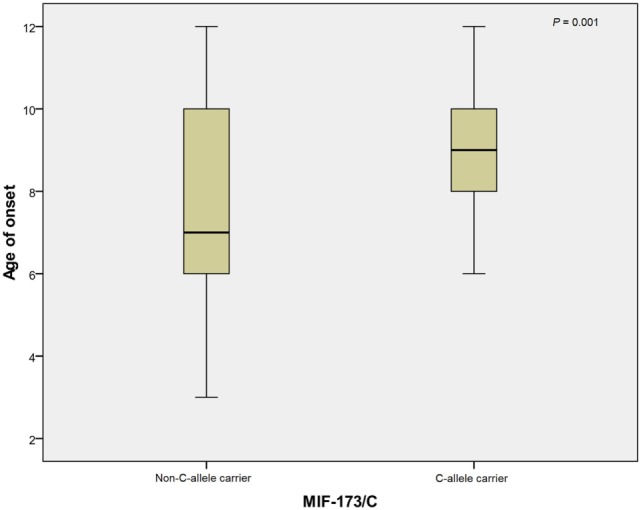
Although macrophage migration inhibitory factor (MIF) has consistently been shown to be an important immune modulator, data on the association between MIF promoter variations and the risk of developing rheumatic heart disease (RHD) remain inconclusive. RHD is an important complication of streptococcal infections in the Middle East, not least in Saudi Arabia, and identifying risk markers is an important priority. Therefore, we investigated the association between two functional MIF promoter variations and RHD susceptibility and severity in Saudi patients: the MIF-173G > C substitution (rs755622) and the MIF-794 CATT5-8 tetranucleotide repeat (rs5844572). Three hundred twenty-six individuals (124 RHD patients and 202 age-, sex-, and ethnically matched healthy controls) were genotyped using allelic discrimination and fragment analysis. Data were analyzed with respect to disease susceptibility, severity, sex, and age of onset. There was a significantly lower frequency of 173C allele carriage in RHD patients compared to controls [odds ratio (OR) = 0.47; 95% confidence intervals (CIs) = 0.28-0.77; p = 0.003]. Interestingly, the 173C allele was associated with late disease onset (p = 0.001). The 794 5-repeat allele was associated with decreased RHD risk (OR = 0.56; 95% CIs = 0.38-0.82; p = 0.003). In contrast, the 794 6-repeat allele was associated with increased risk of RHD (OR = 1.7; 95% CIs = 1.2-2.5; p = 0.002). MIF promoter variations appear to have a dual role in RHD, with 173C allele non-carriers at higher risk of developing RHD at a younger age. These results require further validation in larger multi-ethnic cohorts, and functional studies are necessary to understand the underlying molecular mechanisms driving the at-risk phenotype.
尽管巨噬细胞移动抑制因子(MIF)一直被证明是一种重要的免疫调节剂,但关于MIF启动子变异与风湿性心脏病(RHD)发病风险之间关联的数据仍无定论。RHD是中东地区链球菌感染的一种重要并发症,在沙特阿拉伯尤为如此,识别风险标志物是一个重要的优先事项。因此,我们调查了沙特患者中两个功能性MIF启动子变异与RHD易感性和严重程度之间的关联:MIF - 173G>C替换(rs755622)和MIF - 794 CATT5 - 8四核苷酸重复序列(rs5844572)。使用等位基因鉴别和片段分析对326名个体(124名RHD患者和202名年龄、性别和种族匹配的健康对照)进行基因分型。分析了关于疾病易感性、严重程度、性别和发病年龄的数据。与对照组相比,RHD患者中173C等位基因携带频率显著更低[比值比(OR)= 0.47;95%置信区间(CIs)= 0.28 - 0.77;p = 0.003]。有趣的是,173C等位基因与疾病晚发相关(p = 0.001)。794 5重复等位基因与RHD风险降低相关(OR = 0.56;95% CIs = 0.38 - 0.82;p = 0.003)。相反,794 6重复等位基因与RHD风险增加相关(OR = 1.7;95% CIs = 1.2 - 2.5;p = 0.002)。MIF启动子变异在RHD中似乎具有双重作用,173C等位基因非携带者在年轻时患RHD的风险更高。这些结果需要在更大的多民族队列中进一步验证,并且需要进行功能研究以了解驱动高危表型的潜在分子机制。