Abdallah Atiyeh M, Abu-Madi Marawan
Biomedical and Pharmaceutical Research Unit, Department of Biomedical Sciences, College of Health Sciences, QU Health, Qatar University, Doha, Qatar.
Front Med (Lausanne). 2021 Mar 24;8:611036. doi: 10.3389/fmed.2021.611036. eCollection 2021.
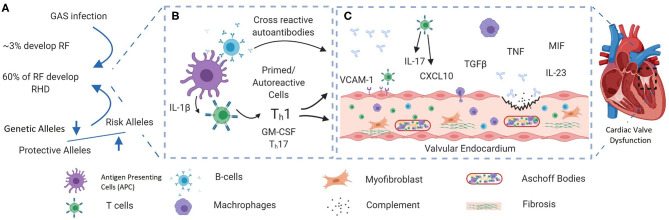
Rheumatic heart disease (RHD) is a heritable inflammatory condition characterized by carditis, arthritis, and systemic disease. Although remaining neglected, the last 3 years has seen some promising advances in RHD research. Whilst it is clear that RHD can be triggered by recurrent group A streptococcal infections, the mechanisms driving clinical progression are still poorly understood. This review summarizes our current understanding of the genetics implicated in this process and the genetic determinants that predispose some people to RHD. The evidence demonstrating the importance of individual cell types and cellular states in delineating causal genetic variants is discussed, highlighting phenotype/genotype correlations where possible. Genetic fine mapping and functional studies in extreme phenotypes, together with large-scale omics studies including genomics, transcriptomics, epigenomics, and metabolomics, are expected to provide new information not only on RHD but also on the mechanisms of other autoimmune diseases and facilitate future clinical translation.
风湿性心脏病(RHD)是一种遗传性炎症性疾病,其特征为心脏炎、关节炎和全身性疾病。尽管仍被忽视,但在过去3年里,RHD研究取得了一些有前景的进展。虽然很明显RHD可由反复的A组链球菌感染引发,但驱动临床进展的机制仍知之甚少。本综述总结了我们目前对该过程中涉及的遗传学以及使一些人易患RHD的遗传决定因素的理解。讨论了证明个体细胞类型和细胞状态在确定因果遗传变异中重要性的证据,并尽可能突出表型/基因型相关性。对极端表型进行遗传精细定位和功能研究,以及包括基因组学、转录组学、表观基因组学和代谢组学在内的大规模组学研究,有望不仅为RHD,也为其他自身免疫性疾病的机制提供新信息,并促进未来的临床转化。