Wang Helen H, Li Xiaodan, Patel Shailendra B, Wang David Q-H
Department of Medicine, Liver Center and Gastroenterology Division, Beth Israel Deaconess Medical Center, Harvard Medical School and Harvard Digestive Diseases Center, Boston, MA.
Department of Internal Medicine, Division of Gastroenterology and Hepatology, Saint Louis University School of Medicine, St. Louis, MO.
Hepatology. 2016 Sep;64(3):853-64. doi: 10.1002/hep.28570. Epub 2016 Jun 3.
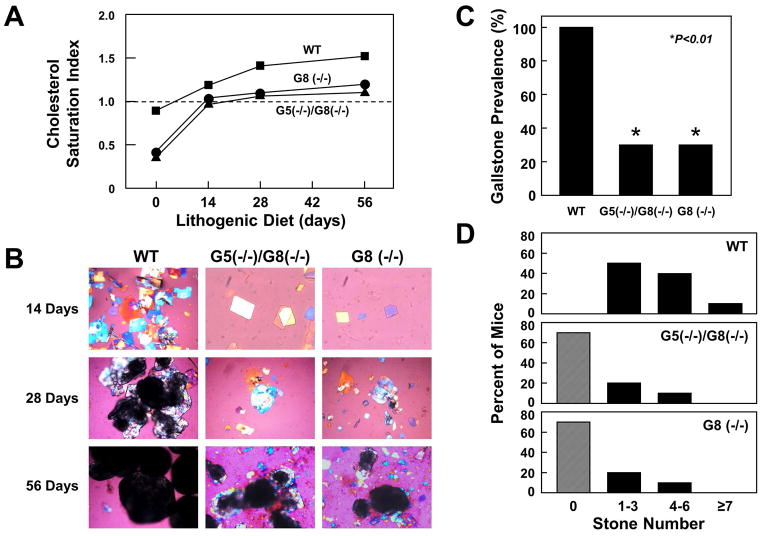
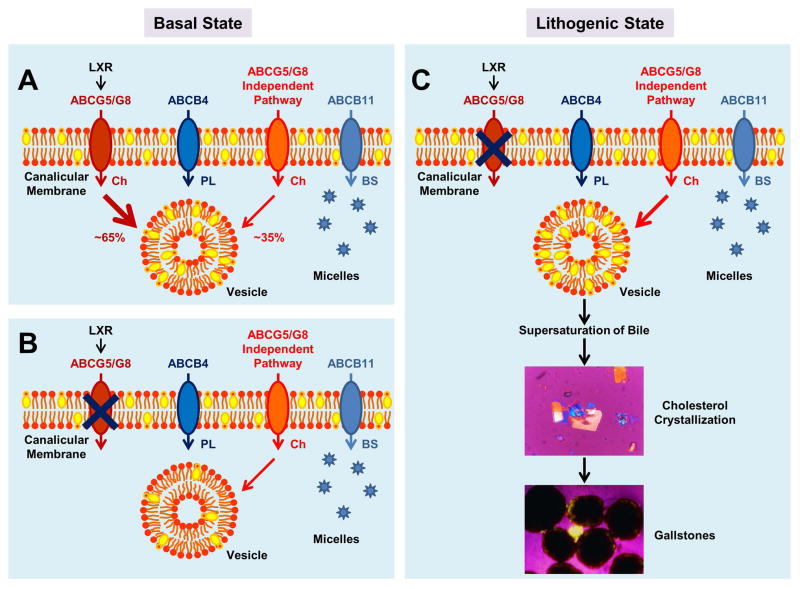
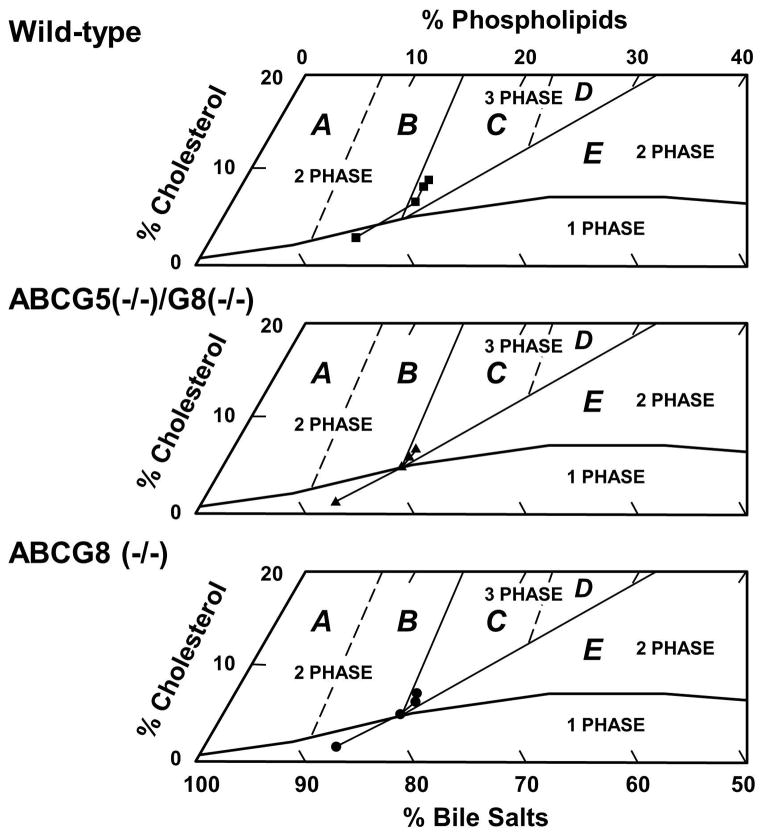
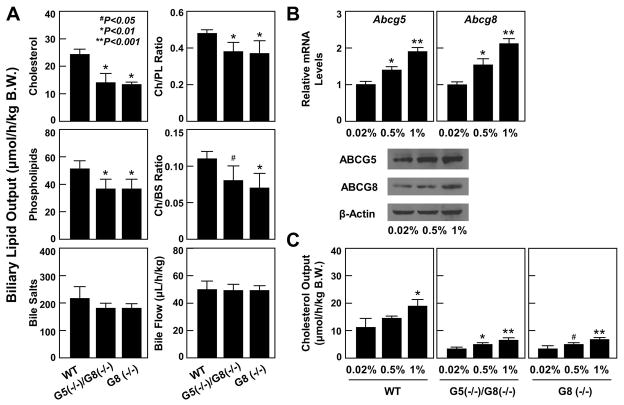
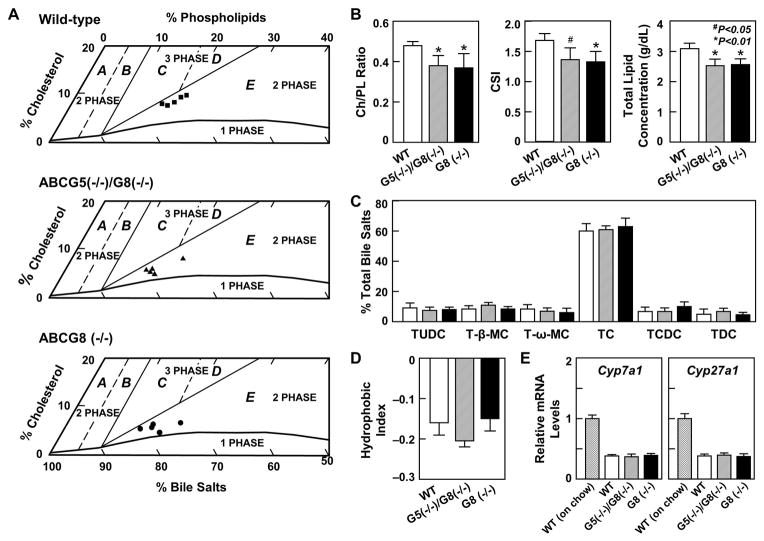
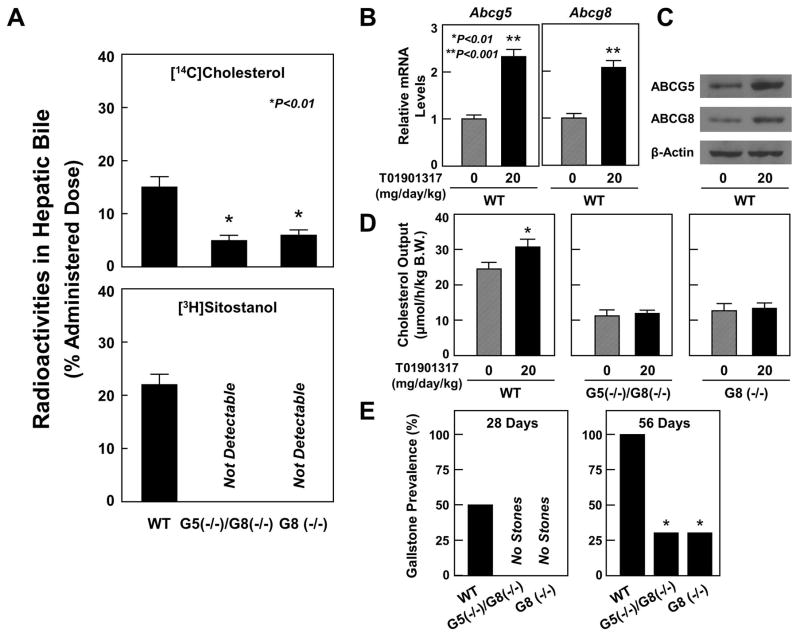
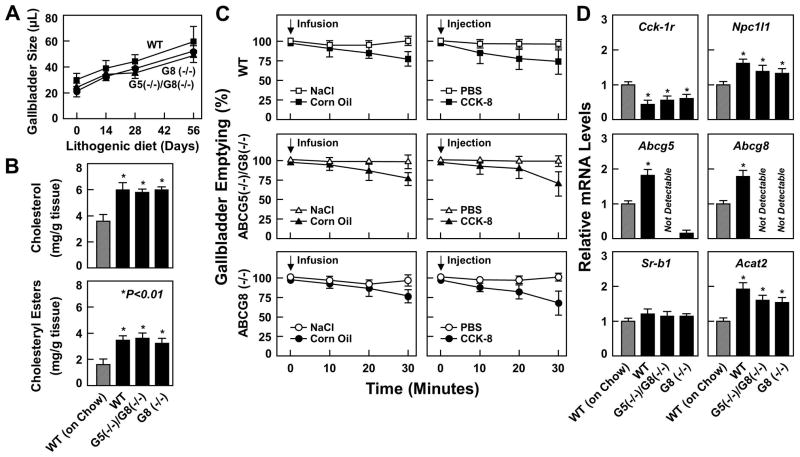
The adenosine triphosphate-binding cassette (ABC) sterol transporter, Abcg5/g8, is Lith9 in mice, and two gallstone-associated variants in ABCG5/G8 have been identified in humans. Although ABCG5/G8 plays a critical role in determining hepatic sterol secretion, cholesterol is still secreted to bile in sitosterolemic patients with a defect in either ABCG5 or ABCG8 and in either Abcg5/g8 double- or single-knockout mice. We hypothesize that in the defect of ABCG5/G8, an ABCG5/G8-independent pathway is essential for regulating hepatic secretion of biliary sterols, which is independent of the lithogenic mechanism of the ABCG5/G8 pathway. To elucidate the effect of the ABCG5/G8-independent pathway on cholelithogenesis, we investigated the biliary and gallstone characteristics in male wild-type (WT), ABCG5(-/-)/G8(-/-), and ABCG8 (-/-) mice fed a lithogenic diet or varying amounts of cholesterol, treated with a liver X receptor (LXR) agonist, or injected intravenously with [(3) H]sitostanol- and [(14) C]cholesterol-labeled high-density lipoprotein (HDL). We found that ABCG5(-/-)/G8(-/-) and ABCG8 (-/-) mice displayed the same biliary and gallstone phenotypes. Although both groups of knockout mice showed a significant reduction in hepatic cholesterol output compared to WT mice, they still formed gallstones. The LXR agonist significantly increased biliary cholesterol secretion and gallstones in WT, but not ABCG5(-/-)/G8(-/-) or ABCG8 (-/-), mice. The 6-hour recovery of [(14) C]cholesterol in hepatic bile was significantly lower in both groups of knockout mice than in WT mice and [(3) H]sitostanol was detected in WT, but not ABCG5(-/-)/G8(-/-) or ABCG8 (-/-), mice.
The ABCG5/G8-independent pathway plays an important role in regulating biliary cholesterol secretion, the transport of HDL-derived cholesterol from plasma to bile, and gallstone formation, which works independently of the ABCG5/G8 pathway. Further studies are needed to observe whether this pathway is also operational in humans. (Hepatology 2016;64:853-864).
三磷酸腺苷结合盒(ABC)固醇转运蛋白Abcg5/g8在小鼠中为Lith9,并且在人类中已鉴定出ABCG5/G8中的两个与胆结石相关的变异体。尽管ABCG5/G8在决定肝脏固醇分泌方面起关键作用,但在ABCG5或ABCG8存在缺陷的谷甾醇血症患者以及Abcg5/g8双敲除或单敲除小鼠中,胆固醇仍会分泌到胆汁中。我们推测,在ABCG5/G8缺陷的情况下,一条不依赖ABCG5/G8的途径对于调节胆汁固醇的肝脏分泌至关重要,该途径独立于ABCG5/G8途径的致石机制。为了阐明不依赖ABCG5/G8的途径对胆石形成的影响,我们研究了喂食致石饮食或不同量胆固醇、用肝脏X受体(LXR)激动剂处理或静脉注射[(3)H]谷甾烷醇和[(14)C]胆固醇标记的高密度脂蛋白(HDL)的雄性野生型(WT)、ABCG5(-/-)/G8(-/-)和ABCG8(-/-)小鼠的胆汁和胆结石特征。我们发现ABCG5(-/-)/G8(-/-)和ABCG8(-/-)小鼠表现出相同的胆汁和胆结石表型。尽管与WT小鼠相比,两组敲除小鼠的肝脏胆固醇输出均显著降低,但它们仍形成胆结石。LXR激动剂显著增加了WT小鼠的胆汁胆固醇分泌和胆结石形成,但对ABCG5(-/-)/G8(-/-)或ABCG8(-/-)小鼠没有影响。两组敲除小鼠肝脏胆汁中[(14)C]胆固醇的6小时回收率均显著低于WT小鼠,并且在WT小鼠中检测到了[(3)H]谷甾烷醇,但在ABCG5(-/-)/G8(-/-)或ABCG8(-/-)小鼠中未检测到。
不依赖ABCG5/G8的途径在调节胆汁胆固醇分泌、将HDL衍生的胆固醇从血浆转运到胆汁以及胆结石形成中起重要作用,该途径独立于ABCG5/G8途径发挥作用。需要进一步研究观察该途径在人类中是否也起作用。(《肝脏病学》2016年;64:853 - 864)