Karastergiou Kalypso, Bredella Miriam A, Lee Mi-Jeong, Smith Steven R, Fried Susan K, Miller Karen K
Department of Medicine, Boston University School of Medicine, Boston, Massachusetts, USA.
Department of Radiology, Massachusetts General Hospital and Harvard Medical School, Boston, Massachusetts, USA.
Obesity (Silver Spring). 2016 May;24(5):1090-1096. doi: 10.1002/oby.21460. Epub 2016 Mar 26.
Growth hormone (GH) administration reduces abdominal, but not lower body, fat mass. To gain insight into the underlying mechanisms, this study examined the expression of the GH receptor (GHR) and some of its targets in abdominal and gluteal adipose tissue.
GHR and GH targets in the lipolytic pathway were assessed (quantitative PCR/Western blotting) in adipose aspirates from premenopausal women [n = 15, age 26.9 ± 6.1 years, body mass index (BMI) 28.0 ± 6.8 kg/m(2) ] and men (n = 28, age 29.2 ± 7.0 years, BMI 26.9 ± 3.7 kg/m(2) ).
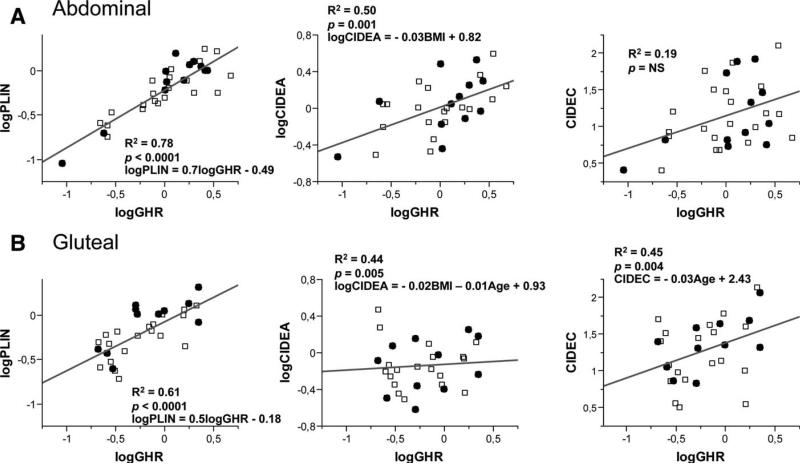
GHR mRNA expression was lower in the gluteal depot when compared with the abdominal depot (P = 0.01). Abdominal GHR correlated negatively with age and BMI, whereas gluteal GHR was associated with lower waist-to-hip ratio (WHR), that is, pear shape. In both sites, GHR mRNA correlated strongly with genes important for the regulation of lipolysis: adipose tissue triglyceride lipase (ATGL), hormone-sensitive lipase, perilipin, and CIDEA (all P < 0.001), independently of BMI, WHR, age, and sex. GHR protein was lower in the gluteal fat when compared with the abdominal fat (P = 0.03) and correlated with ATGL protein in the gluteal depot (P < 0.001).
GHR levels correlate with levels of lipases and lipid droplet-associated proteins crucial for lipolysis. Thus, higher GHR expression in the abdominal depot when compared with the gluteal depot may underlie the in vivo effect of GH to specifically reduce abdominal adipose tissue mass.
生长激素(GH)给药可减少腹部脂肪量,但不能减少下半身脂肪量。为深入了解其潜在机制,本研究检测了GH受体(GHR)及其一些靶点在腹部和臀肌脂肪组织中的表达。
采用定量聚合酶链反应/蛋白质免疫印迹法评估绝经前女性(n = 15,年龄26.9±6.1岁,体重指数[BMI]28.0±6.8kg/m²)和男性(n = 28,年龄29.2±7.0岁,BMI 26.9±3.7kg/m²)脂肪抽吸物中脂解途径中的GHR和GH靶点。
与腹部脂肪库相比,臀肌脂肪库中GHR信使核糖核酸(mRNA)表达较低(P = 0.01)。腹部GHR与年龄和BMI呈负相关,而臀肌GHR与较低的腰臀比(WHR)相关,即梨形身材。在两个部位,GHR mRNA均与脂解调节重要基因:脂肪组织甘油三酯脂肪酶(ATGL)、激素敏感性脂肪酶、围脂滴蛋白和细胞死亡诱导DFFA样效应因子A(CIDEA)密切相关(均P < 0.001),且独立于BMI、WHR、年龄和性别。与腹部脂肪相比,臀肌脂肪中GHR蛋白较低(P = 0.03),且与臀肌脂肪库中ATGL蛋白相关(P < 0.001)。
GHR水平与脂解关键的脂肪酶和脂滴相关蛋白水平相关。因此,与臀肌脂肪库相比,腹部脂肪库中较高的GHR表达可能是GH在体内特异性减少腹部脂肪组织量的作用基础。