Wheeler Natalie A, Fuss Babette
Department of Anatomy and Neurobiology, Virginia Commonwealth University School of Medicine, Richmond, VA 23298, United States.
Department of Anatomy and Neurobiology, Virginia Commonwealth University School of Medicine, Richmond, VA 23298, United States.
Exp Neurol. 2016 Sep;283(Pt B):512-30. doi: 10.1016/j.expneurol.2016.03.019. Epub 2016 Mar 23.
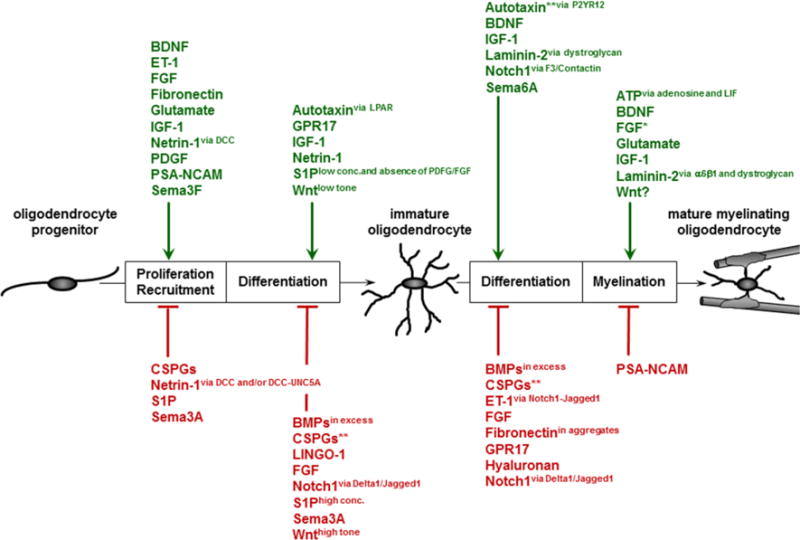
There is an increasing number of neurologic disorders found to be associated with loss and/or dysfunction of the CNS myelin sheath, ranging from the classic demyelinating disease, multiple sclerosis, through CNS injury, to neuropsychiatric diseases. The disabling burden of these diseases has sparked a growing interest in gaining a better understanding of the molecular mechanisms regulating the differentiation of the myelinating cells of the CNS, oligodendrocytes (OLGs), and the process of (re)myelination. In this context, the importance of the extracellular milieu is becoming increasingly recognized. Under pathological conditions, changes in inhibitory as well as permissive/promotional cues are thought to lead to an overall extracellular environment that is obstructive for the regeneration of the myelin sheath. Given the general view that remyelination is, even though limited in human, a natural response to demyelination, targeting pathologically 'dysregulated' extracellular cues and their downstream pathways is regarded as a promising approach toward the enhancement of remyelination by endogenous (or if necessary transplanted) OLG progenitor cells. In this review, we will introduce the extracellular cues that have been implicated in the modulation of (re)myelination. These cues can be soluble, part of the extracellular matrix (ECM) or mediators of cell-cell interactions. Their inhibitory and permissive/promotional roles with regard to remyelination as well as their potential for therapeutic intervention will be discussed.
越来越多的神经系统疾病被发现与中枢神经系统(CNS)髓鞘的丧失和/或功能障碍有关,范围从经典的脱髓鞘疾病——多发性硬化症,到中枢神经系统损伤,再到神经精神疾病。这些疾病造成的致残负担引发了人们越来越浓厚的兴趣,即更好地了解调节中枢神经系统髓鞘形成细胞——少突胶质细胞(OLGs)分化以及(再)髓鞘形成过程的分子机制。在这种背景下,细胞外环境的重要性日益得到认可。在病理条件下,抑制性以及允许性/促进性信号的变化被认为会导致整体细胞外环境对髓鞘再生产生阻碍。鉴于普遍观点认为,尽管在人类中再髓鞘形成有限,但它是对脱髓鞘的一种自然反应,针对病理上“失调”的细胞外信号及其下游途径被视为一种有前景的方法,可通过内源性(或必要时移植的)少突胶质前体细胞增强再髓鞘形成。在这篇综述中,我们将介绍与(再)髓鞘形成调节有关的细胞外信号。这些信号可以是可溶性的、细胞外基质(ECM)的一部分或细胞间相互作用的介质。将讨论它们在再髓鞘形成方面的抑制性和允许性/促进性作用以及它们在治疗干预方面的潜力。