Houle Brian, Pantazis Athena, Kabudula Chodziwadziwa, Tollman Stephen, Clark Samuel J
School of Demography, The Australian National University, #9 Fellows Road, Acton, ACT Australia, Canberra, Australia ; Institute of Behavioral Science, University of Colorado at Boulder, Boulder, CO USA ; MRC/Wits Rural Public Health and Health Transitions Research Unit (Agincourt), School of Public Health, Faculty of Health Sciences, University of the Witwatersrand, Johannesburg, South Africa.
Department of Sociology, University of Washington, Seattle, WA USA.
Popul Health Metr. 2016 Mar 25;14:10. doi: 10.1186/s12963-016-0079-z. eCollection 2016.
Literature is limited on the effects of high prevalence HIV on fertility in the absence of treatment, and the effects of the introduction of sustained access to antiretroviral therapy (ART) on fertility. We summarize fertility patterns in rural northeast South Africa over 21 years during dynamic social and epidemiological change.
We use data for females aged 15-49 from the Agincourt health and socio-demographic surveillance system (1993-2013). We use discrete time event history analysis to summarize patterns in the probability of any birth.
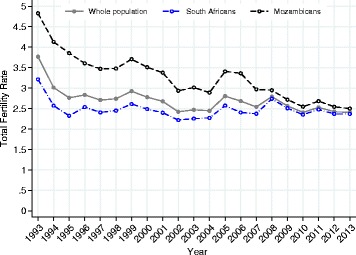
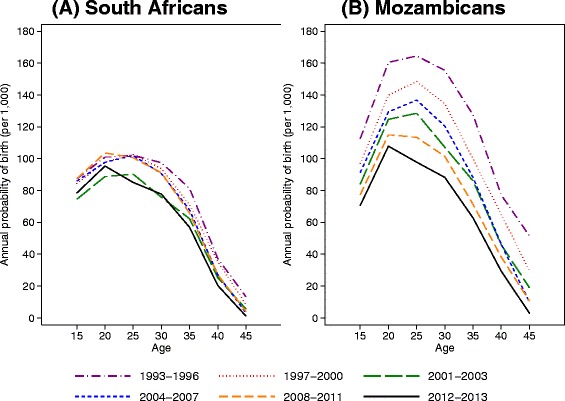
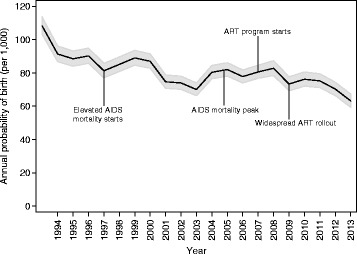
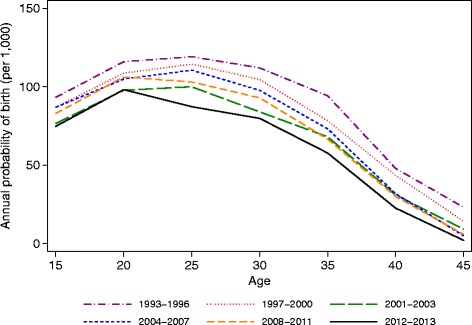
Overall fertility declined in 2001-2003, increased in 2004-2011, and then declined in 2012-2013. South Africans showed a similar pattern. Mozambicans showed a different pattern, with strong declines prior to 2003 before stalling during 2004-2007, and then continued fertility decline afterwards. There was an inverse gradient between fertility levels and household socioeconomic status. The gradient did not vary by time or nationality.
The fertility transition in rural South Africa shows a pattern of decline until the height of the HIV/AIDS pandemic, with a resulting stall until further decline in the context of ART rollout. Fertility patterns are not homogenous among groups.
关于在未接受治疗的情况下,高流行率的艾滋病毒对生育能力的影响,以及持续获得抗逆转录病毒疗法(ART)对生育能力的影响,相关文献有限。我们总结了南非东北部农村地区在21年动态社会和流行病学变化期间的生育模式。
我们使用了阿金库尔健康与社会人口监测系统(1993 - 2013年)中15 - 49岁女性的数据。我们使用离散时间事件史分析来总结任何生育概率的模式。
总体生育率在2001 - 2003年下降,在2004 - 2011年上升,然后在2012 - 2013年下降。南非人呈现出类似的模式。莫桑比克人呈现出不同的模式,在2003年之前大幅下降,在2004 - 2007年停滞,然后之后生育率继续下降。生育水平与家庭社会经济地位之间存在反向梯度。该梯度不随时间或国籍而变化。
南非农村地区的生育转变呈现出一种模式,即在艾滋病毒/艾滋病大流行高峰之前下降,随后在抗逆转录病毒疗法推广的背景下停滞直至进一步下降。不同群体的生育模式并不相同。