Conn Vicki S, Ruppar Todd M, Enriquez Maithe, Cooper Pamela S
School of Nursing, University of Missouri, Columbia, MO, USA.
School of Nursing, University of Missouri, Columbia, MO, USA.
Value Health. 2016 Mar-Apr;19(2):277-85. doi: 10.1016/j.jval.2015.12.001. Epub 2016 Jan 14.
Using meta-analytic procedures to synthesize changes in patient-centered outcomes after medication adherence interventions.
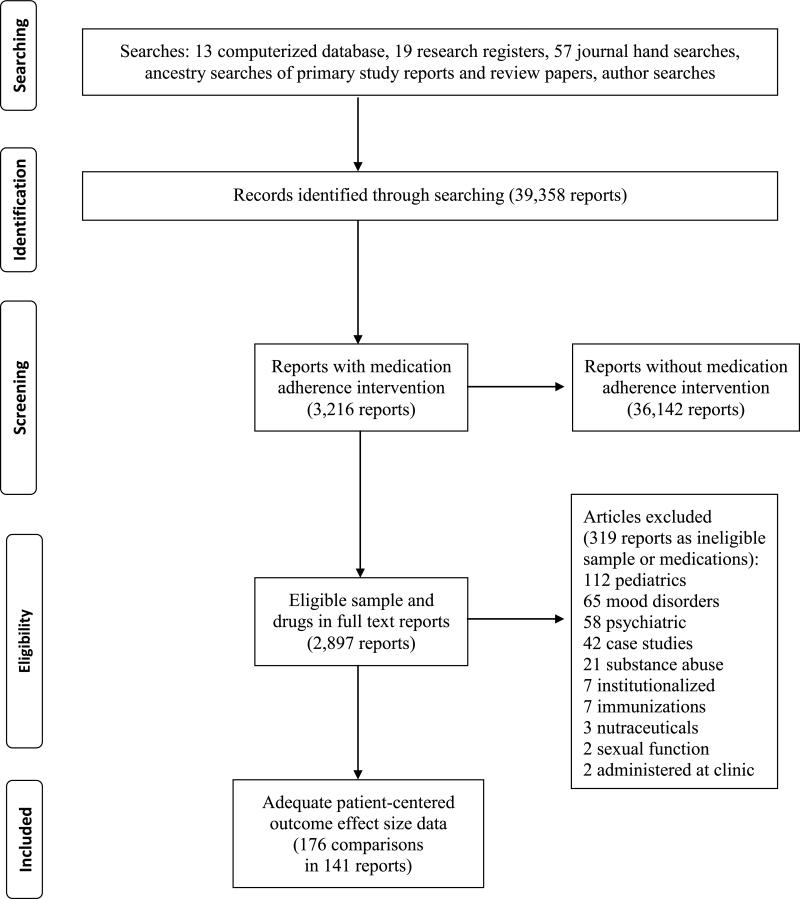
Strategies to locate studies included online searches of 13 databases and 19 research registries, hand searches of 57 journals, and author and ancestry searches of all eligible studies. Search terms included patient compliance, medication adherence, and related terms. Searches were conducted for all studies published since 1960. Eligible published or unpublished primary studies tested medication adherence interventions and reported medication knowledge, quality of life, physical function, and symptom outcomes. Primary study attributes and outcome data were reliably coded. Overall standardized mean differences (SMDs) were analyzed using random-effects models. Dichotomous and continuous moderator analyses and funnel plots were used to explore risks of bias.
Thorough searching located 141 eligible reports. The reports included 176 eligible comparisons between treatment and control subjects across 23,318 subjects. Synthesis across all comparisons yielded statistically significant SMDs for medication knowledge (d = 0.449), quality of life (d = 0.127), physical function (d = 0.142), and symptoms (d = 0.182). The overall SMDs for studies focusing on subsamples of patients with specific illnesses were more modest but also statistically significant. Of specific symptoms analyzed (depression, anxiety, pain, energy/vitality, cardiovascular, and respiratory), only anxiety failed to show a significant improvement after medication adherence interventions. Most SMDs were significantly heterogeneous, and risk of bias analyses suggested links between study quality and SMDs.
Modest but significant improvements in patient-centered outcomes were observed after medication adherence interventions.
采用荟萃分析方法综合药物依从性干预后以患者为中心的结局变化。
查找研究的策略包括对13个数据库和19个研究注册库进行在线搜索、对57种期刊进行手工检索以及对所有符合条件的研究进行作者和溯源检索。检索词包括患者依从性、药物依从性及相关术语。对1960年以来发表的所有研究进行检索。符合条件的已发表或未发表的原始研究对药物依从性干预进行了测试,并报告了药物知识、生活质量、身体功能和症状结局。对原始研究的属性和结局数据进行可靠编码。使用随机效应模型分析总体标准化均值差(SMD)。采用二分法和连续调节分析以及漏斗图来探讨偏倚风险。
全面检索找到141篇符合条件的报告。这些报告包括23318名受试者中治疗组与对照组之间的176项符合条件的比较。对所有比较进行综合分析得出,药物知识(d = 0.449)、生活质量(d = 0.127)、身体功能(d = 0.142)和症状(d = 0.182)的SMD具有统计学意义。针对特定疾病患者亚组的研究的总体SMD较小,但也具有统计学意义。在分析的特定症状(抑郁、焦虑、疼痛、精力/活力、心血管和呼吸)中,只有焦虑在药物依从性干预后未显示出显著改善。大多数SMD存在显著异质性,偏倚风险分析表明研究质量与SMD之间存在关联。
药物依从性干预后,以患者为中心的结局有适度但显著的改善。