Cavanaugh Joseph S, Modi Surbhi, Musau Susan, McCarthy Kimberly, Alexander Heather, Burmen Barbara, Heilig Charles M, Shiraishi Ray W, Cain Kevin
United States Centers for Disease Control and Prevention, Atlanta, Georgia, United States of America.
Kenya Medical Research Institute (KEMRI) Center for Global Health Research, Kisumu, Kenya.
PLoS One. 2016 Mar 29;11(3):e0152364. doi: 10.1371/journal.pone.0152364. eCollection 2016.
Diagnosis followed by effective treatment of tuberculosis (TB) reduces transmission and saves lives in persons living with HIV (PLHIV). Sputum smear microscopy is widely used for diagnosis, despite limited sensitivity in PLHIV. Evidence is needed to determine the optimal diagnostic approach for these patients.
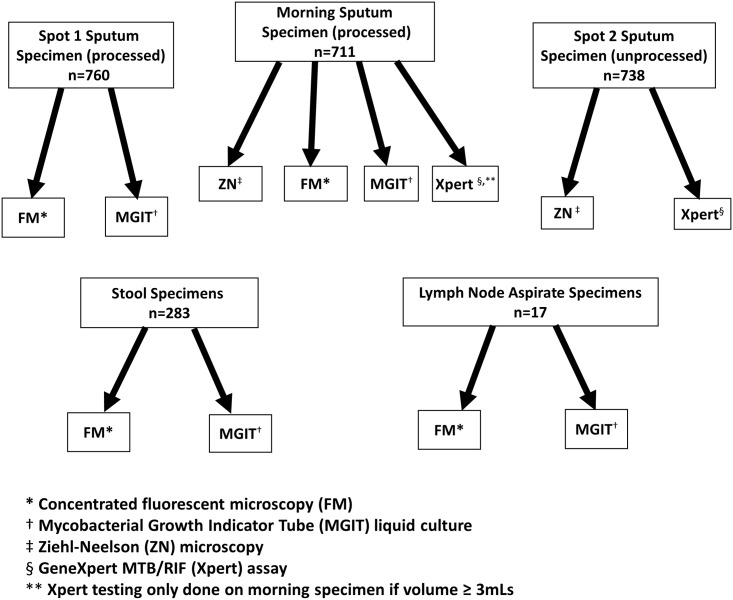
From May 2011 through June 2012, we recruited PLHIV from 15 HIV treatment centers in western Kenya. We collected up to three sputum specimens for Ziehl-Neelsen (ZN) and fluorescence microscopy (FM), GeneXpert MTB/RIF (Xpert), and culture, regardless of symptoms. We calculated the incremental yield of each test, stratifying results by CD4 cell count and specimen type; data were analyzed to account for complex sampling.
From 778 enrolled patients, we identified 88 (11.3%) laboratory-confirmed TB cases. Of the 74 cases who submitted 2 specimens for microscopy and Xpert testing, ZN microscopy identified 25 (33.6%); Xpert identified those plus an additional 18 (incremental yield = 24.4%). Xpert testing of spot specimens identified 48 (57.0%) of 84 cases; whereas Xpert testing of morning specimens identified 50 (66.0%) of 76 cases. Two Xpert tests detected 22/24 (92.0%) TB cases with CD4 counts <100 cells/μL and 30/45 (67.0%) of cases with CD4 counts ≥100 cells/μl.
In PLHIV, Xpert substantially increased diagnostic yield compared to smear microscopy and had the highest yield when used to test morning specimens and specimens from PLHIV with CD4 count <100 cells/μL. TB programs unable to replace smear microscopy with Xpert for all symptomatic PLHIV should consider targeted replacement and using morning specimens.
对结核病(TB)进行诊断并随后给予有效治疗可减少传播,并挽救艾滋病毒感染者(PLHIV)的生命。痰涂片显微镜检查虽在PLHIV中的敏感性有限,但仍被广泛用于诊断。需要证据来确定这些患者的最佳诊断方法。
2011年5月至2012年6月,我们从肯尼亚西部的15个艾滋病毒治疗中心招募了PLHIV。无论有无症状,我们收集了多达三份痰标本用于萋-尼(ZN)染色和荧光显微镜检查(FM)、GeneXpert MTB/RIF检测(Xpert)以及培养。我们计算了每项检测的增量检出率,并按CD4细胞计数和标本类型对结果进行分层;对数据进行分析以考虑复杂抽样情况。
在778名入组患者中,我们确定了88例(11.3%)经实验室确诊的结核病病例。在74例提交了两份标本进行显微镜检查和Xpert检测的病例中,ZN显微镜检查确诊了25例(33.6%);Xpert检测出了这25例以及另外18例(增量检出率=24.4%)。对即时痰标本进行Xpert检测,在84例病例中确诊了48例(57.0%);而对晨痰标本进行Xpert检测,在76例病例中确诊了50例(66.0%)。两次Xpert检测在CD4计数<100个细胞/μL的结核病病例中检测出22/24例(92.0%),在CD4计数≥100个细胞/μL的病例中检测出30/45例(67.0%)。
在PLHIV中,与涂片显微镜检查相比,Xpert显著提高了诊断检出率,并且在用于检测晨痰标本以及CD4计数<100个细胞/μL的PLHIV的标本时检出率最高。对于无法对所有有症状的PLHIV用Xpert替代涂片显微镜检查的结核病防治项目,应考虑有针对性地进行替代并使用晨痰标本。