Prasad Shilpa, Tiwari Meenakshi, Pandey Ashutosh N, Shrivastav Tulsidas G, Chaube Shail K
Cell Physiology Laboratory, Biochemistry Unit, Department of Zoology, Institute of Science, Banaras Hindu University, Varanasi, 221005, UP, India.
Department of Reproductive Biomedicine, National Institute of Health and Family Welfare, Baba Gang Nath Marg, Munirka, New Delhi, 110067, India.
J Biomed Sci. 2016 Mar 29;23:36. doi: 10.1186/s12929-016-0253-4.
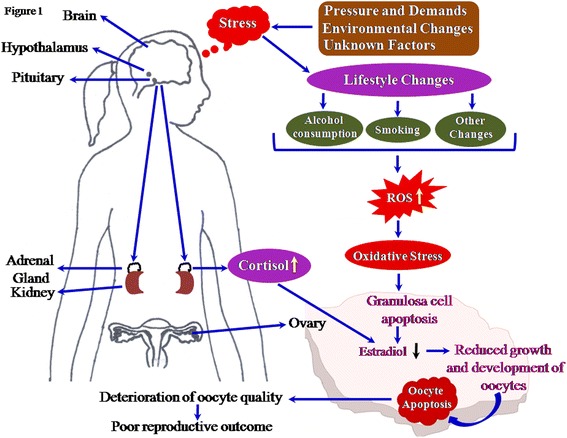
Stress is an important factor that affects physical and mental status of a healthy person disturbing homeostasis of the body. Changes in the lifestyle are one of the major causes that lead to psychological stress. Psychological stress could impact the biology of female reproduction by targeting at the level of ovary, follicle and oocyte. The increased level of stress hormone such as cortisol reduces estradiol production possibly by affecting the granulosa cell functions within the follicle, which results deterioration in oocyte quality. Adaptation of lifestyle behaviours may generate reactive oxygen species (ROS) in the ovary, which further affects female reproduction. Balance between level of ROS and antioxidants within the ovary are important for maintenance of female reproductive health. Physiological level of ROS modulates oocyte functions, while its accumulation leads to oxidative stress (OS). OS triggers apoptosis in majority of germ cells within the ovary and even in ovulated oocytes. Although both mitochondria- as well as death-receptor pathways are involved in oocyte apoptosis, OS-induced mitochondria-mediated pathway plays a major role in the elimination of majority of germ cells from ovary. OS in the follicular fluid deteriorates oocyte quality and reduces reproductive outcome. On the other hand, antioxidants reduce ROS levels and protect against OS-mediated germ cell apoptosis and thereby depletion of germ cells from the ovary. Indeed, OS is one of the major factors that has a direct negative impact on oocyte quality and limits female reproductive outcome in several mammalian species including human.
压力是影响健康人身心健康状态、扰乱身体内稳态的一个重要因素。生活方式的改变是导致心理压力的主要原因之一。心理压力可通过作用于卵巢、卵泡和卵母细胞水平来影响女性生殖生物学。诸如皮质醇等应激激素水平的升高可能通过影响卵泡内颗粒细胞功能而降低雌二醇的产生,这会导致卵母细胞质量下降。生活方式行为的改变可能会在卵巢中产生活性氧(ROS),进而进一步影响女性生殖。卵巢内ROS水平与抗氧化剂之间的平衡对于维持女性生殖健康很重要。生理水平的ROS调节卵母细胞功能,而其积累则会导致氧化应激(OS)。OS会引发卵巢内大多数生殖细胞甚至排卵后卵母细胞的凋亡。虽然线粒体途径和死亡受体途径都参与卵母细胞凋亡,但OS诱导的线粒体介导途径在卵巢中大多数生殖细胞的清除中起主要作用。卵泡液中的OS会降低卵母细胞质量并降低生殖结局。另一方面,抗氧化剂可降低ROS水平,防止OS介导的生殖细胞凋亡,从而防止卵巢中生殖细胞的耗竭。事实上,OS是对卵母细胞质量有直接负面影响并限制包括人类在内的几种哺乳动物物种的女性生殖结局的主要因素之一。