Given Joanne E, Loane Maria, Luteijn Johannes M, Morris Joan K, de Jong van den Berg Lolkje T W, Garne Ester, Addor Marie-Claude, Barisic Ingeborg, de Walle Hermien, Gatt Miriam, Klungsoyr Kari, Khoshnood Babak, Latos-Bielenska Anna, Nelen Vera, Neville Amanda J, O'Mahony Mary, Pierini Anna, Tucker David, Wiesel Awi, Dolk Helen
Centre for Maternal, Fetal and Infant Research, Institute of Nursing and Health Research, Ulster University, United Kingdom.
Wolfson Institute of Preventive Medicine, Queen Mary University of London, United Kingdom.
Br J Clin Pharmacol. 2016 Oct;82(4):1094-109. doi: 10.1111/bcp.12947. Epub 2016 Jul 7.
To evaluate congenital anomaly (CA)-medication exposure associations produced by the new EUROmediCAT signal detection system and determine which require further investigation.
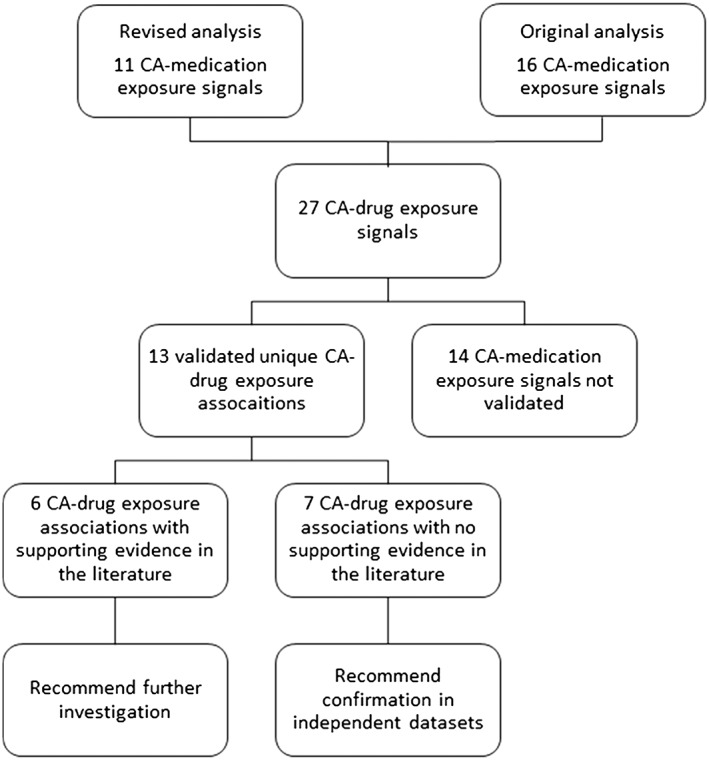
Data from 15 EUROCAT registries (1995-2011) with medication exposures at the chemical substance (5th level of Anatomic Therapeutic Chemical classification) and chemical subgroup (4th level) were analysed using a 50% false detection rate. After excluding antiepileptics, antidiabetics, antiasthmatics and SSRIs/psycholeptics already under investigation, 27 associations were evaluated. If evidence for a signal persisted after data validation, a literature review was conducted for prior evidence of human teratogenicity.
Thirteen out of 27 CA-medication exposure signals, based on 389 exposed cases, passed data validation. There was some prior evidence in the literature to support six signals (gastroschisis and levonorgestrel/ethinylestradiol (OR 4.10, 95% CI 1.70-8.53; congenital heart disease/pulmonary valve stenosis and nucleoside/tide reverse transcriptase inhibitors (OR 5.01, 95% CI 1.99-14.20/OR 28.20, 95% CI 4.63-122.24); complete absence of a limb and pregnen (4) derivatives (OR 6.60, 95% CI 1.70-22.93); hypospadias and pregnadien derivatives (OR 1.40, 95% CI 1.10-1.76); hypospadias and synthetic ovulation stimulants (OR 1.89, 95% CI 1.28-2.70). Antipropulsives produced a signal for syndactyly while the literature revealed a signal for hypospadias. There was no prior evidence to support the remaining six signals involving the ordinary salt combinations, propulsives, bulk-forming laxatives, hydrazinophthalazine derivatives, gonadotropin releasing hormone analogues and selective serotonin agonists.
Signals which strengthened prior evidence should be prioritized for further investigation, and independent evidence sought to confirm the remaining signals. Some chance associations are expected and confounding by indication is possible.
评估新型EUROmediCAT信号检测系统得出的先天性异常(CA)与药物暴露之间的关联,并确定哪些关联需要进一步调查。
使用50%的误报率分析了15个EUROCAT登记处(1995 - 2011年)的数据,这些数据涉及化学物质(解剖治疗化学分类的第5级)和化学亚组(第4级)的药物暴露情况。在排除已在研究中的抗癫痫药、抗糖尿病药、抗哮喘药和选择性5-羟色胺再摄取抑制剂/抗精神病药后,对27种关联进行了评估。如果数据验证后信号证据仍然存在,则对人类致畸性的先前证据进行文献综述。
基于389例暴露病例,27种CA-药物暴露信号中有13种通过了数据验证。文献中有一些先前证据支持6种信号(腹裂与左炔诺孕酮/炔雌醇(比值比4.10,95%置信区间1.70 - 8.53);先天性心脏病/肺动脉瓣狭窄与核苷/核苷酸逆转录酶抑制剂(比值比5.01,95%置信区间1.99 - 14.20/比值比28.20,95%置信区间4.63 - 122.24);肢体完全缺失与孕烯(4)衍生物(比值比6.60,95%置信区间1.70 - 22.93);尿道下裂与孕二烯衍生物(比值比1.40,95%置信区间1.10 - 1.76);尿道下裂与合成排卵刺激剂(比值比1.89,95%置信区间1.28 - 2.70)。抗推进剂产生了并指信号,而文献显示有尿道下裂信号。没有先前证据支持其余6种涉及普通盐组合、推进剂、容积性泻药、肼屈嗪衍生物、促性腺激素释放激素类似物和选择性5-羟色胺激动剂的信号。
应优先对强化先前证据的信号进行进一步调查,并寻求独立证据来证实其余信号。预计会有一些偶然关联,且可能存在指征性混杂。