Ledgerwood Levi G, Kumar Dhruv, Eterovic Agda Karina, Wick Jo, Chen Ken, Zhao Hao, Tazi Loubna, Manna Pradip, Kerley Spencer, Joshi Radhika, Wang Lin, Chiosea Simion I, Garnett James David, Tsue Terance Ted, Chien Jeremy, Mills Gordon B, Grandis Jennifer Rubin, Thomas Sufi Mary
Department of Otolaryngology, University of Kansas Medical Center, and University of Kansas Cancer Center, Kansas City, MO, USA.
Department of Systems Biology and Bioinformatics, MD Anderson Cancer Center, Houston, TX, USA.
Oncotarget. 2016 May 10;7(19):27185-98. doi: 10.18632/oncotarget.8448.
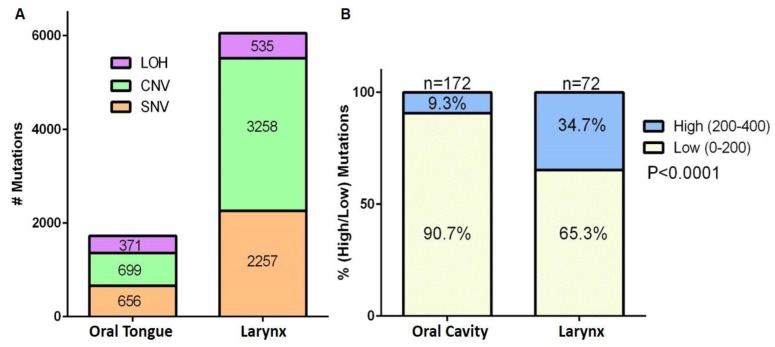
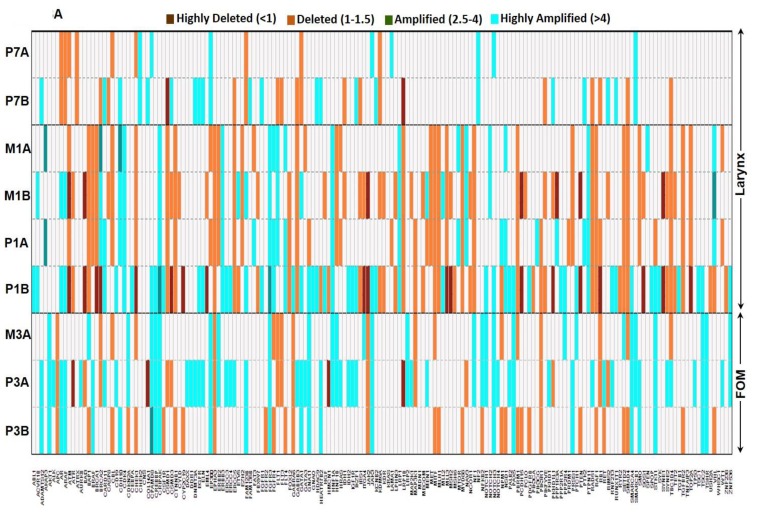
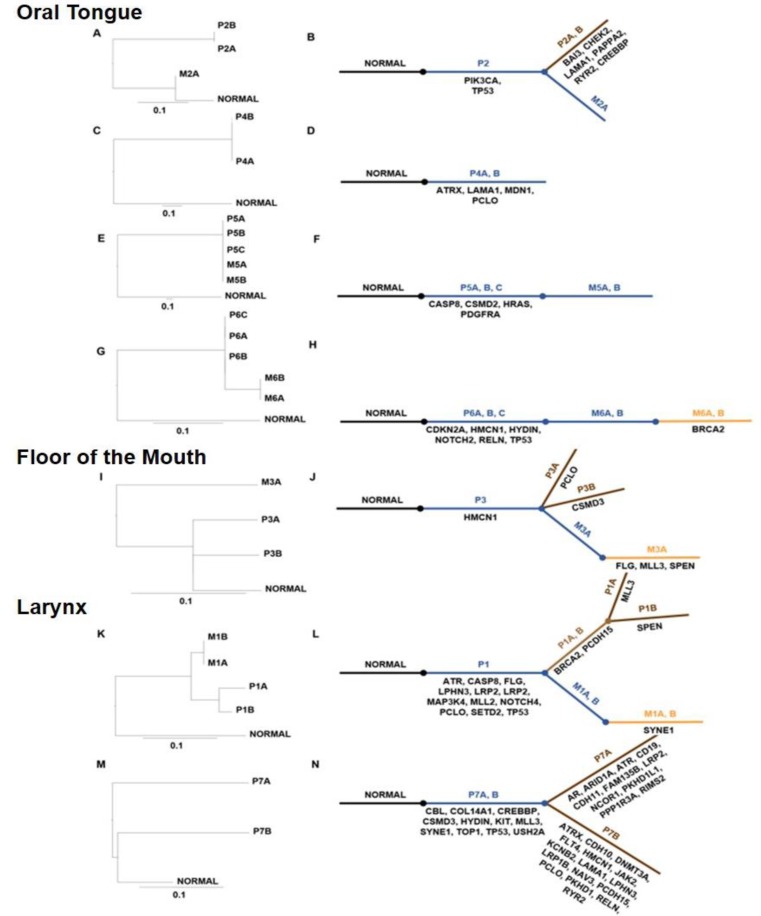
In an era where mutational profiles inform treatment options, it is critical to know the extent to which tumor biopsies represent the molecular profile of the primary and metastatic tumor. Head and neck squamous cell carcinoma (HNSCC) arise primarily in the mucosal lining of oral cavity and oropharynx. Despite aggressive therapy the 5-year survival rate is at 50%. The primary objective of this study is to characterize the degree of intratumor mutational heterogeneity in HNSCC. We used multi-region sequencing of paired primary and metastatic tumor DNA of 24 spatially distinct samples from seven patients with HNSCC of larynx, floor of the mouth (FOM) or oral tongue. Full length, in-depth sequencing of 202 genes implicated in cancer was carried out. Larynx and FOM tumors had more than 69.2% unique SNVs between the paired primary and metastatic lesions. In contrast, the oral tongue HNSCC had only 33.3% unique SNVs across multiple sites. In addition, HNSCC of the oral tongue had fewer mutations than larynx and FOM tumors. These findings were validated on the Affymetrix whole genome 6.0 array platform and were consistent with data from The Cancer Genome Atlas (TCGA). This is the first report demonstrating differences in mutational heterogeneity varying by subsite in HNSCC. The heterogeneity within laryngeal tumor specimens may lead to an underestimation of the genetic abnormalities within tumors and may foster resistance to standard treatment protocols. These findings are relevant to investigators and clinicians developing personalized cancer treatments based on identification of specific mutations in tumor biopsies.
在一个突变谱为治疗方案提供依据的时代,了解肿瘤活检在多大程度上代表原发肿瘤和转移肿瘤的分子特征至关重要。头颈部鳞状细胞癌(HNSCC)主要发生在口腔和口咽的黏膜层。尽管采用了积极的治疗方法,5年生存率仍为50%。本研究的主要目的是描述HNSCC肿瘤内突变异质性的程度。我们对来自7例喉、口底(FOM)或舌癌HNSCC患者的24个空间上不同的样本进行了配对原发肿瘤和转移肿瘤DNA的多区域测序。对202个与癌症相关的基因进行了全长、深度测序。喉和FOM肿瘤在配对的原发和转移病变之间有超过69.2%的独特单核苷酸变异(SNV)。相比之下,舌部HNSCC在多个部位仅有33.3%的独特SNV。此外,舌部HNSCC的突变比喉和FOM肿瘤少。这些发现在Affymetrix全基因组6.0阵列平台上得到了验证,并且与癌症基因组图谱(TCGA)的数据一致。这是第一份证明HNSCC中不同亚部位突变异质性存在差异的报告。喉肿瘤标本内的异质性可能导致对肿瘤内基因异常的低估,并可能促进对标准治疗方案的耐药性。这些发现对于基于肿瘤活检中特定突变的识别来开发个性化癌症治疗的研究人员和临床医生具有重要意义。