Chen Jiayan, Zhang Chi, Li Fei, Xu Liping, Zhu Hongcheng, Wang Shui, Liu Xiaoan, Zha Xiaoming, Ding Qiang, Ling Lijun, Zhou Wenbin, Sun Xinchen
Department of Radiation Oncology, Nanjing Medical University, Nanjing, People's Republic of China.
Department of Breast Surgery, The First Affiliated Hospital, Nanjing Medical University, Nanjing, People's Republic of China.
Onco Targets Ther. 2016 Mar 23;9:1759-66. doi: 10.2147/OTT.S97828. eCollection 2016.
Radiofrequency ablation (RFA) is a minimally invasive thermal ablation technique. We conducted a meta-analysis based on eligible studies to assess the efficacy and safety of RFA for treating patients with breast cancer.
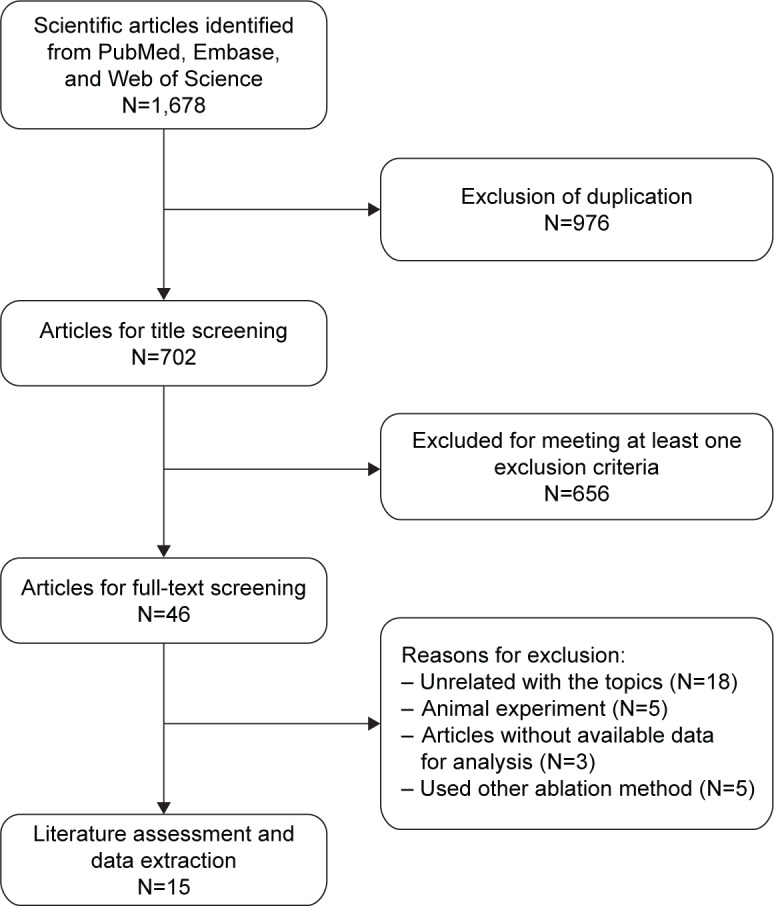
A literature search was conducted in PubMed, Embase, and Web of Science databases. Eligible studies were clinical trials that assessed RFA in patients with breast cancer. The outcomes included complete ablation rate, recurrence rate, excellent or good cosmetic rates, and complication rate. A random-effects or fixed-effects model was used to pool the estimate, according to the heterogeneity among the included studies.
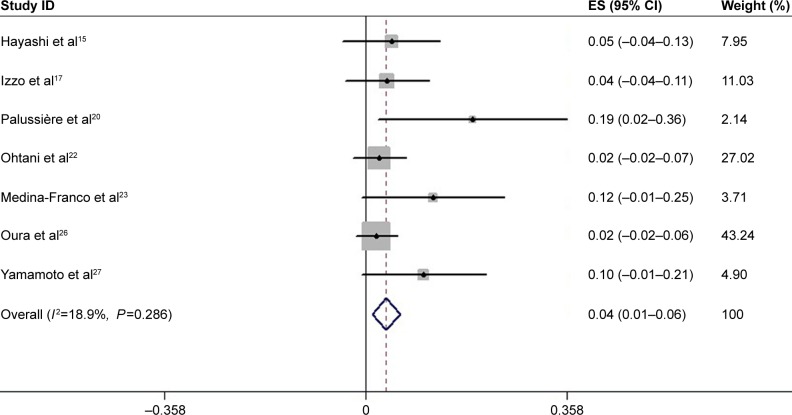
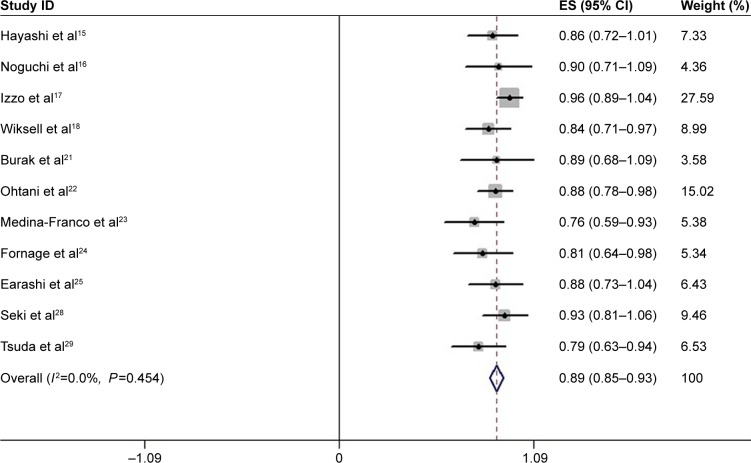
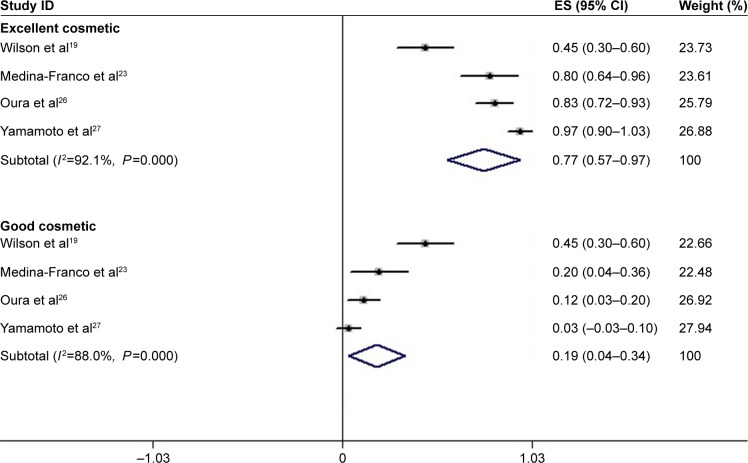
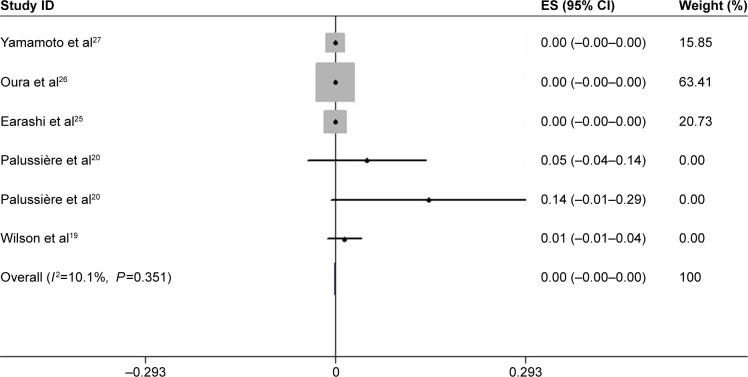
Fifteen studies, with a total of 404 patients, were included in this meta-analysis. Pooled results showed that 89% (95% confidence interval: 85%-93%) of patients achieved a complete ablation after RFA treatment and 96% of patients reported a good-to-excellent cosmetic result. Although the pooled result for recurrence rate was 0, several cases of relapse were observed at different follow-up times. No RFA-related complications were recorded, except for skin burn with an incidence of 4% (95% confidence interval: 1%-6%).
This meta-analysis showed that RFA can be a promising alternative option for treating breast cancer since it produces a higher complete ablation rate with a low complication rate. Further well-designed randomized controlled trials are needed to confirm the efficacy and safety of RFA for breast cancer.
射频消融术(RFA)是一种微创热消融技术。我们基于符合条件的研究进行了一项荟萃分析,以评估RFA治疗乳腺癌患者的疗效和安全性。
在PubMed、Embase和Web of Science数据库中进行文献检索。符合条件的研究为评估乳腺癌患者RFA的临床试验。结局指标包括完全消融率、复发率、美容效果优良率和并发症发生率。根据纳入研究之间的异质性,采用随机效应模型或固定效应模型汇总估计值。
本荟萃分析纳入了15项研究,共404例患者。汇总结果显示,89%(95%置信区间:85%-93%)的患者在RFA治疗后实现了完全消融,96%的患者报告美容效果良好至极佳。尽管复发率的汇总结果为0,但在不同随访时间观察到几例复发病例。除皮肤灼伤发生率为4%(95%置信区间:1%-6%)外,未记录到与RFA相关的并发症。
这项荟萃分析表明,RFA可以成为治疗乳腺癌的一种有前景的替代选择,因为它能产生较高的完全消融率且并发症发生率较低。需要进一步设计良好的随机对照试验来证实RFA治疗乳腺癌的疗效和安全性。