Naeem Abdul, Badshah Syed Lal, Muska Mairman, Ahmad Nasir, Khan Khalid
National Center of Excellence in Physical Chemistry, University of Peshawar, Peshawar, Khyber Pukhtoonkhwa 25120, Pakistan.
Department of Chemistry, Islamia College University Peshawar, Peshawar, Khyber Pukhtoonkhwa 25120, Pakistan.
Molecules. 2016 Mar 28;21(4):268. doi: 10.3390/molecules21040268.
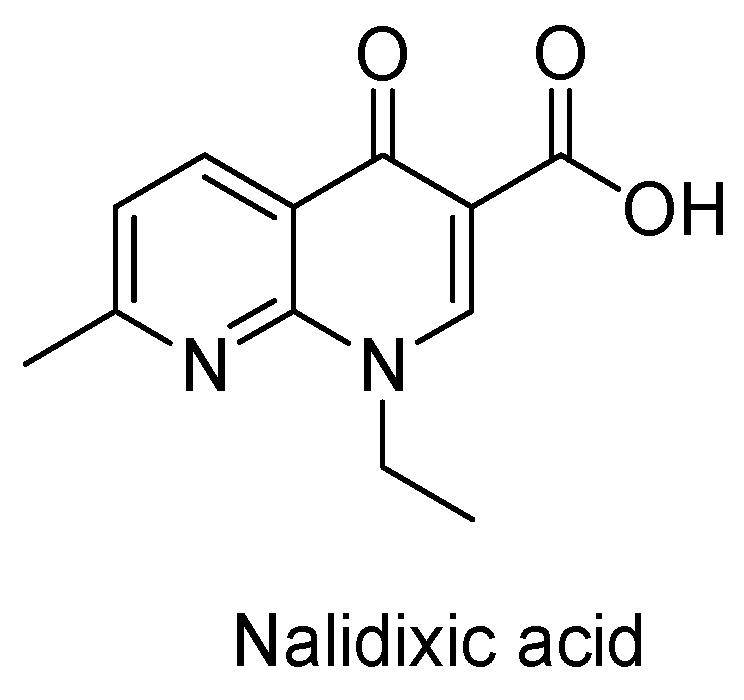
Quinolones are broad-spectrum synthetic antibacterial drugs first obtained during the synthesis of chloroquine. Nalidixic acid, the prototype of quinolones, first became available for clinical consumption in 1962 and was used mainly for urinary tract infections caused by Escherichia coli and other pathogenic Gram-negative bacteria. Recently, significant work has been carried out to synthesize novel quinolone analogues with enhanced activity and potential usage for the treatment of different bacterial diseases. These novel analogues are made by substitution at different sites--the variation at the C-6 and C-8 positions gives more effective drugs. Substitution of a fluorine atom at the C-6 position produces fluroquinolones, which account for a large proportion of the quinolones in clinical use. Among others, substitution of piperazine or methylpiperazine, pyrrolidinyl and piperidinyl rings also yields effective analogues. A total of twenty six analogues are reported in this review. The targets of quinolones are two bacterial enzymes of the class II topoisomerase family, namely gyrase and topoisomerase IV. Quinolones increase the concentration of drug-enzyme-DNA cleavage complexes and convert them into cellular toxins; as a result they are bactericidal. High bioavailability, relative low toxicity and favorable pharmacokinetics have resulted in the clinical success of fluoroquinolones and quinolones. Due to these superior properties, quinolones have been extensively utilized and this increased usage has resulted in some quinolone-resistant bacterial strains. Bacteria become resistant to quinolones by three mechanisms: (1) mutation in the target site (gyrase and/or topoisomerase IV) of quinolones; (2) plasmid-mediated resistance; and (3) chromosome-mediated quinolone resistance. In plasmid-mediated resistance, the efflux of quinolones is increased along with a decrease in the interaction of the drug with gyrase (topoisomerase IV). In the case of chromosome-mediated quinolone resistance, there is a decrease in the influx of the drug into the cell.
喹诺酮类是在氯喹合成过程中首次获得的广谱合成抗菌药物。喹诺酮类的原型药萘啶酸于1962年首次用于临床,主要用于治疗由大肠杆菌和其他致病性革兰氏阴性菌引起的尿路感染。最近,人们开展了大量工作来合成新型喹诺酮类似物,这些类似物具有增强的活性和治疗不同细菌性疾病的潜在用途。这些新型类似物是通过在不同位点进行取代而制成的——C-6和C-8位的变化产生了更有效的药物。在C-6位取代氟原子产生了氟喹诺酮类,它们在临床使用的喹诺酮类中占很大比例。此外,哌嗪或甲基哌嗪、吡咯烷基和哌啶基环的取代也产生了有效的类似物。本综述共报道了26种类似物。喹诺酮类的作用靶点是II类拓扑异构酶家族的两种细菌酶,即DNA回旋酶和拓扑异构酶IV。喹诺酮类增加了药物-酶-DNA裂解复合物的浓度,并将它们转化为细胞毒素;因此它们具有杀菌作用。高生物利用度、相对低毒性和良好的药代动力学导致了氟喹诺酮类和喹诺酮类在临床上的成功。由于这些优越的特性,喹诺酮类已被广泛使用,而这种使用的增加导致了一些耐喹诺酮类细菌菌株的出现。细菌对喹诺酮类产生耐药性有三种机制:(1)喹诺酮类作用靶点(DNA回旋酶和/或拓扑异构酶IV)发生突变;(2)质粒介导的耐药性;(3)染色体介导的喹诺酮类耐药性。在质粒介导的耐药性中,喹诺酮类的外排增加,同时药物与DNA回旋酶(拓扑异构酶IV)的相互作用减少。在染色体介导的喹诺酮类耐药性情况下,药物进入细胞的内流减少。