Hernández Antonio F, Menéndez Pablo
Department of Legal Medicine and Toxicology, University of Granada School of Medicine, Granada 18016, Spain.
Department of Biomedicine, Josep Carreras Leukemia Research Institute, School of Medicine, University of Barcelona, Barcelona 08036, Spain.
Int J Mol Sci. 2016 Mar 29;17(4):461. doi: 10.3390/ijms17040461.
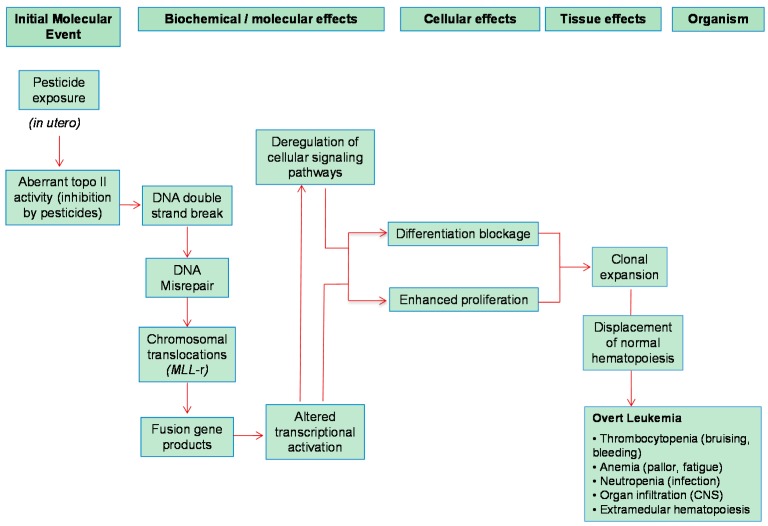
Leukemia is the most common cancer in children, representing 30% of all childhood cancers. The disease arises from recurrent genetic insults that block differentiation of hematopoietic stem and/or progenitor cells (HSPCs) and drives uncontrolled proliferation and survival of the differentiation-blocked clone. Pediatric leukemia is phenotypically and genetically heterogeneous with an obscure etiology. The interaction between genetic factors and environmental agents represents a potential etiological driver. Although information is limited, the principal toxic mechanisms of potential leukemogenic agents (e.g., etoposide, benzene metabolites, bioflavonoids and some pesticides) include topoisomerase II inhibition and/or excessive generation of free radicals, which may induce DNA single- and double-strand breaks (DNA-DSBs) in early HSPCs. Chromosomal rearrangements (duplications, deletions and translocations) may occur if these lesions are not properly repaired. The initiating hit usually occurs in utero and commonly leads to the expression of oncogenic fusion proteins. Subsequent cooperating hits define the disease latency and occur after birth and may be of a genetic, epigenetic or immune nature (i.e., delayed infection-mediated immune deregulation). Here, we review the available experimental and epidemiological evidence linking pesticide exposure to infant and childhood leukemia and provide a mechanistic basis to support the association, focusing on early initiating molecular events.
白血病是儿童中最常见的癌症,占所有儿童癌症的30%。该疾病源于反复的基因损伤,这些损伤会阻碍造血干细胞和/或祖细胞(HSPCs)的分化,并驱动分化受阻克隆的不受控制的增殖和存活。儿童白血病在表型和基因上具有异质性,病因不明。遗传因素与环境因素之间的相互作用是一种潜在的病因驱动因素。尽管信息有限,但潜在致白血病因素(如依托泊苷、苯代谢物、生物类黄酮和一些农药)的主要毒性机制包括拓扑异构酶II抑制和/或自由基的过度产生,这可能在早期HSPCs中诱导DNA单链和双链断裂(DNA-DSBs)。如果这些损伤没有得到适当修复,可能会发生染色体重排(重复、缺失和易位)。起始突变通常发生在子宫内,通常会导致致癌融合蛋白的表达。随后的协同突变决定了疾病的潜伏期,发生在出生后,可能具有遗传、表观遗传或免疫性质(即延迟感染介导的免疫失调)。在这里,我们综述了将接触农药与婴幼儿及儿童白血病联系起来的现有实验和流行病学证据,并提供了支持这种关联的机制基础,重点关注早期起始分子事件。