O'Dwyer Máire, Peklar Jure, McCallion Philip, McCarron Mary, Henman Martin C
School of Pharmacy and Pharmaceutical Sciences, Trinity College Dublin, Dublin, Ireland IDS-TILDA School of Nursing and Midwifery, Trinity College Dublin, Dublin, Ireland.
School of Pharmacy, University of Ljubljana, Ljubljana, Slovenia.
BMJ Open. 2016 Apr 4;6(4):e010505. doi: 10.1136/bmjopen-2015-010505.
(1) To evaluate the prevalence of polypharmacy (5-9 medicines) and excessive polypharmacy (10+ medicines) and (2) to determine associated demographic and clinical characteristics in an ageing population with intellectual disabilities (IDs).
Observational cross-sectional study.
Wave One (2009/2010) of the Intellectual Disability Supplement to the Irish Longitudinal Study on Ageing (IDS-TILDA).
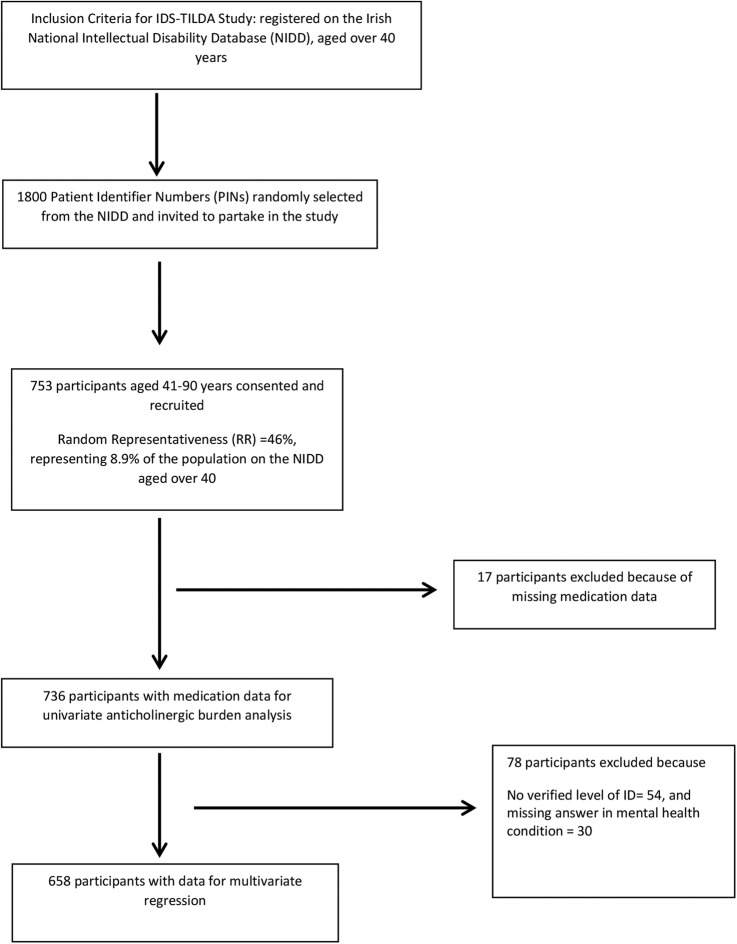
A nationally representative sample of 753 persons with ID, aged between 41 and 90 years. Participants/proxy reported medicines (prescription and over the counter) taken on a regular basis; medication data was available for 736 participants (98%).
MAIN OUTCOME MEASURES/INTERVENTIONS: Participants were divided into those with no polypharmacy (0-4 medicines), polypharmacy (5-9 medicines) and excessive polypharmacy (10+ medicines). Medication use patterns were analysed according to demographic variables and reported chronic conditions. A multinomial logistic regression model identified factors associated with polypharmacy (5-9 medicines) and excessive polypharmacy (≥10 medicines).
Overall, 90% of participants reported use of medicines. Polypharmacy was observed in 31.5% of participants and excessive polypharmacy in 20.1%. Living in a residential institution, and reporting a mental health or neurological condition were strongly associated with polypharmacy and excessive polypharmacy after adjusting for confounders, but age or gender had no significant effect.
Polypharmacy was commonplace for older adults with ID and may be partly explained by the high prevalence of multimorbidity reported. Review of appropriateness of medication use is essential, as polypharmacy places ageing people with ID at risk of adverse effects.
(1)评估多重用药(5 - 9种药物)和过度多重用药(10种及以上药物)的患病率;(2)确定老年智力残疾人群的相关人口统计学和临床特征。
观察性横断面研究。
爱尔兰老龄化纵向研究(IDS - TILDA)的智力残疾补充研究的第一波(2009/2010年)。
753名年龄在41至90岁之间、具有全国代表性的智力残疾者样本。参与者/代理人报告了定期服用的药物(处方药和非处方药);736名参与者(98%)有用药数据。
主要结局指标/干预措施:参与者被分为无多重用药(0 - 4种药物)、多重用药(5 - 9种药物)和过度多重用药(10种及以上药物)组。根据人口统计学变量和报告的慢性病分析用药模式。多分类逻辑回归模型确定与多重用药(5 - 9种药物)和过度多重用药(≥10种药物)相关的因素。
总体而言,90%的参与者报告使用药物。31.5%的参与者存在多重用药情况,20.1%存在过度多重用药情况。在校住机构生活且报告有心理健康或神经疾病与多重用药和过度多重用药在调整混杂因素后密切相关,但年龄或性别无显著影响。
多重用药在老年智力残疾者中很常见,部分原因可能是所报告的多种疾病的高患病率。审查用药的适宜性至关重要,因为多重用药使老年智力残疾者面临不良反应风险。