Bridges Andrew A, Jentzsch Maximilian S, Oakes Patrick W, Occhipinti Patricia, Gladfelter Amy S
Department of Biological Sciences, Dartmouth College, Hanover, NH 03755 The Bell Center, Marine Biological Laboratory, Woods Hole, MA 02543.
Department of Biological Sciences, Dartmouth College, Hanover, NH 03755.
J Cell Biol. 2016 Apr 11;213(1):23-32. doi: 10.1083/jcb.201512029. Epub 2016 Apr 4.
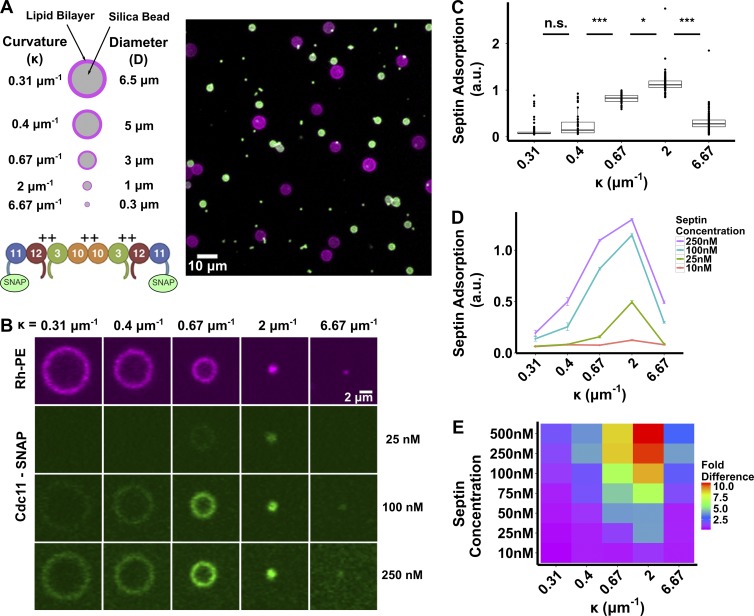
Cells change shape in response to diverse environmental and developmental conditions, creating topologies with micron-scale features. Although individual proteins can sense nanometer-scale membrane curvature, it is unclear if a cell could also use nanometer-scale components to sense micron-scale contours, such as the cytokinetic furrow and base of neuronal branches. Septins are filament-forming proteins that serve as signaling platforms and are frequently associated with areas of the plasma membrane where there is micron-scale curvature, including the cytokinetic furrow and the base of cell protrusions. We report here that fungal and human septins are able to distinguish between different degrees of micron-scale curvature in cells. By preparing supported lipid bilayers on beads of different curvature, we reconstitute and measure the intrinsic septin curvature preference. We conclude that micron-scale curvature recognition is a fundamental property of the septin cytoskeleton that provides the cell with a mechanism to know its local shape.
细胞会根据各种环境和发育条件改变形状,形成具有微米级特征的拓扑结构。尽管单个蛋白质能够感知纳米级的膜曲率,但目前尚不清楚细胞是否也能利用纳米级成分来感知微米级轮廓,如细胞分裂沟和神经元分支的基部。Septins是形成细丝的蛋白质,可作为信号平台,并且经常与质膜上存在微米级曲率的区域相关联,包括细胞分裂沟和细胞突起的基部。我们在此报告,真菌和人类的Septins能够区分细胞中不同程度的微米级曲率。通过在不同曲率的珠子上制备支持的脂质双层,我们重构并测量了Septins固有的曲率偏好。我们得出结论,微米级曲率识别是Septins细胞骨架的基本特性,为细胞提供了一种了解其局部形状的机制。