Khan P Y, Glynn J R, Fielding K L, Mzembe T, Mulawa D, Chiumya R, Fine P E M, Koole O, Kranzer K, Crampin A C
Department of Infectious Disease Epidemiology, London School of Hygiene & Tropical Medicine, Keppel Street, London WD1E 7HT, UK; Karonga Prevention Study, Chilumba, Malawi.
Department of Infectious Disease Epidemiology, London School of Hygiene & Tropical Medicine, London, UK.
Int J Tuberc Lung Dis. 2016 Mar;20(3):342-9. doi: 10.5588/ijtld.15.0672.
Mycobacterium tuberculosis infection in children acts as a sentinel for infectious tuberculosis.
To assess risk factors associated with tuberculous infection in pre-school children.
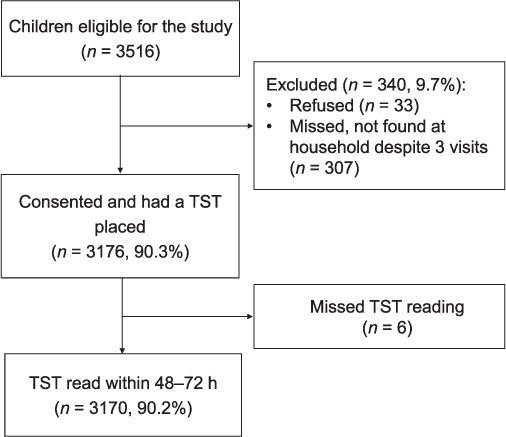
We conducted a population-wide tuberculin skin test (TST) survey from January to December 2012 in Malawi. All children aged 2-4 years residing in a demographic surveillance area were eligible. Detailed demographic data, including adult human immunodeficiency virus (HIV) status, and clinical and sociodemographic data on all diagnosed tuberculosis (TB) patients were available.
The prevalence of M. tuberculosis infection was 1.1% using a TST induration cut-off of 15 mm (estimated annual risk of infection of 0.3%). The main identifiable risk factors were maternal HIV infection at birth (adjusted OR [aOR] 3.6, 95%CI 1.1-12.2), having three or more adult members in the household over a lifetime (aOR 2.4, 95%CI 1.2-4.8) and living in close proximity to a known case of infectious TB (aOR 1.6, 95%CI 1.1-2.4), modelled as a linear variable across categories (>200 m, 100-200 m, <100 m, within household). Less than 20% of the infected children lived within 200 m of a known diagnosed case.
Household and community risk factors identified do not explain the majority of M. tuberculosis infections in children in our setting.
儿童结核分枝杆菌感染是传染性结核病的一个哨兵指标。
评估学龄前儿童结核感染的相关危险因素。
2012年1月至12月在马拉维开展了一项全人群结核菌素皮肤试验(TST)调查。居住在人口监测区的所有2 - 4岁儿童均符合条件。可获取详细的人口统计学数据,包括成人人类免疫缺陷病毒(HIV)感染状况,以及所有确诊结核病(TB)患者的临床和社会人口统计学数据。
采用15毫米硬结作为TST判断标准时,结核分枝杆菌感染率为1.1%(估计年感染风险为0.3%)。主要可识别的危险因素为出生时母亲感染HIV(校正比值比[aOR] 3.6,95%置信区间[CI] 1.1 - 12.2)、一生中家庭中有三名或更多成年成员(aOR 2.4,95%CI 1.2 - 4.8)以及居住在距离已知传染性结核病病例较近的地方(aOR 1.6,95%CI 1.1 - 2.4),按类别(>200米、100 - 200米、<100米、家庭内)建模为线性变量。不到20%的感染儿童居住在距离已知确诊病例200米以内。
所确定的家庭和社区危险因素并不能解释我们研究环境中儿童结核分枝杆菌感染的大多数情况。