Matsui Ryukichi, Nakagawa Tomonori, Takayoshi Hiroyuki, Onoda Keiichi, Oguro Hiroaki, Nagai Atsushi, Yamaguchi Shuhei
Department of Neurology, Faculty of Medicine, Shimane University, Izumo, Japan; Department of Neurology, Masuda Red Cross Hospital, Masuda, Japan.
Department of Neurology, Faculty of Medicine, Shimane University , Izumo , Japan.
Front Neurol. 2016 Mar 22;7:39. doi: 10.3389/fneur.2016.00039. eCollection 2016.
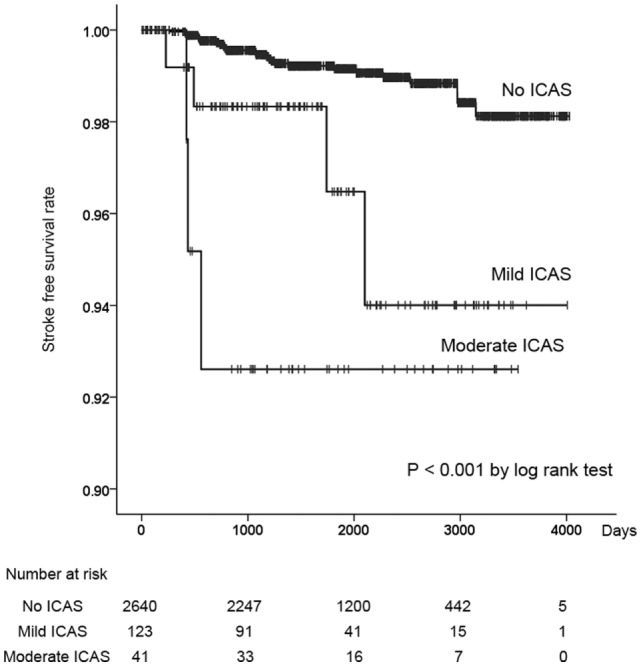
Atherosclerotic stenosis of major intracranial arteries is a leading cause of ischemic stroke in Asia. However, the long-term prognosis of asymptomatic intracranial atherosclerotic stenosis (ICAS) in healthy volunteers has not been fully examined. Here, we conducted a longitudinal study to examine the prognosis of healthy volunteers with asymptomatic ICAS and to determine the risk factors for ICAS, including asymptomatic brain parenchymal lesions. We studied 2,807 healthy Japanese volunteers with no history of stroke (mean age, 62.0 years). They were followed for a mean interval of 64.5 months. The degree of ICAS and the presence of asymptomatic brain lesions were assessed by using magnetic resonance imaging. Asymptomatic ICAS was detected in 166 volunteers (5.9%) at the initial examination. Moderate and mild stenoses were observed in 1.5 and 4.4% of patients, respectively. Significant risk factors for ICAS were older age and a history of hypertension and/or dyslipidemia. During follow-up, ischemic stroke developed in 32 volunteers. Seven strokes occurred in the ICAS group, whose stroke incidence rate was higher than that in the non-ICAS group (0.78 vs. 0.18% per year). According to a Cox regression analysis, asymptomatic ICAS was an independent risk factor for future ischemic stroke after adjustment for age. Furthermore, after asymptomatic brain lesions were taken into account, ICAS was still a significant risk factor for stroke onset. In conclusion, even mild to moderate asymptomatic ICAS was a significant risk factor for future stroke, independent of asymptomatic brain lesions, in a healthy Japanese population. Mild to moderate ICAS might be a therapeutic target for stroke prevention.
颅内主要动脉的动脉粥样硬化狭窄是亚洲缺血性卒中的主要原因。然而,健康志愿者中无症状颅内动脉粥样硬化狭窄(ICAS)的长期预后尚未得到充分研究。在此,我们进行了一项纵向研究,以检查无症状ICAS健康志愿者的预后,并确定ICAS的危险因素,包括无症状脑实质病变。我们研究了2807名无卒中病史的健康日本志愿者(平均年龄62.0岁)。他们平均随访了64.5个月。使用磁共振成像评估ICAS的程度和无症状脑病变的存在情况。在初次检查时,166名志愿者(5.9%)检测到无症状ICAS。分别有1.5%和4.4%的患者观察到中度和轻度狭窄。ICAS的显著危险因素是年龄较大以及有高血压和/或血脂异常病史。在随访期间,32名志愿者发生了缺血性卒中。ICAS组发生了7次卒中,其卒中发生率高于非ICAS组(每年0.78%对0.18%)。根据Cox回归分析,调整年龄后,无症状ICAS是未来缺血性卒中的独立危险因素。此外,在考虑无症状脑病变后,ICAS仍然是卒中发作的显著危险因素。总之,在健康的日本人群中,即使是轻度至中度无症状ICAS也是未来卒中的显著危险因素,独立于无症状脑病变。轻度至中度ICAS可能是预防卒中的治疗靶点。