Bhan Nandita, Karan Anup, Srivastava Swati, Selvaraj Sakthivel, Subramanian S V, Millett Christopher
Department of Research, Public Health Foundation of India, New Delhi, India;
Indian Institute of Public Health Delhi, Gurgaon, India;
Nicotine Tob Res. 2016 Aug;18(8):1711-8. doi: 10.1093/ntr/ntw092. Epub 2016 Apr 5.
India has experienced marked sociocultural change, economic growth and industry promotion of tobacco products over the past decade. Little is known about the influence of these factors on socioeconomic patterning of tobacco use. This study examines trends in tobacco use by socioeconomic status (SES) in India between 2000 and 2012.
We analyzed data in 2014 from nationally-representative repeated cross-sectional National Sample Surveys (NSS) in India for 1999-2000, 2004-2005 and 2011-2012 (n = 346 612 households). Prevalence and volume trends in cigarette, "bidi" and smokeless tobacco use were examined by household expenditure, educational attainment and caste/tribe status using Two-part model.
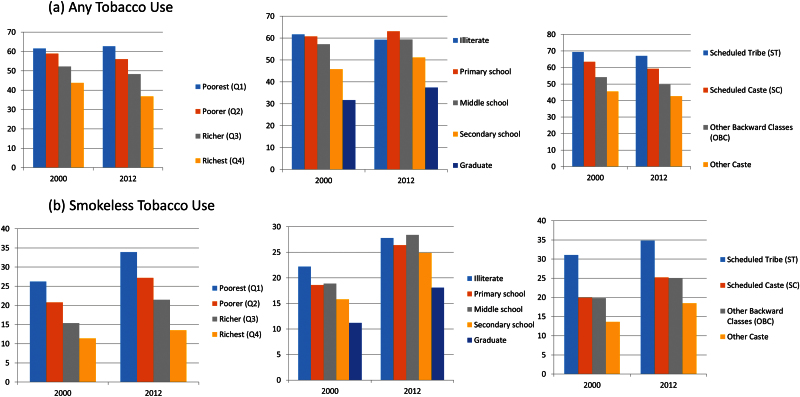
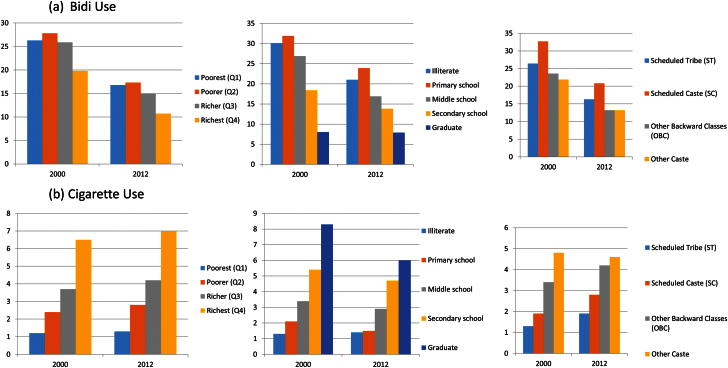
Prevalence of any tobacco use remained consistent in the poorest households (61.5% to 62.7%) and declined among the richest (43.8% to 36.8%) between 2000-2012. Bidi use declined across all groups (poorest: 26.3% to 16.8%, richest: 19.8% to 10.7%) while cigarette use increased (poorest: 1.2% to 1.3%, richest: 6.5% to 7.0%). Relative to educated and general caste households, between 2000 and 2012 cigarette use in illiterate households increased by 38% and among Scheduled Tribe households increased by 32%. Smokeless tobacco use increased for all households (poorest: 26.2% to 33.9%, richest: 11.4% to 13.5%, Scheduled Tribe: 31.1% to 34.8%, general caste: 13.6% to 18.5%), with greater increases among richer, more educated and general caste households.
Marked SES patterning of tobacco use has persisted in India. Improving enforcement of tobacco control policies and monitoring comprehensive smoke-free legislations are needed to address this growing burden.
We found "resilient" tobacco patterns in the last decade despite prevention interventions. SES continues to be inversely associated with tobacco products, with the exception of cigarettes. The declines in bidi use may be getting replaced by increase in cigarette use trends, especially among lower SES groups. The use of smokeless tobacco products has increased across all SES groups and the volume of smokeless tobacco use is not been declining despite a number of policies on tobacco use. This may be attributed to inadequate attention to chewed forms of tobacco in current policies, particularly to implementing pictoral warnings and regulating surrogate advertising. Evaluating the implementation of anti-tobacco policies and ensuring equity dimensions in interventions is urgently needed to address tobacco use inequalities.
在过去十年中,印度经历了显著的社会文化变革、经济增长以及烟草制品行业的发展。对于这些因素对烟草使用的社会经济模式的影响,我们知之甚少。本研究调查了2000年至2012年间印度按社会经济地位(SES)划分的烟草使用趋势。
我们分析了2014年来自印度全国代表性重复横断面全国抽样调查(NSS)的数据,这些数据涵盖了1999 - 2000年、2004 - 2005年和2011 - 2012年(n = 346612户家庭)。使用两部分模型,通过家庭支出、教育程度和种姓/部落地位来研究香烟、“比迪烟”和无烟烟草使用的流行率及使用量趋势。
2000 - 2012年间,最贫困家庭中任何烟草使用的流行率保持稳定(61.5%至62.7%),而最富裕家庭中的流行率有所下降(43.8%至36.8%)。比迪烟的使用在所有群体中均有所下降(最贫困群体:26.3%至16.8%,最富裕群体:19.8%至10.7%),而香烟的使用则有所增加(最贫困群体:1.2%至1.3%,最富裕群体:6.5%至7.0%)。与受过教育的家庭和普通种姓家庭相比,2000年至2012年间,文盲家庭中香烟的使用增加了38%,在册部落家庭中增加了32%。所有家庭的无烟烟草使用均有所增加(最贫困群体:26.2%至33.9%,最富裕群体:11.4%至13.5%,在册部落:31.1%至34.8%,普通种姓:13.6%至18.5%),在较富裕、受教育程度较高的普通种姓家庭中增加幅度更大。
在印度,烟草使用的社会经济模式差异显著且持续存在。需要加强烟草控制政策的执行力度,并监测全面的无烟立法,以应对这一日益加重的负担。
尽管有预防干预措施,但我们在过去十年中发现了“顽固”的烟草模式。除香烟外,社会经济地位与烟草制品仍呈负相关。比迪烟使用的下降可能正被香烟使用趋势的上升所取代,尤其是在社会经济地位较低的群体中。所有社会经济群体的无烟烟草使用均有所增加,尽管有多项烟草使用政策,但无烟烟草的使用量并未下降。这可能归因于当前政策对咀嚼型烟草的关注不足,特别是在实施图片警示和规范替代广告方面。迫切需要评估反烟草政策的实施情况,并确保干预措施中的公平维度,以解决烟草使用不平等问题。