Assari Shervin, Sheikhattari Payam, Zare Hossein
Department of Internal Medicine, Charles R. Drew University of Medicine and Science, Los Angeles, CA, United States.
Department of Family Medicine, Charles R. Drew University of Medicine and Science, Los Angeles, CA, United States.
J Biomed Life Sci. 2024;4(1):15-26. doi: 10.31586/jbls.2024.1039. Epub 2024 Aug 29.
Social determinants of health (SDOH) significantly influence health behaviors, including tobacco use among youth. Adversities such as perceived discrimination, perceived neighborhood stress, life trauma, and financial strain are stressors that may mediate the relationship between various SDOH and youth tobacco use. This study aims to investigate whether multidimensional adversities mediate the effects of SDOH on tobacco use among youth.
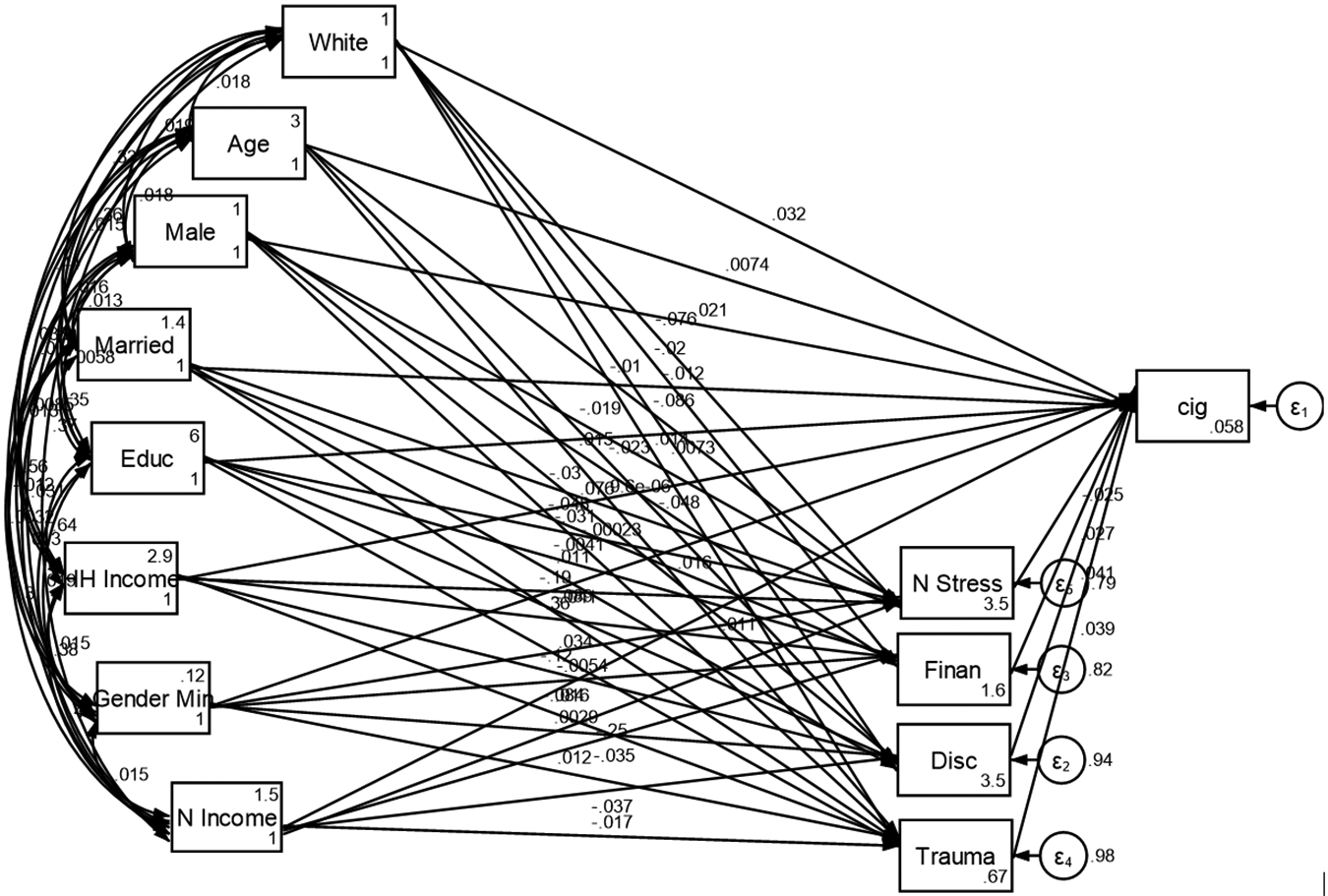
Data from the Adolescent Brain Cognitive Development (ABCD) study were used to test our hypotheses. The sample included a diverse cohort of youth aged 9-10 years old followed until they were 15-16 years old. We examined the effects of baseline parental education, household income, neighborhood income, and family structure on subsequent youth tobacco use. Structural equation models were used to test if adversities (perceived discrimination, life trauma, financial strain) operate as potential mediators.
All ABCD participants were eligible for our analysis, regardless of race, ethnicity, or SDOHs (n = 11,878). The findings indicated that the effects of parental education, household income, neighborhood income, and family structure on youth tobacco use were partially mediated by adversities. Higher levels of parental education and household income were associated with lower tobacco use, and this relationship was weakened when accounting for adversities. Similarly, stable family structures and higher neighborhood income were linked to reduced tobacco use, with adversities playing a mediating role.
Multidimensional adversities partially mediate the relationship between SDOH at baseline and subsequent youth tobacco use. Interventions aimed at reducing youth tobacco use should address both the social determinants and multiple adversities experienced by adolescents. Policies to improve the educational and economic situations of families, enhance neighborhood environments, and support stable family structures all reduce youth tobacco use, with lower exposure to adversities explaining this effect.
健康的社会决定因素(SDOH)对健康行为有重大影响,包括青少年吸烟行为。诸如感知到的歧视、感知到的邻里压力、生活创伤和经济压力等逆境是可能介导各种SDOH与青少年吸烟行为之间关系的压力源。本研究旨在调查多维逆境是否介导SDOH对青少年吸烟行为的影响。
使用青少年大脑认知发展(ABCD)研究的数据来检验我们的假设。样本包括一群年龄在9至10岁的不同青少年,跟踪他们直到15至16岁。我们研究了基线时父母教育程度、家庭收入、邻里收入和家庭结构对青少年后续吸烟行为的影响。使用结构方程模型来检验逆境(感知到的歧视、生活创伤、经济压力)是否作为潜在的中介因素。
所有ABCD参与者都符合我们的分析条件,无论种族、民族或SDOH如何(n = 11,878)。研究结果表明,父母教育程度、家庭收入、邻里收入和家庭结构对青少年吸烟行为的影响部分由逆境介导。父母教育程度和家庭收入水平较高与吸烟率较低相关,而在考虑逆境因素后,这种关系有所减弱。同样,稳定的家庭结构和较高的邻里收入与吸烟率降低有关,逆境起到了中介作用。
多维逆境部分介导了基线时的SDOH与青少年后续吸烟行为之间的关系。旨在减少青少年吸烟行为的干预措施应同时解决社会决定因素和青少年所经历的多种逆境。改善家庭的教育和经济状况、改善邻里环境以及支持稳定家庭结构的政策都能降低青少年吸烟率,较低的逆境暴露解释了这种效果。