Chon Young Eun, Kim Dong Joon, Kim Sang Gyune, Kim In Hee, Bae Si Hyun, Hwang Seong Gyu, Heo Jeong, Jang Jeong Won, Lee Byung Seok, Kim Hyung Joon, Jun Dae Won, Kim Kang Mo, Chung Woo Jin, Choi Moon Seok, Jang Jae Young, Yim Hyung Joon, Tak Won Young, Yoon Ki Tae, Park Jun Yong, Han Kwang-Hyub, Suk Ki Tae, Lee Hyun Woong, Jang Byoung Kuk, Ahn Sang Hoon
From the Yonsei University College of Medicine (YEC, JYP, K-HH, SHA), The Catholic University College of Medicine (SHB), Chung-Ang University College of Medicine (HJK, HWL), Hanyang University College of Medicine (DWJ), University of Ulsan College of Medicine (KMK), Sungkyunkwan University College of Medicine (MSC), Soonchunhyang University College of Medicine, Seoul (JYJ), Hallym University College of Medicine, Chuncheon (DJK, KTS), Soonchunhyang University College of Medicine, Bucheon (SGK), Chonbuk National University College of Medicine, Jeonju (IHK), Cha University College of Medicine, Seongnam (SGH), Pusan National University School of Medicine, Busan (JH), The Catholic University College of Medicine, Incheon (JWJ), Chungnam National University College of Medicine, Daejeon (BSL), Keimyung University College of Medicine (WJC, BKJ), Kyungpook National University College of Medicine, Daegu (WYT), Korea University College of Medicine, Ansan (HJY), Pusan National University School of Medicine (KTY), Yangsan, Korea.
Medicine (Baltimore). 2016 Apr;95(14):e3026. doi: 10.1097/MD.0000000000003026.
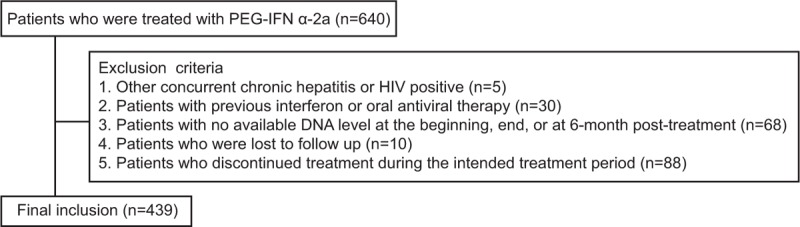
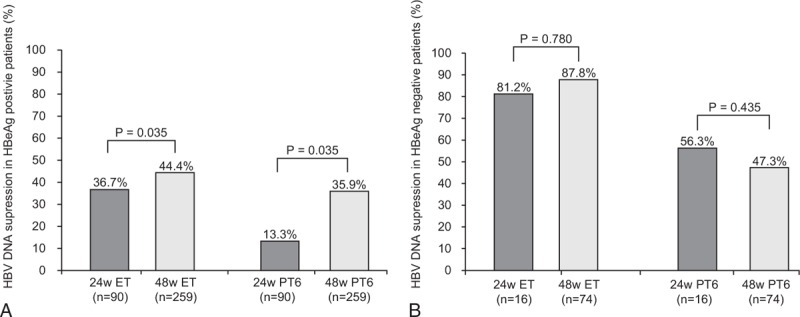
Currently, limited data are available regarding the efficacy and safety of pegylated interferon alpha-2a (PEG-IFN α-2a) in Korean patients with chronic hepatitis B (CHB), in whom hepatitis B virus (HBV) genotype C is the most common type.We collected data from 439 patients (HBeAg positive, n = 349; HBeAg negative, n = 90) with CHB who were treated with PEG-IFN α-2a as a first-line therapy from 18 institutions. Treatment responses at the end of treatment (ET) and at 6 months posttreatment (PT6) were compared between the patients who were treated for 24 weeks versus 48 weeks, and adverse events (AEs) were evaluated.In HBeAg-positive patients, those who received PEG-IFN α-2a for 48 weeks showed significantly higher HBV DNA suppression (HBV DNA < 2000 IU/mL) than those who were treated for 24 weeks (48 weeks vs 24 weeks; at ET, 44.4% vs 36.7%, P = 0.035; at PT6, 35.9% vs 13.3%, P = 0.035). The HBeAg seroconversion rate at ET was 18.1% in 48-week treatment group, which is significantly higher than the 2.2% (P < 0.001) that was seen in 24-week treatment group. This finding also continued at PT6 (29.0% vs 10.0%, P < 0.001). Following 48 weeks of treatment in HBeAg-negative patients, HBV DNA suppression at ET was higher than in HBeAg-positive patients (87.8% vs 44.4%). AEs were typical of those associated with PEG-IFN α-2a.In naïve Korean HBeAg-positive CHB patients treated with PEG-IFN α-2a, higher rates of HBV DNA suppression and HBeAg seroconversion were achieved in the 48-week treatment group than in the 24-week treatment group without additional risk of AEs.
目前,关于聚乙二醇化干扰素α-2a(PEG-IFNα-2a)在慢性乙型肝炎(CHB)韩国患者中的疗效和安全性的数据有限,在这些患者中,乙型肝炎病毒(HBV)C基因型是最常见的类型。我们收集了来自18家机构的439例接受PEG-IFNα-2a一线治疗的CHB患者的数据(HBeAg阳性,n = 349;HBeAg阴性,n = 90)。比较了接受24周与48周治疗的患者在治疗结束时(ET)和治疗后6个月(PT6)的治疗反应,并评估了不良事件(AE)。在HBeAg阳性患者中,接受PEG-IFNα-2a治疗48周的患者的HBV DNA抑制率(HBV DNA<2000 IU/mL)显著高于接受24周治疗的患者(48周与24周;在ET时,44.4%对36.7%,P = 0.035;在PT6时,35.9%对13.3%,P = 0.035)。48周治疗组在ET时的HBeAg血清学转换率为18.1%,显著高于24周治疗组的2.2%(P<0.001)。这一发现在PT6时也持续存在(29.0%对10.0%,P<0.001)。在HBeAg阴性患者中,治疗48周后,ET时的HBV DNA抑制率高于HBeAg阳性患者(87.8%对44.4%)。AE是与PEG-IFNα-2a相关的典型不良事件。在接受PEG-IFNα-2a治疗的初治韩国HBeAg阳性CHB患者中,48周治疗组的HBV DNA抑制率和HBeAg血清学转换率高于24周治疗组,且没有额外的AE风险。