Zhang Xia-Xia, Li Min-Ran, Xi Hong-Li, Cao Ying, Zhang Ren-Wen, Zhang Yu, Xu Xiao-Yuan
Department of Infectious Disease, Peking University First Hospital, Beijing 100034, China.
Chin Med J (Engl). 2016 Apr 20;129(8):929-35. doi: 10.4103/0366-6999.179802.
The ultimate goal of hepatitis B treatment is hepatitis B surface antigen (HBsAg) seroclearance. Several factors have been suggested to be associated with the rate of HBsAg reduction in antiviral-naive or lamivudine therapy cohorts. However, there are few studies evaluating the factors during long-term entecavir (ETV) therapy. In the present study, we aimed to evaluate the factors to predict the outcome of ETV therapy for 7 years.
A total of 47 chronic hepatitis B (CHB) patients treated with ETV monotherapy were included in this study. Liver biochemistry, hepatitis B virus (HBV) serological markers, serum HBV DNA, and HBsAg titers were tested at baseline, 3 months, 6 months, and yearly from 1 to 7. The associations between factors and HBsAg reduction were assessed using multivariate tests with repeated measure analysis of variance.
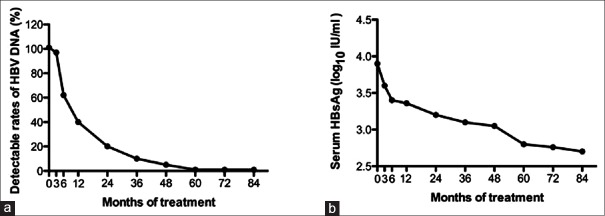
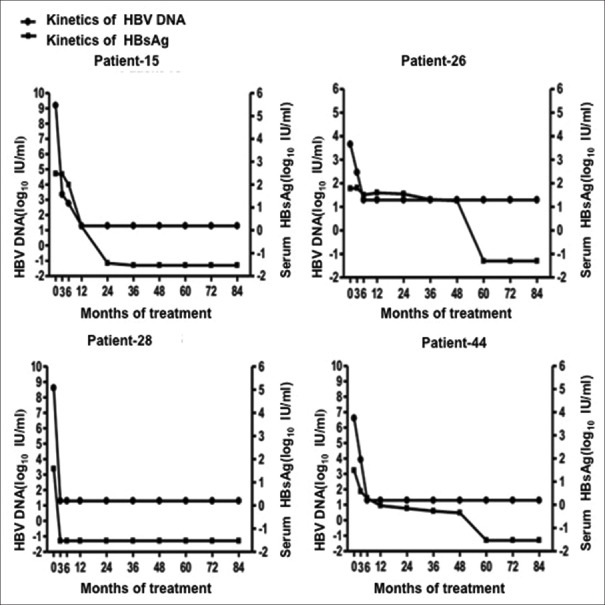
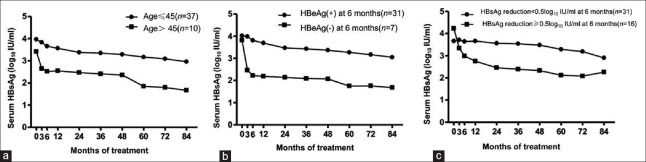
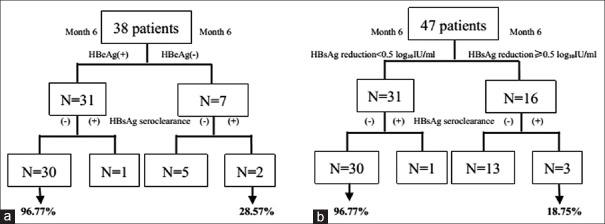
At baseline, serum HBsAg levels showed a positive correlation with baseline HBV DNA levels (r = 0.625, P < 0.001). The mean HBsAg titers after ETV treatment were significantly lower than the baseline titers (P ranges from 0.025 to 0.000,000,6). The HBsAg reduction rate during the 1st year was greater compared to after 1 year of treatment (P < 0.05). Multivariate test showed that hepatitis B e antigen (HBeAg) seroclearance and/or HBsAg reduction ≥0.5 log10 IU/ml at 6 months had a high negative predictive value (96.77%) for HBsAg seroclearance (P = 0.002, P = 0.012, respectively).
The HBsAg reduction rate during the 1st year was greater than that after 1 year of treatment. Further, HBeAg status and HBsAg levels at month 6 are the optimal factors for the early prediction of HBsAg seroclearance after long-term ETV therapy in CHB patients.
乙型肝炎治疗的最终目标是实现乙肝表面抗原(HBsAg)血清学清除。已有多项因素被认为与初治或接受拉米夫定治疗人群的HBsAg降低率相关。然而,评估长期恩替卡韦(ETV)治疗期间相关因素的研究较少。在本研究中,我们旨在评估预测ETV治疗7年结局的因素。
本研究共纳入47例接受ETV单药治疗的慢性乙型肝炎(CHB)患者。在基线、3个月、6个月以及1至7年每年检测肝脏生化指标、乙肝病毒(HBV)血清学标志物、血清HBV DNA和HBsAg滴度。采用重复测量方差分析的多变量检验评估各因素与HBsAg降低之间的关联。
在基线时,血清HBsAg水平与基线HBV DNA水平呈正相关(r = 0.625,P < 0.001)。ETV治疗后的平均HBsAg滴度显著低于基线滴度(P值范围为0.025至0.0000006)。与治疗1年后相比,第1年的HBsAg降低率更高(P < 0.05)。多变量检验显示,乙肝e抗原(HBeAg)血清学清除和/或6个月时HBsAg降低≥0.5 log10 IU/ml对HBsAg血清学清除具有较高的阴性预测价值(96.77%)(分别为P = 0.002,P = 0.012)。
第1年的HBsAg降低率高于治疗1年后。此外,HBeAg状态和第6个月时的HBsAg水平是CHB患者长期ETV治疗后早期预测HBsAg血清学清除的最佳因素。