Peking University Hepatology Institute, Beijing Key Laboratory of Hepatitis C and Immunotherapy for Liver Diseases, Peking University People's Hospital, Beijing 100044, China.
Chin Med J (Engl). 2017 Sep 20;130(18):2190-2197. doi: 10.4103/0366-6999.213969.
: Entecavir (ETV) has been shown to be effective in randomized controlled trials in highly selected patients with hepatitis B virus (HBV) infection. This study aimed to evaluate the efficacy of ETV in chronic hepatitis B (CHB) patients in the real-world setting.
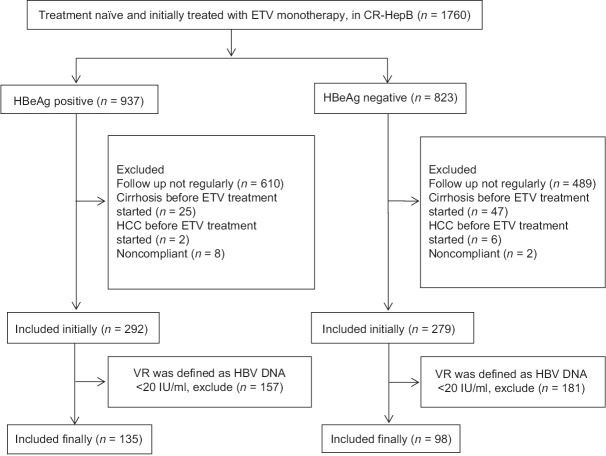
: A total of 233 treatment-naïve, CHB patients who received at least 12 months of ETV treatment were included in this retrospective study. Rates of virological response (VR), hepatitis B s antigen (HBsAg) loss, hepatitis B e antigen (HBeAg) clearance/seroconversion, virological breakthrough, cirrhosis, and hepatocellular carcinoma were evaluated.
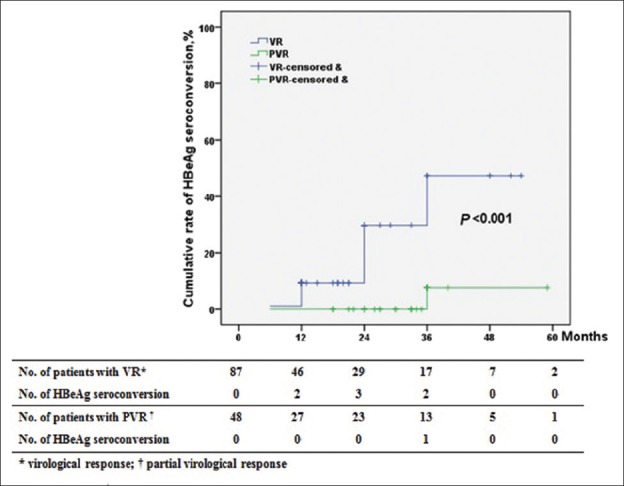
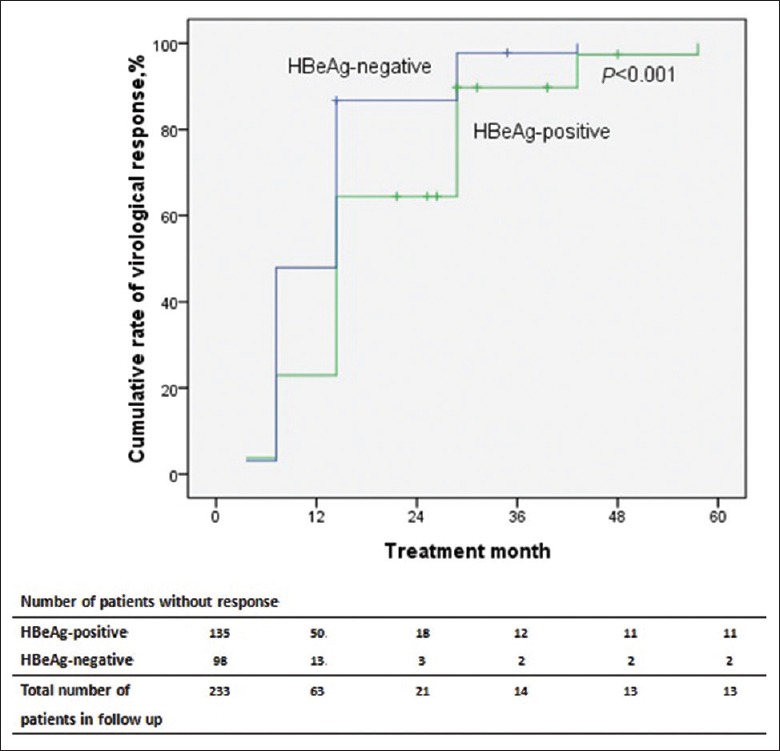
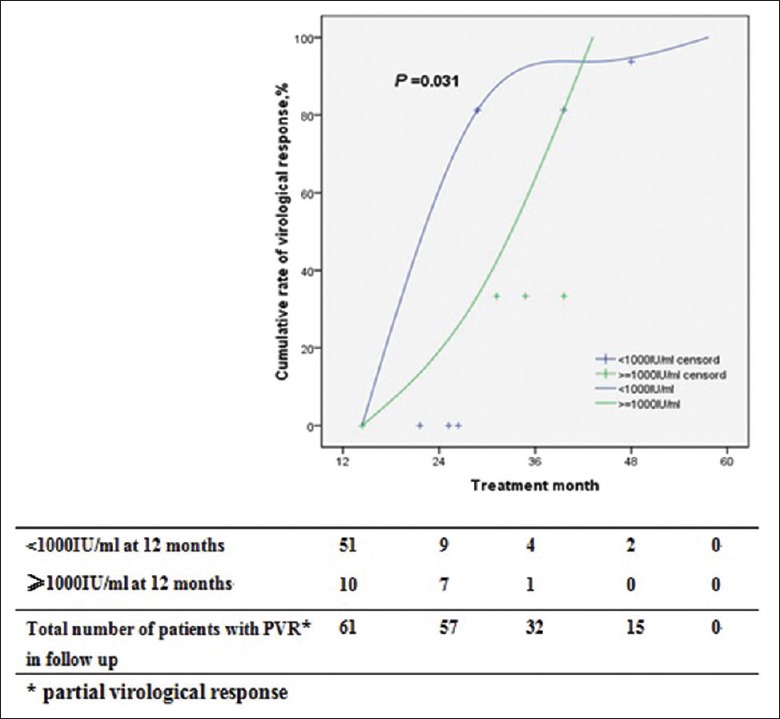
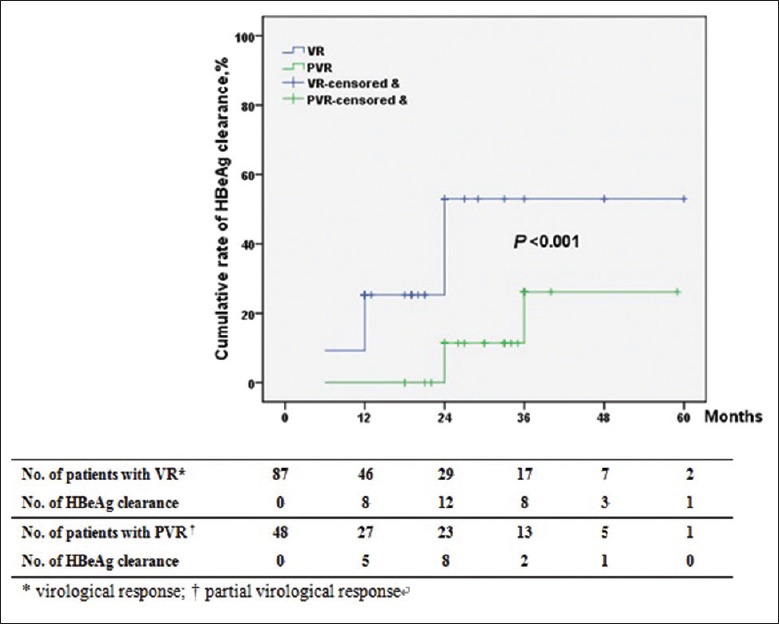
: Of 233 patients, 175 patients were male, with mean age of 43 years old, and 135 patients were HBeAg positive. The mean baseline levels of serum alanine aminotransferase and HBV DNA in all patients were 230 U/L and 6.6 log 10 IU/ml, respectively. The mean follow-up period was 28 months. The cumulative rates of achieving VR increased from 3.4% at 3 months to 94.4% at 60 months. Primary nonresponse occurred in 3 (1.3%) patients. Partial VR (PVR) occurred in 61 (26.2%) patients at 12 months. The baseline serum HBV DNA level (hazard ratio [HR], 2.054; P < 0.001) was an independent risk factor for PVR. HBsAg loss did not occur. The cumulative rates of HBeAg clearance increased from 2.2% at 3 months to 28.2% at 60 months. PVR was the significant determinant of HBeAg clearance (HR, 0.341; P = 0.026). Age (HR, 1.072; P = 0.013) and PVR (HR, 5.131; P = 0.017) were the significant determinants of cirrhosis.
: ETV treatment was effective for HBV DNA suppression in this study, but HBsAg loss and HBeAg clearance/seroconversion rates were lower compared with previous clinical trials. PVR was associated with HBeAg clearance and cirrhosis.
恩替卡韦(ETV)已在乙型肝炎病毒(HBV)感染的高度选择患者的随机对照试验中显示出疗效。本研究旨在评估 ETV 在真实世界环境中治疗慢性乙型肝炎(CHB)患者的疗效。
这项回顾性研究共纳入 233 名初治、接受 ETV 治疗至少 12 个月的 CHB 患者。评估了病毒学应答(VR)、乙型肝炎表面抗原(HBsAg)丢失、乙型肝炎 e 抗原(HBeAg)清除/血清转换、病毒学突破、肝硬化和肝细胞癌的发生率。
233 名患者中,175 名为男性,平均年龄为 43 岁,135 名为 HBeAg 阳性。所有患者的基线血清丙氨酸氨基转移酶和 HBV DNA 水平均值分别为 230 U/L 和 6.6 log 10 IU/ml。平均随访时间为 28 个月。获得 VR 的累积率从 3 个月时的 3.4%增加到 60 个月时的 94.4%。3 名(1.3%)患者发生原发性无应答。12 个月时,61 名(26.2%)患者发生部分 VR(PVR)。基线血清 HBV DNA 水平(风险比[HR],2.054;P < 0.001)是 PVR 的独立危险因素。未发生 HBsAg 丢失。HBeAg 清除率从 3 个月时的 2.2%增加到 60 个月时的 28.2%。PVR 是 HBeAg 清除的显著决定因素(HR,0.341;P = 0.026)。年龄(HR,1.072;P = 0.013)和 PVR(HR,5.131;P = 0.017)是肝硬化的显著决定因素。
在这项研究中,ETV 治疗对 HBV DNA 抑制有效,但与以前的临床试验相比,HBsAg 丢失和 HBeAg 清除/血清转换率较低。PVR 与 HBeAg 清除和肝硬化相关。